
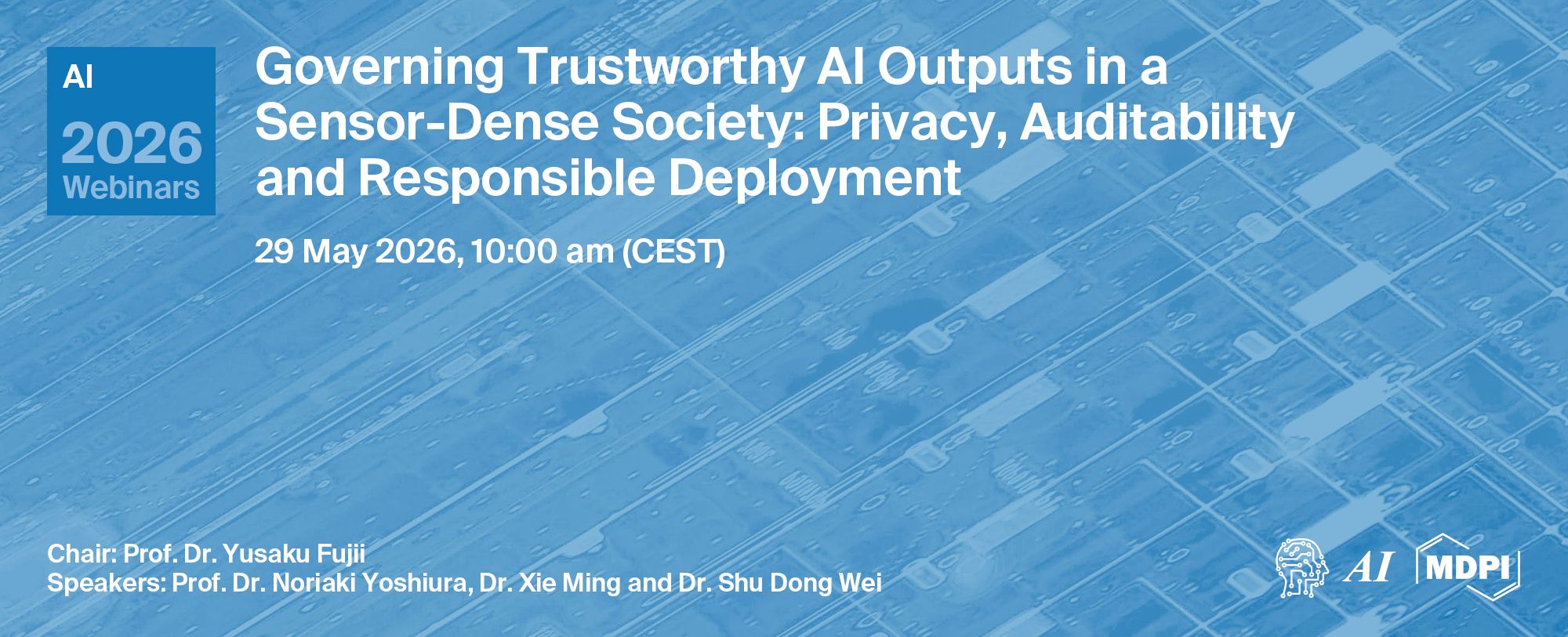
AI Webinar | Governing Trustworthy AI Outputs in a Sensor-Dense Society: Privacy, Auditability and Responsible Deployment
the chair
AI Webinar
Governing Trustworthy AI Outputs in a Sensor-Dense Society: Privacy, Auditability and Responsible Deployment
Dear colleagues,
Thank you very much for joining us today.
Welcome to this Special Issue Webinar on
“Governing Trustworthy AI Outputs in a Sensor-Dense Society: Privacy, Auditability and Responsible Deployment.”
This session is held in conjunction with the pre-symposium seminar of ISTA-PSI 2026, taking place today in Bangkok. Some of us, including myself, are participating from the seminar venue, while many of you are joining online from around the world. This hybrid setting itself reflects the kind of interconnected, sensor-dense society that we are here to discuss.
As AI systems become deeply embedded in public infrastructure—such as smart cities, transportation systems, and online platforms—the key challenge is no longer limited to model performance. Rather, the central question is how to govern the outputs of these systems in a way that ensures privacy protection, accountability, and societal trust.
While output-related regulation has existed in the form of rules established by regulatory authorities, such approaches have often lacked effective technical mechanisms for enforcement and verification. As a result, their practical effectiveness in real-world systems has remained limited.
This Special Issue aims to address this gap by proposing a perspective of output-level governance grounded in verifiable records and auditability. At the same time, this discussion is not limited to output alone. It seeks to encompass and integrate existing approaches, including:
- input regulation
- internal process management
- data governance frameworks (including output regulation)
In this sense, our goal is to move toward a more comprehensive and integrated governance framework for AI systems.
Today’s webinar aims to bring together researchers and practitioners to explore these emerging challenges and opportunities. We hope this session will serve not only as an introduction to the Special Issue, but also as a platform for building new collaborations and advancing a shared research agenda.
We warmly invite you to actively engage in the discussion and to consider submitting your work to the Special Issue.
Thank you very much for your participation.
Yusaku Fujii
Guest Editor, Special Issue
Gunma University, Japan
Date: 29 May 2026
Time: 10:00 am - 11:30 am CEST
Webinar ID: 896 8789 4531
Meet Our Chair

School of Science and Technology Gunma University, Maebashi, Japan;Yusaku Fujii, Ph.D. is a Professor in the Department of Mechanical Science and Technology at Gunma University, Japan, and President of the NPO e-JIKEI Network Promotion Institute. He received his B.E., M.E., and Ph.D. in Engineering from the University of Tokyo. His research spans instrumentation engineering, mechanical measurement, optical sensing, and applied physics, with particular contributions to precision measurement technologies such as the Levitation Mass Method. In recent years, his work has expanded toward AI governance, privacy-preserving sensing systems, and socially deployable technologies, including AI output governance frameworks and public-oriented protective systems such as powered air-purifying respirators (PAPRs). He has led interdisciplinary and international projects integrating sensing, AI, and societal infrastructure, aiming to establish trustworthy and accountable AI systems in sensor-dense environments.
Meet Our Speakers

Prof. Dr. Noriaki Yoshiura
Information and Computer Sciences, Saitama University, Saitama, Japan;Noriaki Yoshiura, Ph.D. is a Professor in Information and Computer Sciences, Saitama University,Japan. His research spans Software Formal Specification, Network, Security Camera System and Biometric Authentication.

Nanyang Technological University School of Mechanical and Production Engineering Singapore, Singapore;Xie Ming is an Associate Professor at Nanyang Technological University, Editor-in-Chief of the International Journal of Humanoid Robotics, Associate Editor of IEEE Transactions on Autonomous Mental Development, and Director of private companies. He has provided technical consultancy to companies including Asia Electronics, Port of Singapore Authority, Delphi, ST Aerospace, Murata, and Sony, and collaborated with Renault Automation, INRIA Sophia-Antipolis, and the Singapore-MIT Alliance. He served as General Chair for CLAWAR 2007 and ICIRA 2009. He received his B.Eng (1984) in China, M.Eng (1986) from the University of Valenciennes, and Ph.D. (1989) from the University of Rennes, France. He has published one best-selling robotics book and over 100 research papers. His research focuses on machine intelligence, humanoid robotics, and autonomous vehicles. He has won two scientific competition awards and two best conference paper awards.
School of Mechanical and Aerospace Engineering, Singapore City, Singapore;Dong Wei SHU is an Associate Professor in the School of Mechanical and Aerospace Engineering. He received his BEng (1984) and MEng (1986) from Peking University, and a PhD in Dynamic Plasticity from Cambridge University (1990). He conducted postdoctoral research at the University of Waterloo (Canada) and University of Sydney (Australia). He started his academic career at Monash University, Australia. His research focuses on FEM drop-test simulation of Seagate HDDs, composite delamination, and high-strain-rate effects. He has published over 80 papers in top journals, received sustained Seagate funding, and consulted for Hewlett Packard and Phillips. He serves on the Singapore Accreditation Council, is founding President of the Peking University Alumni Association in Singapore, a Churchill College member, and Guest Professor at Shandong Institute of Architectural Engineering. He received a Provincial Third Prize in Science and Technology


The full recording can be found below. In order to learn about future webinars, you can sign up to our newsletter by clicking “Subscribe” at the top of the page.
Edited by: Prof. Dr. Yusaku Fujii
Deadline for manuscript submissions: 31 March 2027