
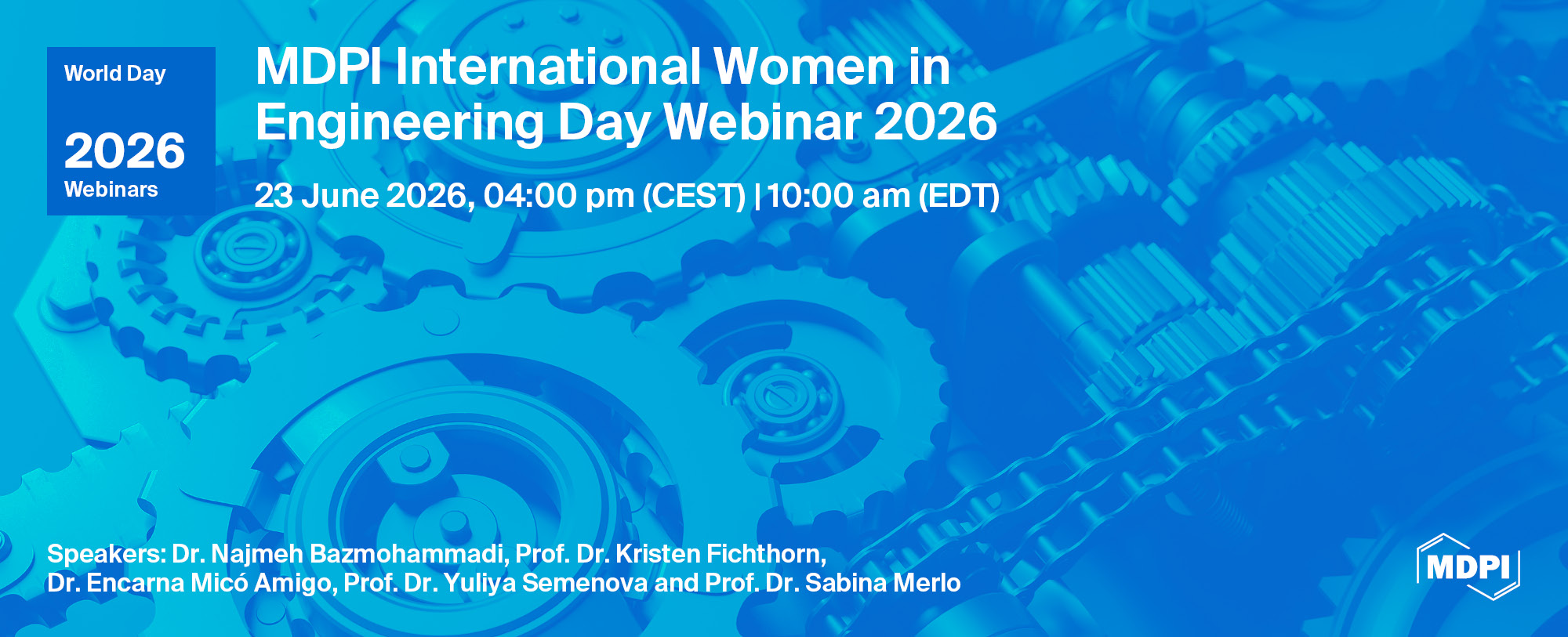
MDPI International Women in Engineering Day Webinar 2026 | Session 2
International Women in Engineering Day (INWED), observed annually on 23 June, is a global initiative that celebrates the outstanding achievements of women in engineering while inspiring more young women to pursue engineering careers. Aligned with the 2026 theme, "Engineering Intelligence", and Goal 5 (Gender Equality) of the United Nations Sustainable Development Goals (SDGs), MDPI highlights the innovative contributions of women engineers who are shaping the future through creativity, collaboration, and technological advancement. Together, we can foster a more inclusive engineering landscape and empower the next generation of women in STEM.
Join us in celebrating International Women in Engineering Day and supporting initiatives that empower women in STEM. This webinar will showcase not only the technical contributions of women engineers, but also the personal journeys, challenges, and achievements that have shaped their careers and inspired others to pursue paths in engineering and innovation.
Date: 23 June 2026
Time: 4:00 pm CEST | 10:00 am EDT
Webinar ID: 833 7384 9123
Webinar Secretariat: journal.webinar@mdpi.com
Meet Our Speakers
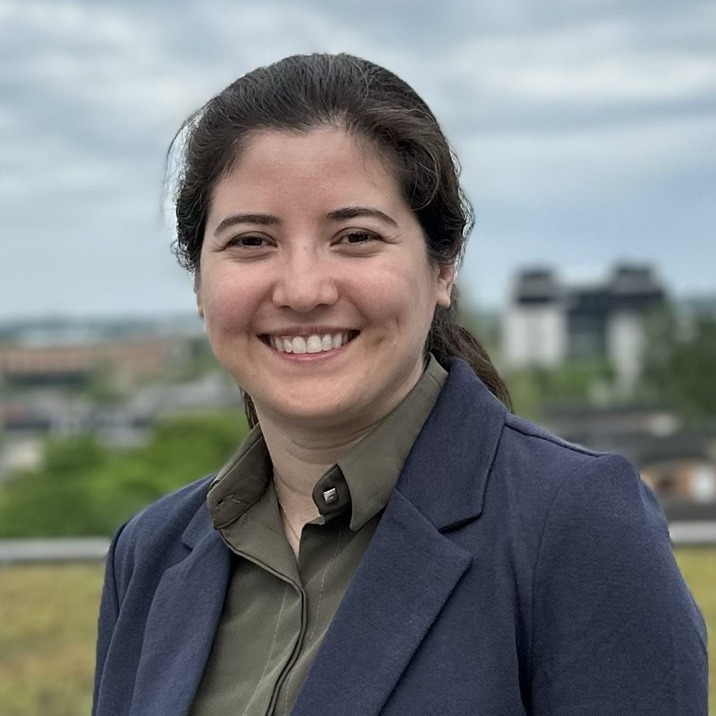
Center for Research on Microgrids (CROM), AAU Energy, Aalborg University, Aalborg, Denmark;Najmeh Bazmohammadi (Senior Member, IEEE) earned a B.Sc. Degree in Electrical Engineering in 2009 and M.Sc. and Ph.D. Degrees in Electrical Engineering with a focus on control theory in 2012 and 2019, respectively. She is currently an assistant professor at the Center for Research on Microgrids (CROM), AAU Energy, Aalborg University, Denmark. Her current research interests include the modeling, optimization, and energy management of hybrid and renewable-based microgrids; model predictive control; digital twins; data-driven systems; and system dynamics.

Department of Chemical Engineering, Pennsylvania State University, Pennsylvania, USA;Kristen Fichthorn is the Merrell Fenske Professor of Chemical Engineering and a professor of physics at Pennsylvania State University. She received a B.S. in Chemical Engineering from the University of Pennsylvania and a Ph.D. in Chemical Engineering from the University of Michigan. She spent one year working as an IBM Postdoctoral Fellow at the University of California at Santa Barbara before joining Penn State. Professor Fichthorn’s research primarily focuses on multi-scale material simulation, developing and applying theoretical techniques ranging from quantum density functional theory to molecular dynamics, Monte Carlo methods, and continuum theories to varied fundamental problems involving fluid–solid interfaces, with applications in nanoscale materials, thin-film and crystal growth, colloidal assembly, and wetting. In addition to being recognized by Penn State for her outstanding research and teaching, she received the NSF Presidential Young Investigator Award (1990) and Alexander von Humboldt Research Fellowship (1998), and she is a Fellow of the American Physical Society (2011), a Fellow of the American Institute of Chemical Engineers (2017), a recipient of the Nanoscale Science and Engineering Forum Award of the American Institute of Chemical Engineers (2019), and a recipient of the Langmuir Lectureship of the American Chemical Society (2020).
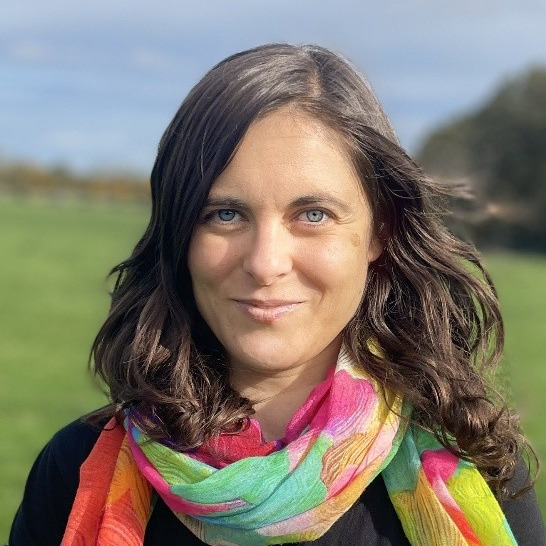
Institute of Mechanical, Process and Energy Engineering (IMPEE), School of Engineering and Physical Sciences (EPS), Heriot-Watt University, Edinburgh, UK;With over 12 years of academic and industrial experience and a newly established research laboratory, Encarna Micó-Amigo is committed to advancing the development, implementation, and analytical validation of algorithms for extracting biometrics using wearable technology. Her career reflects her growing leadership in digital health, driven by interdisciplinary collaboration and a strong commitment to innovation. Her industrial PhD, competitively funded through the Marie Curie FP7 Actions, and her subsequent role as a research associate in the EUR 50 million Mobilise-D project, focused on developing signal-processing algorithms to study neurological conditions. In 2023, she was top-ranked at University College Dublin for a Horizon 2020-funded postdoctoral fellowship on digital biomarkers for Parkinson’s disease but instead chose to begin her independent academic career as an assistant professor in biomedical engineering at Heriot-Watt University. She currently supervises four PhD students and leads the Sensors for Ubiquity and Physiological Engineering Research (SUPER) Laboratory (https://super.site.hw.ac.uk/people/). Their research focuses on advancing methods for better understanding the effects of anti-Parkinsonian medication, the use of lower-limb prostheses, the prediction of pregnancy complications, and the promotion of physical activity in refugee populations.
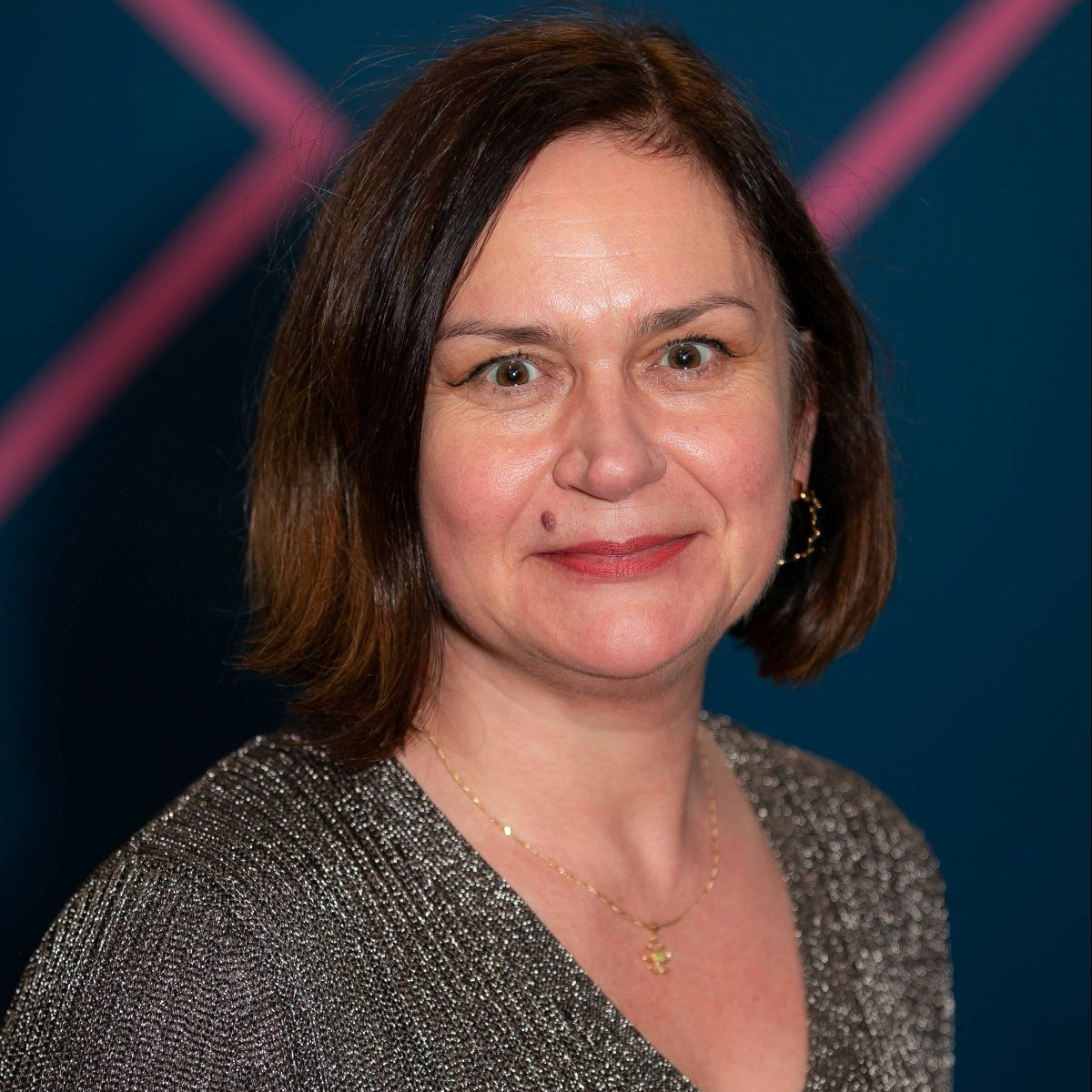
School of Electrical and Electronic Engineering, Photonics Research Centre, Technological University Dublin, Dublin, Ireland;Yuliya Semenova received her Master’s Degree in Electronic Engineering from the National University “Lviv Polytechnic” in Ukraine in 1992 and her Ph.D. in Physics from the Ukrainian Academy of Sciences in 1999. She is a professor at the School of Electrical and Electronic Engineering at Technological University Dublin, where she worked since 2001, and has been Director of the Photonics Research Centre since 2019. She has over 350 publications in the field of photonics, with her research receiving over 8000 citations. She has given numerous invited talks and tutorials and supervised to completion 17 PhD graduates. She is an associate editor of several journals in her field including IET Electronics Letters and the Journal of Lightwave Technology. Her current research interests span both photonics and applications of photonic devices in engineering with a focus on fiber optics. Much of her research to date has focused on improving the design and performance of optical fiber sensors with applications ranging from macro- to nanoscales. Some of her specific interests are whispering gallery mode effects in microfiber resonators, plasmonic structures, and photonic (liquid) crystal fiber sensors.
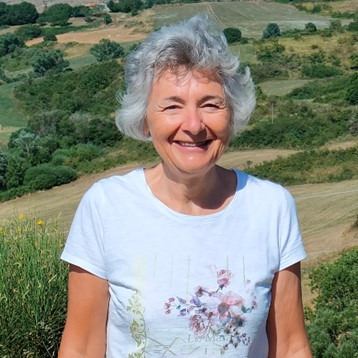
Department of Electrical, Computer and Biomedical Engineering, University of Pavia, Pavia, Italy;Sabina Merlo was born in Pavia, Italy, in 1962 and received the degree in electronic engineering from the University of Pavia, Pavia, in 1987. She received a Rotary Foundation Graduate Scholarship to study at the University of Washington, Seattle, WA, USA, and received the M.S.E. degree in bioengineering in 1989 from the same university. She received a Ph.D. degree in electronic engineering from the University of Pavia in 1991. She became an Assistant Professor in 1993, an Associate Professor in 2001, and a Full Professor in 2018 in the Department of Electrical, Computer, and Biomedical Engineering of the University of Pavia. Her main research interests include optical measurements on micromachined and microfluidic devices, optical interferometry, chaos in lasers, fiber-optic passive components and sensors, and optical biosensors. She holds four patents and is the coauthor of more than 200 publications in journals, books, and conference proceedings. She is an Associate Editor of MDPI Sensors and MDPI Micromachines. Dr. Merlo is a Member of AEIT, GMEE, and a Senior Member of the IEEE I&M Society and Photonics Society. Sciprofile: https://sciprofiles.com/profile/197857
In this section, you'll find the webinar recording. Share it with your colleagues!
| Speaker | Presentation | Time in CEST | Time in EDT |
|---|---|---|---|
| MDPI Introduction | 4:00–4:10 pm | 10:00–10:10 am | |
| Dr. Najmeh Bazmohammadi | Next-Generation Power Systems Resilience | 4:10–4:30 pm | 10:10–10:30 am |
| Prof. Dr. Kristen Fichthorn | What Enhanced Free-Energy Sampling Techniques and Machine Learning Can Tell Us about Effective Catalysts | 4:30–4:50 pm | 10:30–10:50 am |
| Dr. Encarna Micó-Amigo | Wearable Sensors for Real-World Health Monitoring: Algorithms and Applications | 4:50–5:10 pm | 10:50–11:10 am |
| Prof. Dr. Yuliya Semenova | Optical Fiber Sensing Solutions From Macro- to Nanoscale | 5:10–5:30 pm | 11:10–11:30 am |
| Prof. Dr. Sabina Merlo |
|
5:30–5:50 pm | 11:30–11:50 am |
| Q&A | 5:50–6:15 pm | 11:50 am–12:15 pm | |
| Closing Remarks | 6:15–6:20 pm | 12:15–12:20 pm |
"The 15th Anniversary of Nanomaterials—Women in Nanomaterials"
Special Issue Editors: Prof. Dr. Eugenia Valsami-Jones, Prof. Dr. Barbara Bonelli, Prof. Dr. Fei Xiao and Dr. Ilaria Armentano
Deadline for manuscript submissions: 31 July 2026
"Advancing Human Gait Monitoring with Wearable Sensors"
Special Issue Editors: Dr. M. Encarna Micó-Amigo and Dr. Sauvik Das Gupta
Deadline for manuscript submissions: 20 September 2026
"Neural Microelectrodes for Brain–Computer Interfaces"
Special Issue Editors: Dr. Jinping Luo, Dr. Yilin Song and Prof. Dr. Xinxia Cai
Deadline for manuscript submissions: 31 August 2026