Molecules Webinar | Methods in Food Analysis - Part 2: Future Perspectives
the chair
26th Molecules Webinar
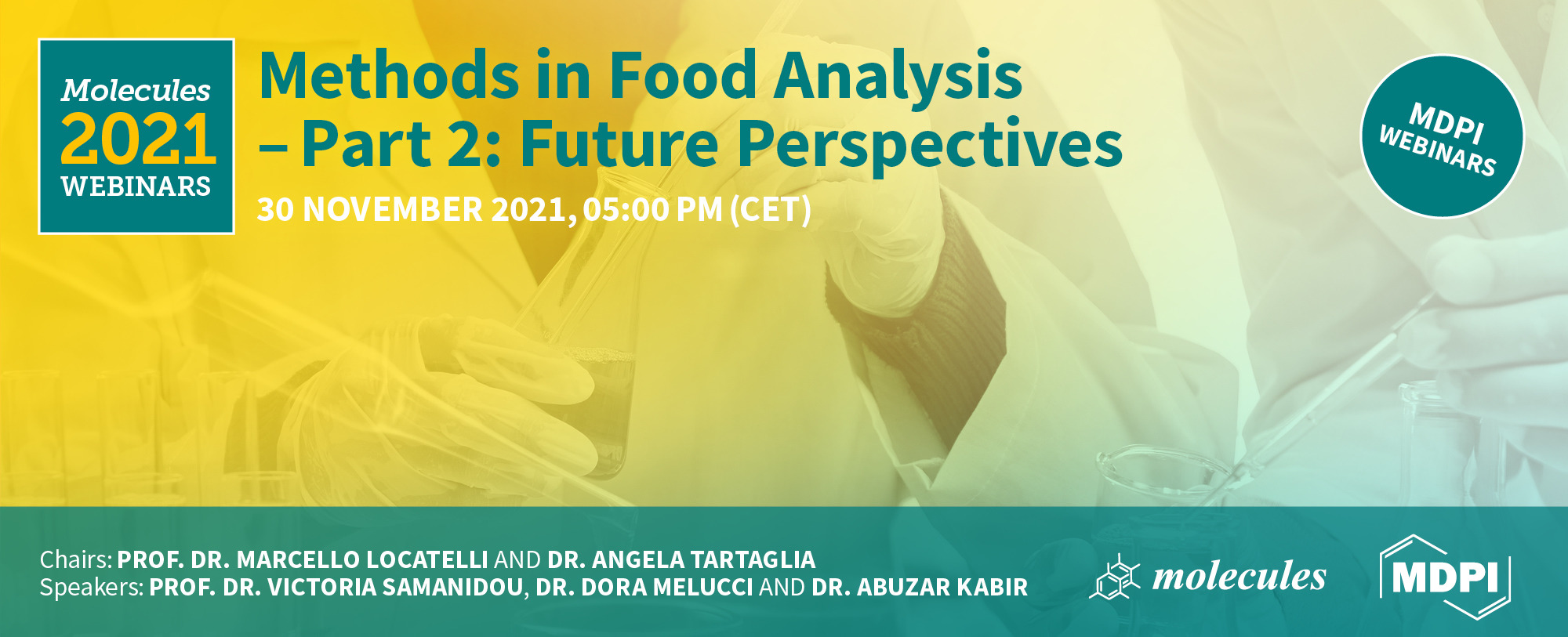
Methods in Food Analysis - Part 2: Future Perspectives
Nowadays, the possibility of analyzing, tracing, and certifying food products (as well as supplements) is of fundamental importance for guaranteeing not only the quality of the product but, above all, to safeguarding the health of the consumer. Within this perspective, the availability of analytical procedures, instrumental configurations, and statistical and chemometric methods that can be integrated to maximize analytical information is fundamental.
One element not to be overlooked is the scalability of the processes, from the laboratory to the industrial level, in addition to quality control and traceability (which can include the verification of product authenticity).
Of additional value is the role of nanotechnologies that can be used in the production of food and food supplements in order to improve their health benefits.
This is the second part of a two-part webinar. For information on the first webinar, please click here.
Date: 30 November 2021
Time: 5:00pm CET | 11:00am EST | 12:00am CST Asia (1 Dec)
Webinar ID: 890 0822 5186
Webinar Secretariat: molecules.webinar@mdpi.com
Meet Our Speakers
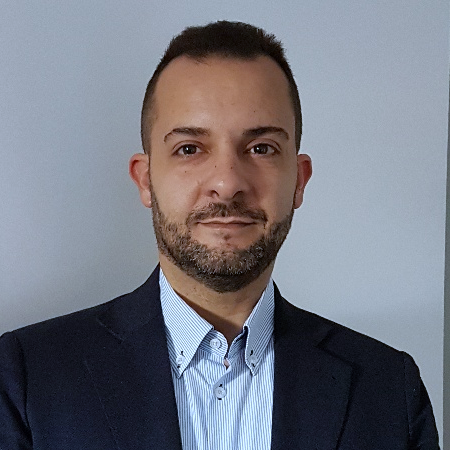
University "G. d'Annunzio" of Chieti-Pescara; Dept of Pharmacy, Italy;Prof. Marcello Locatelli obtained his master’s degree in Chemistry and his PhD from the University of Bologna, Department of Chemistry “G. Ciamician”. He is currently Associate Professor of Analytical Chemistry at the University “G. d'Annunzio” of Chieti–Pescara, Department of Pharmacy. His research activities are devoted to the development and validation of chromatographic methods for the qualitative and quantitative determination of biologically active molecules in complex matrices. This applies to the study of all processes related to preanalytical stages, even the application of conventional and coupled analytical methods for accurate, sensitive, and selective determination. Particular attention has recently been paid to innovative (micro)extraction procedures such as MEPS, FPSE, MIP, DLLME, and SULLE. As part of method development, predictive models and chemometrics are also tested, both for the optimization of extraction protocols and for final data processing, where new instrument configurations for quantitative analysis in complex matrices are a focal point. Prof. Locatelli has served as Guest Editor for 20 Special Issues, and his research activities have resulted in more than 174 manuscripts, 161 congress communications (oral and poster), 16 book chapters, and 6 books, with a corresponding h-index of 35 (for 165 papers with 3413 citations (Scopus (23rd of February 2021)), attesting to the influence of his scientific output. He is a reviewer for more than 100 international peer-reviewed journals. He serves as a referee for MIUR Institution for National Projects (SIR), and is included in the register REPRISE (Register of Expert Peer Reviewers for Italian Scientific Evaluation) in the “Basic Research” section, in addition to having served as a referee for VQR (2011–2014).
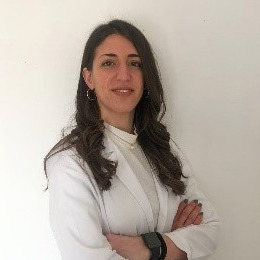
University "G. d'Annunzio" of Chieti-Pescara; Dept of Pharmacy, Italy;Angela Tartaglia obtained her master’s degree in Pharmacy in March 2018 from the “G. d’Annunzio” University of Chieti–Pescara (Italy), with her research thesis titled “FPSE–HPLC–PDA Method for the Quantification of Anticancer Drugs in Human Whole Blood, Plasma and Urine”. From March to June 2018, she conducted additional research at Aristotle University of Thessaloniki, School of Chemistry, Laboratory of Analytical Chemistry, on microextraction procedures and a method validation focused on food products. She has been a PhD candidate at “G. d’Annunzio” University of Chieti–Pescara (Italy) since November 2018. Her research activity is focused on the development and validation of chromatographic methods (according to international guidelines, ICH) for the qualitative and quantitative determination of biologically active molecules in complex matrices, such as biological fluids (e.g., serum, plasma, urine, whole blood, saliva), cosmetic formulations, food, and environmental samples. This research involves the optimization of new protocols for sample preparation, where particular attention is given to innovative (micro)extraction, mostly microextraction by packed sorbent (MEPS), fabric phase sorptive extraction (FPSE), and MIP-based solid-phase extraction (MIP–SPE). These procedures have been applied to different analytes: natural or synthetic bioactive compounds, drugs, and their metabolites, secondary metabolites of plant material, and food supplements, in addition to finding applications in clinical and preclinical studies aimed at the evaluation of quantitative, pharmacokinetic, bioequivalence and absorption, distribution, metabolism, and excretion (ADME) profiles of the analyzed analytes, in order to characterize new systems for conveying the active principle of improving their pharmacological properties.

Guest Editors: Prof. Dr. Clinio Locatelli, Prof. Dr. Dora Melucci & Prof. Dr. Marcello Locatelli
Deadline for manuscript submissions: 30 April 2022