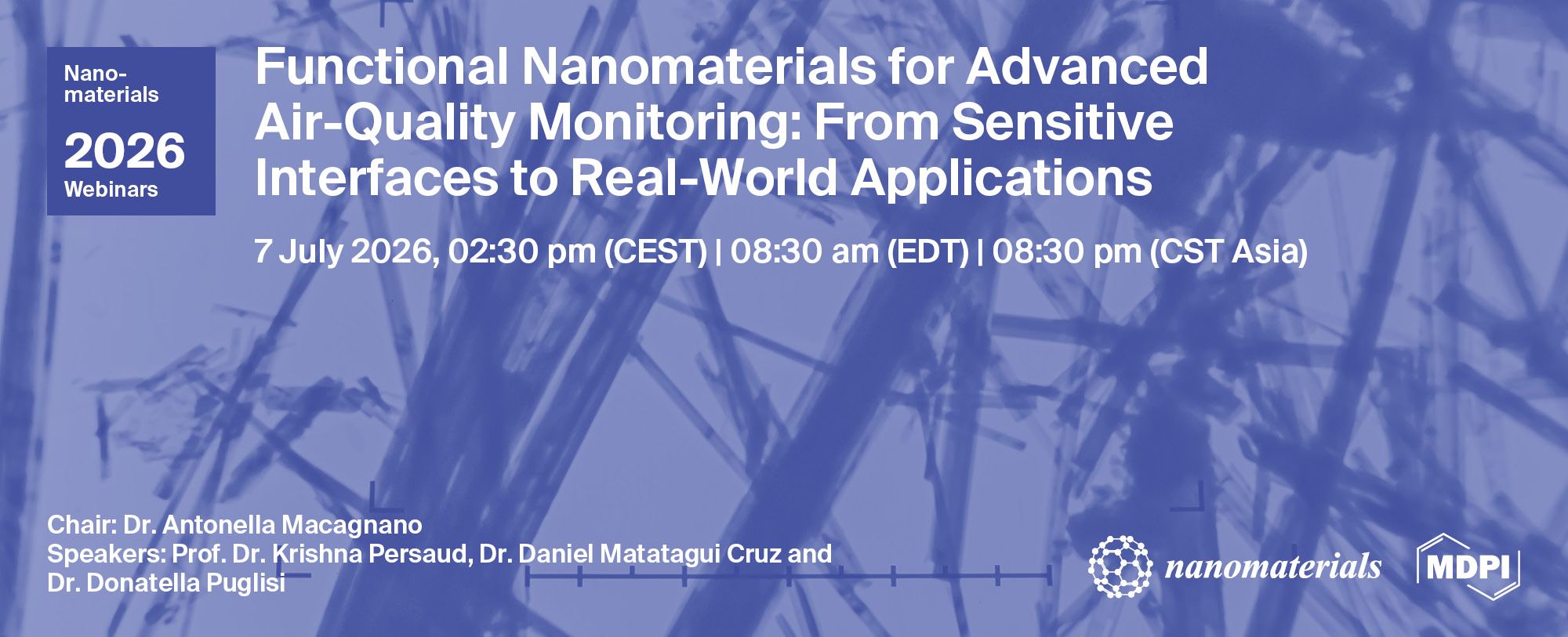
Nanomaterials Webinar | Functional Nanomaterials for Advanced Air-Quality Monitoring: From Sensitive Interfaces to Real-World Applications
the chair
31st Nanomaterials Webinar
Functional Nanomaterials for Advanced Air-Quality Monitoring: From Sensitive Interfaces to Real-World Applications
Emerging air-quality challenges increasingly require sensing systems capable of detecting and interpreting volatile chemicals under complex, dynamically changing, and often poorly controlled environmental conditions. Volatile organic compounds and other gaseous pollutants may occur at low concentrations, fluctuate over time and coexist within multicomponent mixtures, making their selective and reliable monitoring particularly demanding. Meeting these challenges requires the coordinated development of selective recognition elements, high-performance sensing materials and robust data-interpretation strategies.
Nature offers highly efficient models for chemical recognition. Biological olfactory systems can identify and discriminate complex volatile mixtures through highly selective molecular interactions, inspiring the development of bio-derived and biomimetic sensing interfaces. In this context, odorant-binding proteins and other biologically derived recognition elements can be engineered as functional sensing layers, combining molecular selectivity, reversibility and room-temperature operation.
Building on this molecular-recognition perspective, advanced nanomaterials can further enhance gas adsorption, surface reactivity and signal transduction. Magnetic nanomaterials offer promising opportunities for the development of high-performance gas-sensing systems, providing tuneable physicochemical properties and new possibilities for the design of responsive sensing interfaces.
The transition from advanced sensing materials to reliable real-world monitoring platforms, however, also requires effective system integration and data interpretation. Sensor arrays, temperature-controlled operation and machine-learning approaches can compensate for the limited selectivity and environmental cross-sensitivity of individual sensors, transforming low-cost sensing elements into more robust and actionable monitoring systems.
Following this progression, the webinar will first examine bioinspired materials for volatile chemical sensing, with particular attention to odorant-binding proteins derived from the black soldier fly for the recognition of decomposition-related VOCs. It will then explore magnetic nanomaterials as potential systems for high-performance gas sensing in air-quality monitoring. Finally, it will address data-driven electronic noses combining MOS sensor arrays, temperature modulation and machine learning for indoor and outdoor VOC monitoring under real-world conditions.
By connecting biological recognition, nanomaterial engineering and data-driven system integration, the webinar will provide a multidisciplinary perspective on the development of selective, low-power and deployable sensing technologies for environmental monitoring, organic-waste valorisation and air-quality assessment.
Date: 7 July 2026
Time: 2:30 pm CEST | 8:30 am EDT | 8:30 pm CST Asia
Webinar ID: 897 9593 1423
Webinar Secretariat: journal.webinar@mdpi.com
Meet Our Chair

National Research Council—Institute for Atmospheric Pollution Research, Rome, Italy;Antonella Macagnano is a Senior Researcher at the Institute of Atmospheric Pollution Research of the Italian National Research Council (CNR-IIA), where she coordinates research activities on advanced sensors and functional na-nomaterials. Her scientific interests include electrospinning and elec-trospraying, molecularly imprinted polymers, conductive nanocomposites and bioinspired interfaces for chemical sensing. Her research is mainly de-voted to the development of nanofibrous chemiresistive sensors and portable platforms for the detection of VOCs, ammonia and other airborne pollutants, with applications in environmental monitoring, air-quality assessment and sustainable technologies. She has coordinated and contributed to several na-tional and European projects and is a member of the Editorial Board of Na-nomaterials, with specific interests in nanosensors, nanoelectronics and functional devices.
In this section, you will find the recordings of this webinar to watch, re-watch and share with your colleagues!
Meet Our Speakers

Department of Chemical Engineering, The University of Manchester, United Kingdom;Krishna Persaud, Emeritus Professor at University of Manchester, is an inter-nationally recognised scientist and entrepreneur in artificial olfaction, biosen-sors, and biomimetic sensing technologies. He is Emeritus Professor of Chem-oreception at the University of Manchester and Director and Chief Scientist of Multisensor Systems Ltd, with a career spanning academia, technology transfer, and commercial innovation. His work integrates molecular biology, electronics, and analytical chemistry to advance sensing systems for medical diagnostics, environmental monitoring, industrial applications, and security. He has founded or co-founded several sensor technology companies, contributed to more than 250 publications, secured 92 granted patents across approximately seven patent families, and held leadership roles in major international chemo-reception and olfaction organisations.

Institute of Applied Magnetism, Complutense University of Madrid, Spain;Daniel Matatagui, (Member, IEEE), was born in Madrid, Spain, in 1982. He received his B.S. degree in Physics in 2007 and the M.Sc. degree in Advanced Materials and Nanotechnology in 2008. He earned his Ph.D. degree in Physics from the Universidad Autónoma de Madrid, Madrid, Spain, in 2012. His doc-toral research was conducted with the GRIDSEN Group of the Institute of Ap-plied Physics at the Spanish National Research Council (CSIC). His major field of study is physics and sensor technology. He began his career with a Research Personnel Training (FPI) contract at CSIC. Subsequently, he moved to Mexico under a Postdoctoral Grant at the Centre for Applied Science and Technological Development (CCADET/UNAM). Later, he served as a Professor at ICAT/UNAM, where he led the Biomedical Devices Group. After returning to Spain through a ComFuturo contract at ITEFI/CSIC, he held several teaching positions at the Universidad Autónoma de Madrid and the Universidad Complutense de Madrid. He has served as a Principal Inves-tigator for seven research projects related to sensors and has had three of his research works selected as journal issue covers. His current research interests include magnetic and nanostructured gas sensors, environmental applications, and biomedical devices. He was a member of the Researcher National System of Mexico and the Nano-ciencias y Nanotecnología National Network of Mexico. He is a member of the Board of the Spanish Network of Micro and Nanosystems (IBERNAM). He was also awarded the Ibero-America Santander Research Grant (2019).

Department of Physics, Chemistry and Biology, Linköping University, Sweden;Donatella Puglisi, PhD and Docent, is an Associate Professor of Applied Physics at Linköping University, Sweden. Over the past two decades, she has led or contributed to more than 25 national and international research and innovation projects, including FP7, Horizon 2020, Horizon Europe, and COST initiatives. Her research focuses on the development of intelligent gas sensing platforms for vola-tile organic compound (VOC) detection, combining gas sensor technologies, machine learning, and advanced data analytics to address real-world challenges in air quality, diagnostics, and sustainability. She has published more than 70 peer-reviewed articles and two book chapters and has presented her work at over 100 international conferences and workshops. Dr. Puglisi serves on international advisory boards, expert panels, and scientific committees, including the EUROSENSORS International Steering Committee, where she chairs the ES Fellow Sub-Committee. She is also co-founder and board member of NORNDiP (Nordic Network for Diversity in Physics) and serves on the executive board of SINAPSE (Swedish Italian Network for Advanced Partnership in Science and Education). Her contributions to research, innovation, and entrepreneurship have been recognised through several awards, including the Sahlgrenska Global Health Hackathon Award (2025), the Åforsk Entrepreneurship Award (2019), and the Sten K. Johansson Scholarship (2026).


Hybrid and Functional Nanomaterials for Next-Generation Air Quality Monitoring
edited by Dr. Antonella Macagnano
Deadline for manuscript submissions: 31 August 2026