
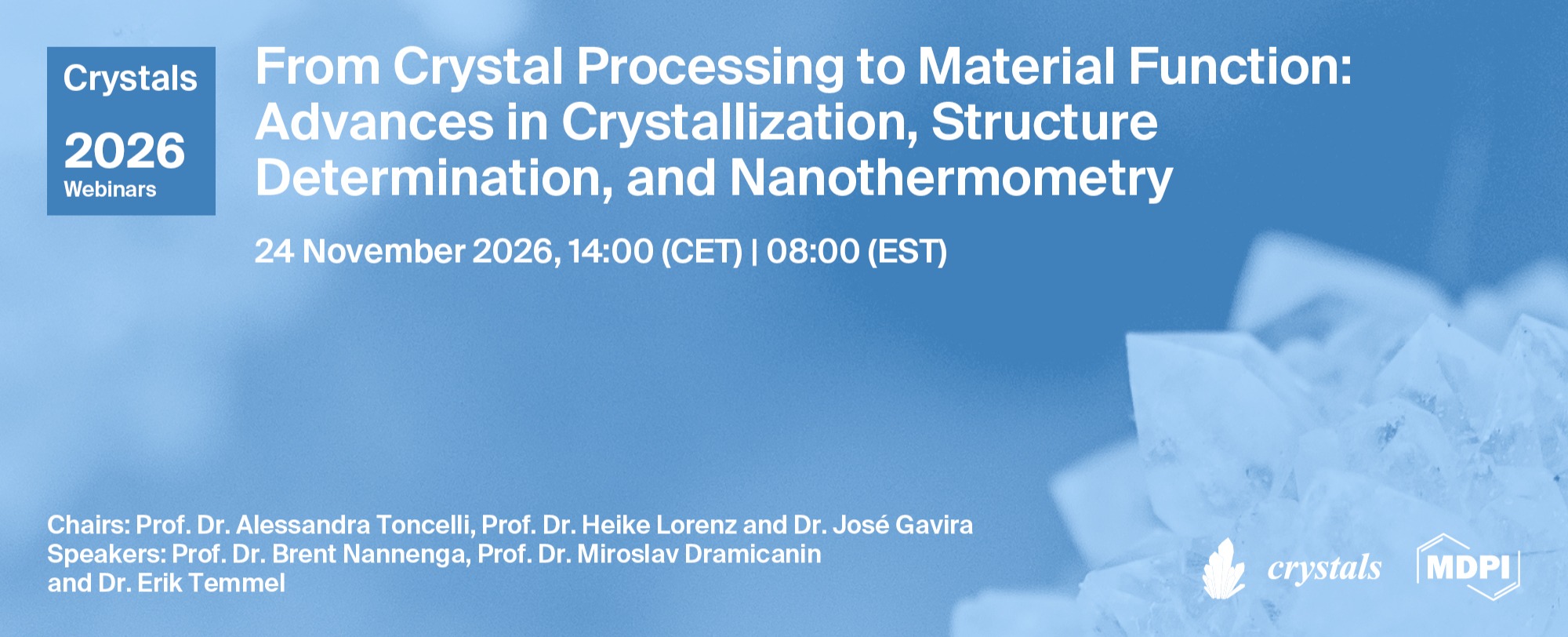
Crystals Webinar | From Crystal Processing to Material Function: Advances in Crystallization, Structure Determination, and Nanothermometry
the chairs
Crystals Webinar
From Crystal Processing to Material Function: Advances in Crystallization, Structure Determination, and Nanothermometry
Dear Colleagues,
It is a great pleasure to welcome you to the Crystals webinar entitled “From Crystal Formation to Material Function: Advances in Crystallization, Structure Determination and Nanothermometry.”
Crystals play a fundamental role in many areas of science and technology; progress in their synthesis, characterization, and application continues to open new and exciting research directions. This webinar will highlight some of these developments by bringing together three distinct and complementary perspectives on modern crystal science.
Our invited speakers will explore the role of crystallization in plastics recycling, demonstrating how crystal-related processes can contribute to more sustainable technologies; the use of machine learning to enhance luminescent thermometry based on crystalline materials; and the remarkable opportunities offered by three-dimensional electron diffraction for determining the structure of crystals that are too small for conventional X-ray crystallography.
Although these topics cover different research fields, they share a common theme: the importance of understanding and exploiting crystalline materials to address scientific and technological challenges.
I hope this webinar will provide an opportunity to discover new developments, exchange ideas, and stimulate discussions across different areas of crystallography and materials science.
Furthermore, this webinar is part of the celebrations marking the 15th anniversary of Crystals. To mark the occasion, we are pleased to promote the Special Issue “Crystals: 15th Anniversary”, which will publish recent advances and emerging trends across the broad field of crystal science. Therefore, we invite researchers to contribute their latest work to this special collection.
In closing, let me invite you to join us for what promises to be an interesting and inspiring event.
Alessandra Toncelli
Editor-in-Chief, Crystals
University of Pisa, Italy
Date: 24 November 2026
Time: 14:00 pm CET | 08:00 EST | 21:00 CST Asia
Webinar ID: 823 5739 7976
Webinar Secretariat: journal.webinar@mdpi.com
Meet Our Chairs
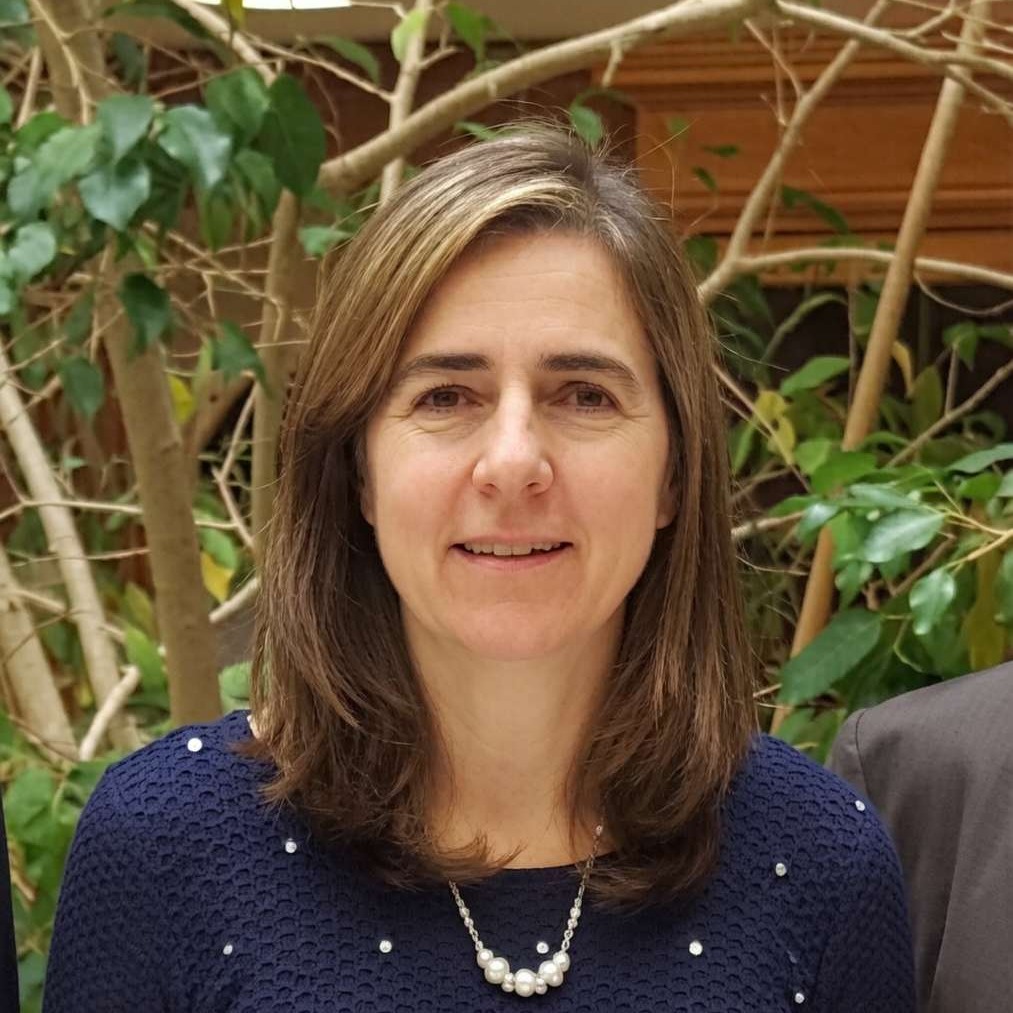
University of Pisa, Italy;Alessandra Toncelli received her Ph.D. in Physics from the University of Pisa in 1998 and has been an Associate Professor at the same university since 2017. Her research activity has been strongly focused on the growth, spectroscopic characterization, and development of crystalline materials for photonic applications. She has extensive experience with rare-earth-doped crystals and nanocrystals for laser applications from the visible to the near- and mid-infrared, as well as with luminescent nanocrystals for bioimaging and luminescence intensity ratio (LIR) thermometry. Her research interests also include crystalline materials for scintillation and quantum technologies and, more recently, the development of integrated photonic devices on silicon for sensing applications. Her activities have progressively expanded to THz spectroscopy and imaging, with applications ranging from materials characterization to non-invasive monitoring in the agri-food sector. She has authored more than 200 peer-reviewed publications and holds two patents. Since 2024, she has served as Editor-in-Chief of Crystals.

Max Planck Institute for Dynamics of Complex Technical Systems, Magdeburg, Germany;Heike Lorenz studied Chemistry at Freiberg University of Mining and Technology and received her Ph.D. from Otto von Guericke University (OVGU) in Magdeburg. After research periods at the OVGU and the Max Planck Institute for Dynamics of Complex Technical Systems in Magdeburg, she obtained her habilitation with a thesis on heterogeneous processes on the example of combustion of solids and crystallization from solution. Since 1998, she has been a Senior Researcher at the Max Planck Institute and is heading the crystallization research team. In 2010, she was appointed as apl. Professor at OVGU. Heike Lorenz has authored or co-authored more than 200 papers and 12 book contributions, and she has edited 2 international conference books. She is a member of the European Federation of Chemical Engineering’s (EFCE) Working Party on Crystallization and the DECHEMA/VDI’s Specialist Group Crystallization in Germany. Her research interests include crystallization as a process for separation and product design, and application of crystallization for sustainable production and purification of fine chemicals, large-scale industrial and natural products. Since 2019, she has been a member of the Editorial Board of Crystals and Editor-in-Chief of its Industrial Crystallization Section.
LEC, IACT-CSIC, Armilla, Spain;José A. Gavira (PhD in Chemistry/Biochemistry) is a tenured research scientist at the Spanish National Research Council (CSIC) and Head of the Laboratory of Crystallographic Studies (LEC) at the Andalusian Earth Sciences Institute (IACT). He is internationally recognized for his pioneering research on protein crystallization under diffusive mass-transport conditions (hydrogels, capillaries, and microgravity environments), and for his contributions to the development of counter-diffusion techniques. His current research lies at the interface of fundamental and applied biocrystallogenesis, with a particular focus on the rational design of protein/enzyme–hydrogel composite crystals for biotechnological and pharmaceutical applications. His work combines the study of the fundamental mechanisms governing biomacromolecular crystallization with the development of functional crystalline materials.
Meet Our Speakers
Vinca Institute of Nuclear Sciences, University of Belgrade, Serbia;Prof. Dr. Miroslav D. Dramićanin earned his PhD in Physics from the University of Belgrade and has held notable positions including Full Professor of Applied Physics at the University of Belgrade and Head of the Department for Radiation Chemistry and Physics at Vinča Institute. He currently serves as Associate Editor for Optical Materials and is a foreign member of the Latvian Academy of Sciences. His research centers on materials science, spectroscopy, luminescence, and biophysics, with a focus on luminescence thermometry and nanomaterials for advanced optical applications. Prof. Dramićanin has authored one book, nine book chapters, and nearly 400 peer-reviewed publications, with approximately 19,200 citations and an h-index of 67, according to Google Scholar. He is the winner of the Galileo Galilei Award for 2025 from the International Commission for Optics. He has also led major international projects, such as the EU’s NanoTBTech under Horizon 2020 and NATO’s “Optical Nose Grid” initiative. Additionally, he is recognized on Stanford University’s list of the world’s most influential scientists.
Sulzer Chemtech Ltd., Allschwil, Switzerland;Dr. Erik Temmel is currently the Manager of R&D Crystallization at Sulzer Chemtech Ltd. in Allschwil/Basel, Switzerland. He earned his Ph.D. (Dr.-Ing.) from Otto von Guericke University Magdeburg, Germany, with a thesis focused on the design of continuous crystallization processes. Prior to his industrial role, he conducted research at the Max Planck Institute for Dynamics of Complex Technical Systems in Magdeburg, where he built a strong foundation in crystallization science and chiral separation techniques.

Arizona State University, Tempe, United States;Brent Nannenga is a Professor of Chemical Engineering in the School for Engineering Matter, Transport and Energy at Arizona State University and a member of The Biodesign Institute’s Center for Applied Structural Discovery. He received his Ph.D. in Chemical Engineering from the University of Washington in 2011 and conducted postdoctoral research at Janelia Research Campus (Howard Hughes Medical Institute), where he focused on the development and application of microcrystal electron diffraction (MicroED). The Nannenga research group is focused on developing and using methods for high-resolution structure determination at the interface between structural biology, chemistry, and materials science, and employing structural insights gained from these methods in order to engineer biomolecules and materials with novel and unique properties. Currently he is the co-Director of the NIH-funded MicroED Imaging Center at UCLA, a technology development center focused on MicroED methodology and application.