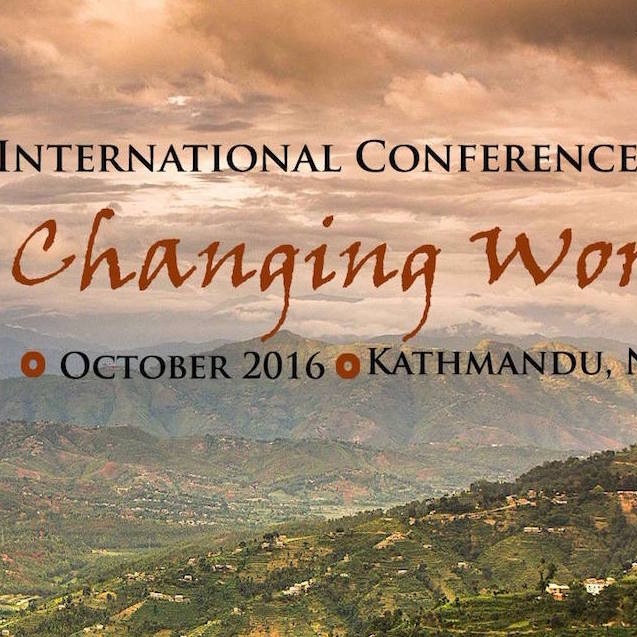

International conference on Mountains in the Changing World
the chair
Dear friends,
On behalf of the organizing committee, it is my pleasure to welcome you to the international conference on "Mountains in the Changing World" (MoChWo).
Mountains are a part of global biodiversity repository and play a vital role in maintaining global ecosystems and supporting millions of people. Unfortunately, they are the most vulnerable to rapid environmental change.
The MoChWo conference will be held in Kathmandu later this year (1-2 Oct). It aims to provide a forum for international/national scholars, researchers, policy maker and students with opportunity to share their research findings and knowledge related to various aspects of mountains (see focus areas in conference website). We are sure that this conference can be an effective and insightful for the benefit of people depending on mountains.
This would be a great opportunity for your to share your findings in Kathmandu, which is known for its long history, ancient cultures and civilizations, Hindu and Buddhist temples, architecture & sculptures. Kathmandu hosts seven UNESCO world heritage sites and is also the gateway of many high Himalayas in Nepal.
Please visit conference site at www.conference.kias.org.np.
See you in Kathmandu!
With regards,
MoChWo Kathmandu 2016 Secretariat
conference@kias.org.np
Conference Chair
.JPG)
Dr. Basant Giri
Scientist
Kathmandu Institute of Applied Sciences
Meet Our Chair
'%3e%3cpath%20d='M12.6647%2010.9104C12.4176%2010.325%2012.0589%209.7933%2011.6088%209.34485C11.16%208.89511%2010.6283%208.53653%2010.0432%208.28891C10.038%208.28629%2010.0327%208.28498%2010.0275%208.28236C10.8437%207.69282%2011.3743%206.73252%2011.3743%205.64907C11.3743%203.85423%209.92005%202.40002%208.12522%202.40002C6.33038%202.40002%204.87618%203.85423%204.87618%205.64907C4.87618%206.73252%205.40677%207.69282%206.22296%208.28367C6.21772%208.28629%206.21248%208.2876%206.20724%208.29022C5.62031%208.53783%205.09365%208.89287%204.64167%209.34616C4.19192%209.79496%203.83334%2010.3266%203.58573%2010.9117C3.34247%2011.4846%203.21128%2012.0987%203.19925%2012.721C3.1989%2012.735%203.20135%2012.7489%203.20646%2012.7619C3.21157%2012.7749%203.21924%2012.7868%203.22901%2012.7968C3.23877%2012.8068%203.25045%2012.8148%203.26334%2012.8202C3.27623%2012.8256%203.29007%2012.8284%203.30406%2012.8284H4.09012C4.14776%2012.8284%204.19362%2012.7825%204.19493%2012.7262C4.22113%2011.7148%204.62726%2010.7676%205.34519%2010.0497C6.08802%209.30686%207.07452%208.89811%208.12522%208.89811C9.17592%208.89811%2010.1624%209.30686%2010.9052%2010.0497C11.6232%2010.7676%2012.0293%2011.7148%2012.0555%2012.7262C12.0568%2012.7839%2012.1027%2012.8284%2012.1603%2012.8284H12.9464C12.9604%2012.8284%2012.9742%2012.8256%2012.9871%2012.8202C13%2012.8148%2013.0117%2012.8068%2013.0214%2012.7968C13.0312%2012.7868%2013.0389%2012.7749%2013.044%2012.7619C13.0491%2012.7489%2013.0515%2012.735%2013.0512%2012.721C13.0381%2012.0947%2012.9084%2011.4856%2012.6647%2010.9104ZM8.12522%207.90243C7.52388%207.90243%206.95792%207.66793%206.53214%207.24215C6.10636%206.81636%205.87185%206.2504%205.87185%205.64907C5.87185%205.04773%206.10636%204.48177%206.53214%204.05599C6.95792%203.63021%207.52388%203.3957%208.12522%203.3957C8.72655%203.3957%209.29252%203.63021%209.7183%204.05599C10.1441%204.48177%2010.3786%205.04773%2010.3786%205.64907C10.3786%206.2504%2010.1441%206.81636%209.7183%207.24215C9.29252%207.66793%208.72655%207.90243%208.12522%207.90243Z'%20fill='%235D1EE1'/%3e%3c/g%3e%3c/svg%3e)
[Not defined];
Important Dates
19 Aug
2016
20 Aug
2016
20 Aug
2016
22 Aug
2016
20 Sep
2016



Mountains are a part of global biodiversity repository and play a vital role in maintaining global ecosystems and supporting millions of people. In the mean time they are the most vulnerable to rapid environmental change.
The international conference on “Mountains in the Changing World” (MoChWo) is organized by the Kathmandu Institute of Applied Sciences (www.kias.org.np). It aims to provide a forum for international/national scholars, researchers, policy maker and students with opportunity to share their research findings and knowledge related to various aspects of mountains (see focus areas below). We are sure that this conference can be an effective and insightful for the benefit of people depending on mountains.
Focus areas: Disasters, resilience, and adaptation; Biodiversity conservation; Climate change; Environmental pollution; Forest management; Soil, water and atmospheric research; Agriculture and agro-ecology; Sustainable livelihood; Policies for mountain resources and livelihood.