
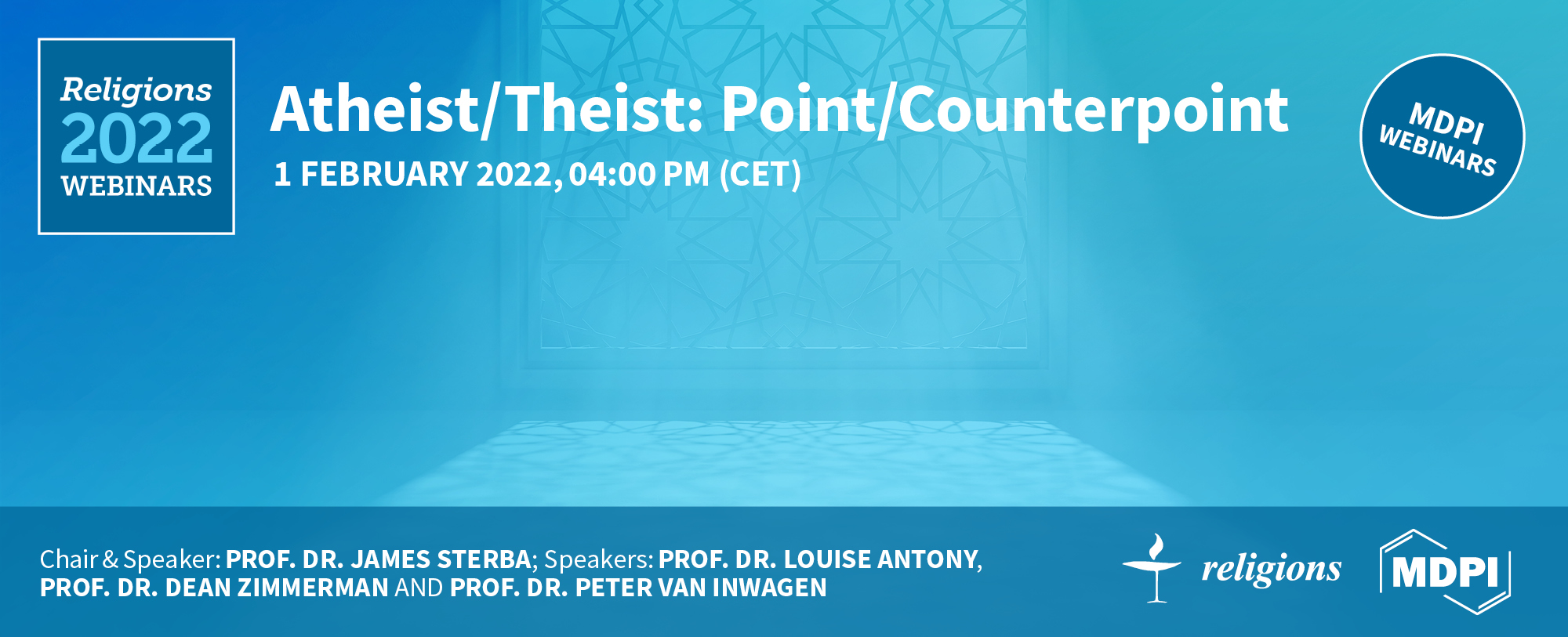
Religions Webinar | Atheist/Theist: Point/Counterpoint
Postponed!
The date of this webinar has been postponed to 1 February 2022 at 4:00 pm CET | 10:00 am EST | 11:00 pm CST Asia. All those who have already registered for the webinar will remain registered. For those of you who cannot make this new date, please still register for it as you will be informed about the recording.
Thank you for your understanding!
The Religions Webinar Secretariat
Meet Our Speaker
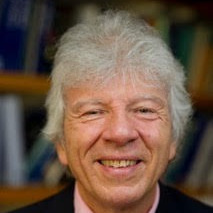
Department of Philosophy, University of Notre Dame, Notre Dame, IN, USA;Jim Sterba teaches graduate and undergraduate courses in ethics and political philosophy at the University of Notre Dame. He has published 35 books, and over 200 articles. And he is past president of the American Philosophical Association, Central Division, the North American Society for Social Philosophy, past president of Concerned Philosophers for Peace, and past president of the International Association for Philosophy of Law and Social Philosophy, American Section. He has been visiting professor of philosophy at the University of Rochester and at the University of Latvia in the then Soviet Union on a Fulbright Award. He has also been visiting distinguished professor of philosophy at the University of San Francisco, the University of California at Irvine, and Santa Clara University. More recently, he has taught at Wuhan University and Peking University. In 2013, he received a grant from the John Templeton Foundation to bring the yet untapped resources of ethics and political Philosophy to bear on the problem of evil. This led the publication of his Is a Good God Logically Possible? in 2019, and to the special issue published this year in Religions devoted to the topic of the book and to another special issue that will come out next year in Religions devoted to the argument of the book.

On Tuesday, 1 February 2022, MDPI and the Journal Religions organized the 1st Webinar on Religions, entitled "Atheist/Theist: Point/Counterpoint”. This online seminar was chaired by Prof. Dr. Jim Sterba from the Department of Philosophy, University of Notre Dame, Notre Dame, IN, USA. The event witnessed two major discussions: the Prof. Dr. Louise Antony/Prof. Dr. Dean Zimmerman Point/Counterpoint and the Prof. Dr. Jim Sterba/Prof. Dr. Peter van Inwagen Point/Counterpoint.
The webinar was offered via Zoom and required registration to attend. The full recording and the summaries of the two discussions can be found below. In order to stay updated on the next webinars on Religions, be sure to sign up for our newsletter by clicking on “Subscribe” at the top of the page.
Summary of the Antony/Zimmerman Point/Counterpoint
Dr. Louise Antony offered penetrating criticisms of “On Perceiving God”, a paper jointly authored by Dr. Zimmerman and Dr. Baker. This programmatic paper was a call for the updating or retooling of William Alston’s program in Perceiving God (1990) — suggesting that it needs input from cognitive scientists studying normal perception. Alston’s project is a conditional one: Supposing there is a God, could it be that experiences in which it seems to the subject that God is present really are perceptions of God, or sufficiently analogous to perception to carry something like the same evidential weight? We wanted to suggest some ways in which the cognitive revolution in psychology, and especially advances in the cognitive scientific study of perception, might support Alston’s construal of at least some religious experiences as perceptual, and as properly playing a perception-like role in the cognitive lives of those who have them.
We (like Alston) offered, not so much an argument from experience to convince sceptics; but rather a response to sceptical worries one might have about the significance of certain religious experiences — experiences that seem, to many of those who have them, to demand that they be treated like perceptions. Subjects sometimes find them as difficult to doubt as the deliverances of their normal senses, at least while they are having these experiences. Louise pointed to several important disanalogies with ordinary sense perception to argue that such trust is improper or undeserved, in light of these differences. Like Alston, we think the differences are not so deep as all that. So we consider some of the disanalogies she pointed out to see how much they should be taken to undermine the hypothesis that some of these experiences really are perceptual.
Summary of the Sterba/van Inwagen Point/Counterpoint
In his “Ten Years in the Making: A Response to van Inwagen’s Defense,” Sterba challenged the examples that Inwagen had used in The Problem of Evil to show that for all we know it is logically possible that the God of traditional theism is justified in permitting all the evil in the world. Sterba argued what Inwagen claimed about these examples was either inconsistent or ignored morally preferable alternatives that did not require permitting especially the horrendous evil consequences at issue. Sterba also showed how his critique of Inwagen fit within his own larger argument that the God of traditional theism is logically incompatible with all the evil, especially all the horrendous evil, in the world. In his response, van Inwagen provided a more abstract defense of the God of traditional theism’s permission of all the evil in the world. Sterba had argued that God’s provision of the opportunity to obtain the Highest Good could not be conditional on his permission of the horrendous consequences of immoral actions otherwise God would not be the all-powerful God of traditional theism. In his response, Inwagen maintained that God could be completely free to offer the Highest Good without permitting the vast amount of evil in the world, but that if God were to do that, it could be the case that no one would accept his offer. Thus, it could be the case that only if God permitted vast amounts of horrendous evil in the world would people actually be willing to accept his offer of the Highest Good. So, van Inwagen maintained that what is at issue is a receiver problem not a sender problem. In discussion, Sterba countered that if God allowed bad people to inflict vast amounts of horrendous evil consequences on good people, there would be a receiver problem but of a different sort. Sterba claimed that God’s permitting bad people to inflict horrendous evil consequences on good people would undercut the freedom of both good and bad people to turn to God and accept his offer of the Highest Good for the right reasons, something the God of traditional theism would require. (Throughout this summary, Sterba has allowed van Inwagen’s term “Highest Good” to be used for his preferred term “friendship with God.”)
Is the God of Traditional Theism Logically Compatible with All the Evil in the World?
Guest Editor: Prof. Dr. James Sterba
Deadline for manuscript submissions: closed (15 February 2021)
Do We Now Have A Logical Argument From Evil?
Guest Editor: Prof. Dr. James Sterba
Deadline for manuscript submissions: 30 September 2022