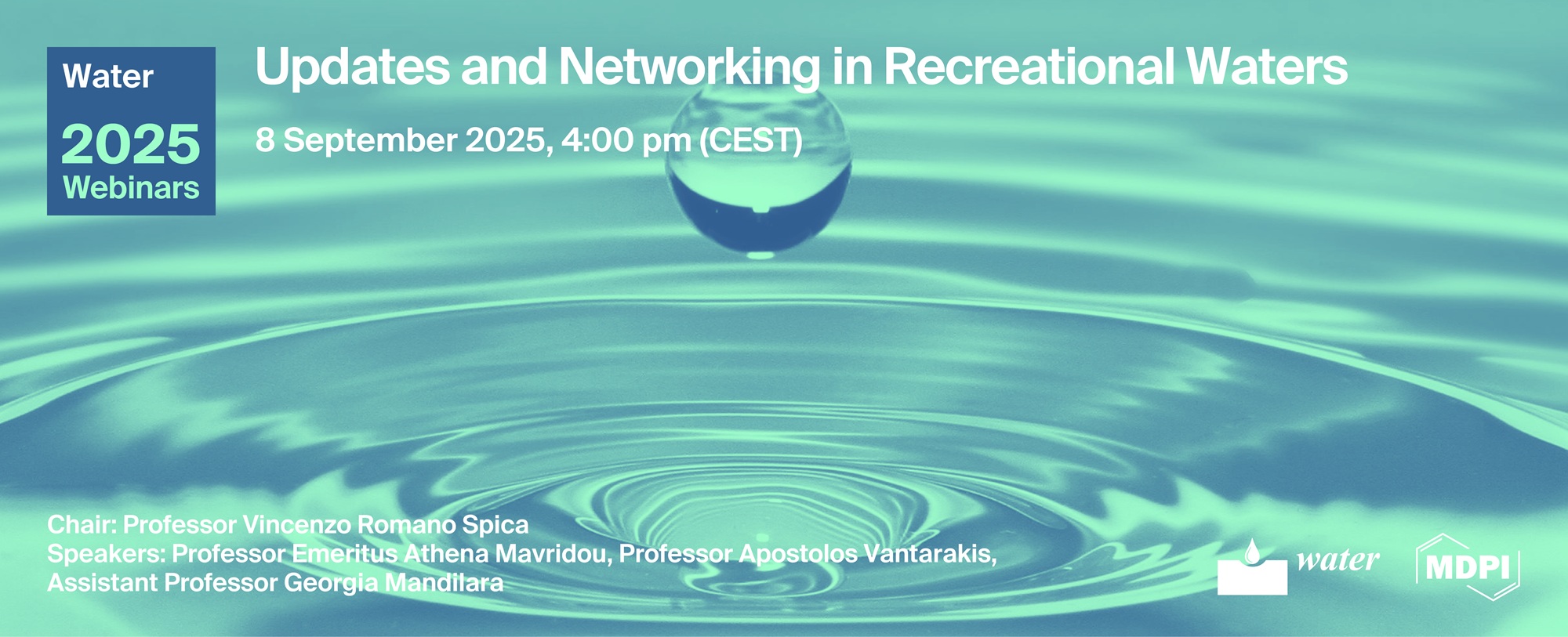
Water Webinar | Updates and Networking in Recreational Waters
the chair
8th Water Webinar
Updates and Networking in Recreational Waters
Dear colleagues,
Welcome to this opportunity to approach recreational waters from different points of view: chemistry, microbiology, physics, engineering, health promotion, prevention or epidemiology.
The Special Issue entitled “Advances in Swimming Pool Hygiene Safety and Spa Research" is available to read at https://www.mdpi.com/journal/water/special_issues/4HK14ALQDC and is currently open for submissions.
In particular, the main focus will be on technical and scientific issues applied to “waters for playing” such as swimming pools, SPAs, aquatic parks, and free waters for sport and physical activities.
The General Topic addresses recreational waters and public health issues in a one-health perspective, anticipating the XI ICSPS, International Conference on Swimming Pools and SPA, that will be held in Athens in October 2025 (https://11icsps.uniwa.gr/). The main subtopics include i) biological risks and emerging pathogens (e.g., Legionella, Protozoa, Microbiota); ii) chemical issues and advancements in monitoring (e.g., dbps, nir, cec); and iii) transversal risks (drowning, physical risks).
The Q&A session will involve contributions from researchers from different countries and speakers at XI ICSPS.
We are looking forward to meeting on the 8th of September at this Water webinar.
Date: 8 September 2025
Time: 4:00PM CEST | 10:00AM EDT | 10:00PM CST (Asia)
Webinar ID: 824 7316 2165
Webinar Secretariat: journal.webinar@mdpi.com
Meet Our Chair
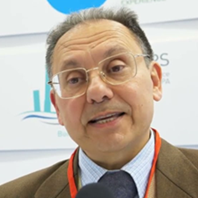
University of Rome “Foro Italico”, Italy.;Vincenzo Romano Spica, MD PhD, has been Full Professor of Public Health at the Department of Movement, Health and Human Sciences, of the University of Rome “Foro Italico”, Rome, Italy, since 2005. He received his MD cum Laude from Medical School “A Gemelli”, Rome, in July 1990. He served as an Assistant Professor at the Institute of Hygiene of the Faculty of Medicine of the Catholic University Medical School from 1994 to 2002. He served as a Fellow at the National Institute of Hygiene, Budapest, Hungary, in 1990, a member of the Laboratory of Molecular Oncology, NCI, USA, from 1991 to 1994, a Visiting Scientist at The Scripps Research Institute, USA, in 1995, a Visiting Scientist at Laboratory Genomic Diversity, NIH, USA, in 1997, an Associate Researcher at The Scripps Research Institute, USA, in 2005. He was a founder/member of a University Spin-off and scientific director of a research start-up. He has worked as Associate Editor for Biotech Ann Rev since 1997, New Biotechnology since 2009, a Guest Editor of a dedicated issue in Molecular Medicine (2012), as Guest Editor for the Microchem Journal on ICSPS (2013) and Water in 2018 (2020 Editor for the One Health Section), and a referee for several indexed international journals. He won the prizes ISRA SITI 2002, ML Profeta 1998, and Prizes SITI 2014. His research interests include recreational water illnesses, recreational waters, disinfection, surveillance, monitoring, hygiene, public health, biotechnology, innovation, swimming pools, spas, and microbiota.
Meet Our Speakers

Biologist, PhD Water Microbiologist, retired from West Attica University.;Athena Mavridou, Professor Emeritus of water microbiology, has taught at undergraduate and post-graduate levels in various universities, and has supervised doctoral dissertations. She has organized training seminars in developing countries as an appointed expert by the W.H.O. She has organized national and international conferences on water quality and public health issues. She has coordinated numerous research projects on the subjects of microbiological quality, analysis methods, the management of drinking and swimming waters, and the safe reuse of treated sewage, and has beed published in international scientific journals. She pioneered Legionella laboratory methods and related building surveillance in Greece. She has worked as a temporary advisor of the UNEP/WHO for the protection of the marine environment. She worked as an expert on the Hellenic Accreditation System (ESYD) and was a member of the Board of the Panhellenic Union of Bioscientists. She is a member of the Academic Committee and a lecturer of the Free Eleusis University In Situ. As an expert and writer for the WHO on issues related to drinking and bathing water quality, she contributed, among other publications, to the WHO Guidelines for Safe Recreational Environments Vol. II: Swimming Pools and Similar Environments. Geneva, 2006 She is an Editor of Water Science & Τechnology, and a reviewer for various international scientific journals. She has published 85 papers in Greek and International scientific journals. She in an author and co-author of textbooks. She has received an award from the Academy of Athens for her scientific work.

Professor in the Public Health Laboratory at the Department of Medicine, University of Patra, Greece.;He was born in Patras. He received his B.Sc in Biology from the University of Patras, Greece, his M.Sc. in Genetic Toxicology from University College Swansea, Wales, UK, and his Ph.D in Public Health from the University of Patras. He was an Assistant Professor at the Department of Medicine of the Democritus University of Thrace, Greece, from June 2004 to May 2008. Ηe was a technical Inspector at the EFET, Ministry of Rural Development. Additionally, he was a Technical Inspector at the Occupational Risk Prevention Center/Labor Inspection of Western Greece. He has supervised over 40 European and 70 Greek research projects. He has supervised research projects on various thematic areas such as public health for vulnerable social groups (e.g. immigrants, Roma, etc.) and environmental health. Also, he has supervised 15 doctoral theses and over 60 diploma theses (at the postgraduate level) and 30 diploma theses (at the undergraduate level). He has published over 170 research papers in peer-reviewed journals, 5 books and 3 Chapters in a foreign language book (Global Water Pathogen Project). He is a member of 10 scientific societies and Assistant Editor in 5 international journals. Also, he is Director at Postgraduate Course in Public Health of Medical School University of Patras, and Director of Postgraduate Course in Epidemiology from Open University of Greece. He is a member of the Bioethics Committee, the Health and Safety Coordinating Committee of the University of Patras, and chairman of the Panhellenic Union of Bioscientists. He was Representative of the Medical schools in the National Committee of Public Health of the Ministry of Health. He is the Director of the Clinical Laboratories Sector, Dept. of Medicine, University of Patras.
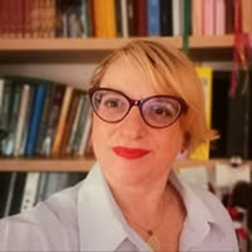
Assistant Professor of Public Health Microbiology, Unit of Environmental Microbiology Laboratory, Faculty of Public Health Policies School of Public Health, University of West Attica.;Dr. Mandilara specializes in the microbiology and surveillance of public health-related pathogens, with a strong focus on foodborne and waterborne infectious diseases. Since 2014, Dr. Mandilara has served as the Scientific Head at the National Reference Centre for Salmonella, Shigella, Listeria, and Verotoxigenic E. coli. In this role, she coordinates surveillance and laboratory testing for these critical pathogens. Her research includes their antimicrobial resistance (AMR), epidemiology, and the development of molecular typing and characterization methods. Notable publications cover the genomic analysis of Salmonella in Greece and the evaluation of Listeria monocytogene growth in food. With a PhD in Environmental Microbiology from the National Technical University of Athens, Dr. Mandilara's work extends to the microbiological quality of water (drinking, recreational, wastewater) and its public health implications. She has managed programs monitoring swimming pool water quality and contributed to research on waterborne infections, also addressing food microbiological quality. Dr. Mandilara has an extensive publication record in international scientific journals and has presented at numerous international and Greek conferences. She is also a respected reviewer for reputable scientific journals, contributing to scientific evaluation. She actively participates in the School of Public Health's educational programs, teaching undergraduate and postgraduate courses in environmental microbiology, laboratory surveillance of foodborne infections, and industrial pollution. She also supervises postgraduate and doctoral theses, guiding emerging public health scientists. Dr. Mandilara maintains a close collaboration with the European Centre for Disease Prevention and Control (ECDC), particularly through her role as Scientific Head at the National Reference Centre, including involvement in the Food and Water-borne Disease Network.


The webinar was hosted via Zoom and required registration to attend. The full recording can be found below. In order to learn about future webinars, you can sign up to our newsletter by clicking “Subscribe” at the top of the page. View the Chair's closing summary below:
Thank you for attending our webinar on pools and recreational water uses! We addressed several scientific, technological and policy issues within a public health framework. It was also a great opportunity to retrace the history of ICSPS, the biennial International Conference on Swimming Pools and SPA and anticipate the main topics of the next "XI ICSPS" that will be held next October in Athens, Greece: https://11icsps.uniwa.gr/.
The webinar highlighted how "recreational waters" (as defined by WHO-guidelines https://www.who.int/teams/environment-climate-change-and-health/water-sanitation-and-health/water-safety-and-quality/recreational-waters), cover hot topics in their management that are common to other kinds of waters (e.g., freshwaters, drinking waters, wastewaters, bathing waters, industrial waters) including surveillance and monitoring, disinfection and prevention, treatments and engineering, education, and One Health implications. Interestingly, environments and pools involving "waters for playing" for wellness, sport or SPA and medicinal or rehabilitation uses can be approached with a more relaxed spirit, allowing a focus on human and environmental health, research, and innovation.
Prof. Mavridou summarized two decades of ICSPS editions hosted in different European Countries, Prof. Vantarakis reported about risk assessment and the contribute of mathematical models to simulated and predict different scenarios in an epidemiological and public health view, while Prof. Mandilara opened a window on future perspectives reporting hot topics in the field, e.g., chemical and microbiological aspects, policy and prevention issues, emerging risks related to disinfection bioproducts or waterborne pathogens, e.g., Legionella and Mycobacteria, briefly anticipating the structure of next XI ICSPS. In the Q&A section, several reports allowed to obtain scientific questions approaching new technologies for water monitoring, surveillance, disinfection, and water treatments, outlining studies by colleagues from European and USA research centers or health authorities.
We invite you to join XI ICSPS and contribute your studies to the Special Issue dedicated to "Advances in Swimming Pool Hygiene, Safety and SPA Research": https://www.mdpi.com/journal/water/special_issues/4HK14ALQDC.
Advances in Swimming Pool Hygiene Safety and Spa Research
Special Issue Editors: Prof. Vincenzo Romano Spica, Prof. Emeritus Athena Mavridou, and Assistant Prof. Georgia Mandilara
Deadline for manuscript submissions: 31 December 2025