Event submissions
Published
 10.3390/IECAG2021-10022 (registering DOI)
 This submission belongs to the session S2. Sustainable Management Practices for Soil Health and Food Security of the event The 1st International Electronic Conference on Agronomy
Published date
11 May, 2021
Citation
Edoardo Antonio Costantino Costantini, Ana Marta Paz, Esperanza Amezketa, Loredana Canfora, Nadia Castanheira, Gloria Falsone, Maria Gonçalves, Biser Hristov, Marcello Mastrorilli, Tiago Ramos, Salt-affected soils at the farm scale: successful experiences and innovation needs, in Proceedings of The 1st International Electronic Conference on Agronomy, 3 May–17 May 2021, MDPI: Basel, Switzerland, doi: 10.3390/IECAG2021-10022
Share
Email
Facebook
Twitter
LinkedIn
Salt-affected soils at the farm scale: successful experiences and innovation needs

Edoardo Antonio Costantino Costantini 1
'%3e%3cpath%20d='M12.6647%2010.9104C12.4176%2010.325%2012.0589%209.7933%2011.6088%209.34485C11.16%208.89511%2010.6283%208.53653%2010.0432%208.28891C10.038%208.28629%2010.0327%208.28498%2010.0275%208.28236C10.8437%207.69282%2011.3743%206.73252%2011.3743%205.64907C11.3743%203.85423%209.92005%202.40002%208.12522%202.40002C6.33038%202.40002%204.87618%203.85423%204.87618%205.64907C4.87618%206.73252%205.40677%207.69282%206.22296%208.28367C6.21772%208.28629%206.21248%208.2876%206.20724%208.29022C5.62031%208.53783%205.09365%208.89287%204.64167%209.34616C4.19192%209.79496%203.83334%2010.3266%203.58573%2010.9117C3.34247%2011.4846%203.21128%2012.0987%203.19925%2012.721C3.1989%2012.735%203.20135%2012.7489%203.20646%2012.7619C3.21157%2012.7749%203.21924%2012.7868%203.22901%2012.7968C3.23877%2012.8068%203.25045%2012.8148%203.26334%2012.8202C3.27623%2012.8256%203.29007%2012.8284%203.30406%2012.8284H4.09012C4.14776%2012.8284%204.19362%2012.7825%204.19493%2012.7262C4.22113%2011.7148%204.62726%2010.7676%205.34519%2010.0497C6.08802%209.30686%207.07452%208.89811%208.12522%208.89811C9.17592%208.89811%2010.1624%209.30686%2010.9052%2010.0497C11.6232%2010.7676%2012.0293%2011.7148%2012.0555%2012.7262C12.0568%2012.7839%2012.1027%2012.8284%2012.1603%2012.8284H12.9464C12.9604%2012.8284%2012.9742%2012.8256%2012.9871%2012.8202C13%2012.8148%2013.0117%2012.8068%2013.0214%2012.7968C13.0312%2012.7868%2013.0389%2012.7749%2013.044%2012.7619C13.0491%2012.7489%2013.0515%2012.735%2013.0512%2012.721C13.0381%2012.0947%2012.9084%2011.4856%2012.6647%2010.9104ZM8.12522%207.90243C7.52388%207.90243%206.95792%207.66793%206.53214%207.24215C6.10636%206.81636%205.87185%206.2504%205.87185%205.64907C5.87185%205.04773%206.10636%204.48177%206.53214%204.05599C6.95792%203.63021%207.52388%203.3957%208.12522%203.3957C8.72655%203.3957%209.29252%203.63021%209.7183%204.05599C10.1441%204.48177%2010.3786%205.04773%2010.3786%205.64907C10.3786%206.2504%2010.1441%206.81636%209.7183%207.24215C9.29252%207.66793%208.72655%207.90243%208.12522%207.90243Z'%20fill='%235D1EE1'/%3e%3c/g%3e%3c/svg%3e)
Ana Marta Paz 2
Esperanza Amezketa 3
Loredana Canfora 4

Nadia Castanheira 2
Gloria Falsone 5
Maria Gonçalves 2
Biser Hristov 6
Marcello Mastrorilli 7
Tiago Ramos 8
1. International Union of Soil Sciences, European Society for Soil Conservation, via Mameli 21, Sesto Fiorentino (FI) 50019 (Italy)
2. INIAV I.P., Quinta do Marquês 2780-157 Oeiras Portugal
3. Tracasa, C/Cabárceno, 6, 31621, Sarriguren, Navarra, Spain
4. Consiglio per la ricerca in agricoltura e l’analisi dell’economia agraria. Centro di Ricerca Agricoltura e Ambiente Via della Navicella 2-4, 00184 Roma (Italy)
5. Department of Agricultural and Food Sciences, Alma Mater Studiorum - University of Bologna, Via Fanin, 40, 40127, Bologna, Italy
6. University of Forestry, 10 Kl. Ohridski Blvd., Sofia 1797, Bulgaria.
7. Consiglio per la ricerca in agricoltura e l’analisi dell’economia agraria. Centro di Ricerca Agricoltura e Ambiente Via Celso Ulpiani, 70125 Bari (Italy)
8. Centro de Ciência e Tecnologia do Ambiente e do Mar (MARETEC-LARSyS), Instituto Superior Técnico, University of Lisbon, Av. Rovisco Pais, 1, 1049-001 Lisbon, Portugal.
Abstract
Climate change, land use and management malpractices are increasing the areas of salt-affected soils, threatening soil health and the economical sustainability of farms. Salt-affected soils are mainly characterized by an excess of soluble salts, in which case they are classified as saline, or by an excess of sodium ions, sodic soils, or a combination of these conditions. Causes and processes are manifold and variable in space and time. There is the need to continuously update strategies to tackle salt-affected soils, finding solutions tailored at different scales.
In this paper we present existing case studies to prevent, reduce, or adapt to soil salinity at the farm level, identifying their sustainability and innovation potential. The reviewed case studies show the prevention of soil salinity and sodicity by leaching, scheduled irrigation to avoid the rise of groundwater table, and cycling irrigation for allowing the use of brackish waters, where freshwater is a scarce resource. The remediation of sodicity by making calcium available for exchange with the sodium in the soil’s exchange complex, either by the use of chemical amendments such as gypsum or phytoremediation and bioremediation, in which plant growth increases CO2 in the root zone, leading to the dissolution of calcite, a process that can be further enhanced by the activity of microorganisms. Finally, adaptation cases are presented involving agronomical practices, such as plant selection, crop rotation, nutrient management and microbial management, as well as cases where the land-use changes were the chosen option for maintaining the soil’s health and its vital functions.
The reviewed cases show the successful application of innovative practices, but also point out the need for further research and innovation projects to counter salt-affected soils, particularly in the fields of irrigation and crop management, phyto and bioremediation, and microbial ecology of saline soils.
Keywords
soil salinity
prevention
remediation
adaptation
farm level
case studies
Manuscript
sciforum-043884.pdf
Poster
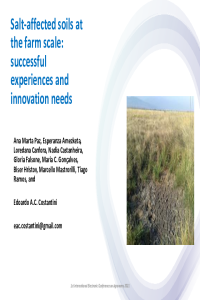
Agronomy_2021_Costantini-salinity.pdf
Using apparent soil electrical conductivity (ECap) and remote sensing to delineate soil sampling for precision fertilization in a vineyard
Spatial prediction of the properties of chernozem soils on a field scale using machine learning methods based on data from Landsat 8 OLI and Sentinel 2 images for precision farming