Event submissions
Published

This submission belongs to the session S2. Corrosion in Concrete and Porous Media of the event 1st Corrosion and Materials Degradation Web Conference
Published date
14 May, 2021
Citation
Marija Kušter Marić, Joško Ožbolt, Gojko Balabanić, Ivona Pavlica, Evaluation of chloride-ingress models on concrete bridge exposed to deicing salts, in Proceedings of 1st Corrosion and Materials Degradation Web Conference, 17 May–19 May 2021, MDPI: Basel, Switzerland, doi: 10.3390/CMDWC2021-10046
Share
Email
Facebook
Twitter
LinkedIn
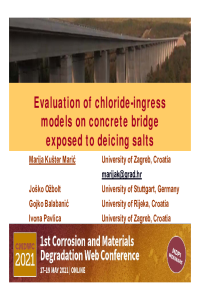
Evaluation of chloride-ingress models on concrete bridge exposed to deicing salts

Marija Kušter Marić 1
'%3e%3cpath%20d='M12.6647%2010.9104C12.4176%2010.325%2012.0589%209.7933%2011.6088%209.34485C11.16%208.89511%2010.6283%208.53653%2010.0432%208.28891C10.038%208.28629%2010.0327%208.28498%2010.0275%208.28236C10.8437%207.69282%2011.3743%206.73252%2011.3743%205.64907C11.3743%203.85423%209.92005%202.40002%208.12522%202.40002C6.33038%202.40002%204.87618%203.85423%204.87618%205.64907C4.87618%206.73252%205.40677%207.69282%206.22296%208.28367C6.21772%208.28629%206.21248%208.2876%206.20724%208.29022C5.62031%208.53783%205.09365%208.89287%204.64167%209.34616C4.19192%209.79496%203.83334%2010.3266%203.58573%2010.9117C3.34247%2011.4846%203.21128%2012.0987%203.19925%2012.721C3.1989%2012.735%203.20135%2012.7489%203.20646%2012.7619C3.21157%2012.7749%203.21924%2012.7868%203.22901%2012.7968C3.23877%2012.8068%203.25045%2012.8148%203.26334%2012.8202C3.27623%2012.8256%203.29007%2012.8284%203.30406%2012.8284H4.09012C4.14776%2012.8284%204.19362%2012.7825%204.19493%2012.7262C4.22113%2011.7148%204.62726%2010.7676%205.34519%2010.0497C6.08802%209.30686%207.07452%208.89811%208.12522%208.89811C9.17592%208.89811%2010.1624%209.30686%2010.9052%2010.0497C11.6232%2010.7676%2012.0293%2011.7148%2012.0555%2012.7262C12.0568%2012.7839%2012.1027%2012.8284%2012.1603%2012.8284H12.9464C12.9604%2012.8284%2012.9742%2012.8256%2012.9871%2012.8202C13%2012.8148%2013.0117%2012.8068%2013.0214%2012.7968C13.0312%2012.7868%2013.0389%2012.7749%2013.044%2012.7619C13.0491%2012.7489%2013.0515%2012.735%2013.0512%2012.721C13.0381%2012.0947%2012.9084%2011.4856%2012.6647%2010.9104ZM8.12522%207.90243C7.52388%207.90243%206.95792%207.66793%206.53214%207.24215C6.10636%206.81636%205.87185%206.2504%205.87185%205.64907C5.87185%205.04773%206.10636%204.48177%206.53214%204.05599C6.95792%203.63021%207.52388%203.3957%208.12522%203.3957C8.72655%203.3957%209.29252%203.63021%209.7183%204.05599C10.1441%204.48177%2010.3786%205.04773%2010.3786%205.64907C10.3786%206.2504%2010.1441%206.81636%209.7183%207.24215C9.29252%207.66793%208.72655%207.90243%208.12522%207.90243Z'%20fill='%235D1EE1'/%3e%3c/g%3e%3c/svg%3e)
Joško Ožbolt 2
Gojko Balabanić 3
Ivona Pavlica 1
1. University of Zagreb Faculty of Civil Engineering
2. University of Stuttgart
3. University of Rijeka
Abstract
Numerical models for chloride transport in concrete have been improved in the last four decades, however, their application to existing structures is still not at a satisfactory level. While simple models have many limitations that cannot be applied to existing structures in a real environment, more comprehensive models for service life prediction are not suitable for everyday engineering practice. Two chloride ingress models, a more comprehensive 3D chemo-hygro-thermo mechanical (CHTM) model implemented into the MASA software and well-known Life-365, are used for a case study: motorway bridge in the mountain region in Croatia. Both models are capable to predict the chloride content in concrete and match well with measured data on the bridge after 11 and 14 years of exposure to deicing salts. However, calibration with measured results led to higher values of surface chloride content and initial chloride diffusion coefficient for numerical analyses using the Life-365, which assumes that the concrete is uncracked and the surface chloride content is constant. On the other hand, the 3D CHTM model considers more realistic conditions: variable temperature, surface water and chloride contents, wetting and drying cycles, chloride diffusion and convection in cracked and un-cracked concrete. Consequently, input values for chloride diffusivity and surface chloride content do not require calibration for each chloride profile, as is the case for the Life-365 application.
Keywords
chloride diffusion
numerical model
concrete bridge
wetting-draying cycles
crack
numerical analysis
chloride content
de-icing salts.
Manuscript
sciforum-045003.pdf
Poster
KusterMaricEtAl.pdf
Corrosion resistance of aluminium against salt hydrates used for latent heat storage by using different coating materials
Passive film evolution over 2.5 years of lean-duplex stainless steel reinforcements embedded in mortar containing chlorides