Event submissions
Published

This submission belongs to the session S1. Mechanism and Predictive/Deterministic Aspects of Corrosion of the event 1st Corrosion and Materials Degradation Web Conference
Published date
14 May, 2021
Citation
Ebenezer O. Fanijo, Alexander S Brand, Initiation of chloride-induced corrosion of low carbon steel rebar in concrete using in-situ quantitative phase microscopy, in Proceedings of 1st Corrosion and Materials Degradation Web Conference, 17 May–19 May 2021, MDPI: Basel, Switzerland, doi: 10.3390/CMDWC2021-10050
Share
Email
Facebook
Twitter
LinkedIn
Initiation of chloride-induced corrosion of low carbon steel rebar in concrete using in-situ quantitative phase microscopy
'%3e%3cpath%20d='M12.6647%2010.9104C12.4176%2010.325%2012.0589%209.7933%2011.6088%209.34485C11.16%208.89511%2010.6283%208.53653%2010.0432%208.28891C10.038%208.28629%2010.0327%208.28498%2010.0275%208.28236C10.8437%207.69282%2011.3743%206.73252%2011.3743%205.64907C11.3743%203.85423%209.92005%202.40002%208.12522%202.40002C6.33038%202.40002%204.87618%203.85423%204.87618%205.64907C4.87618%206.73252%205.40677%207.69282%206.22296%208.28367C6.21772%208.28629%206.21248%208.2876%206.20724%208.29022C5.62031%208.53783%205.09365%208.89287%204.64167%209.34616C4.19192%209.79496%203.83334%2010.3266%203.58573%2010.9117C3.34247%2011.4846%203.21128%2012.0987%203.19925%2012.721C3.1989%2012.735%203.20135%2012.7489%203.20646%2012.7619C3.21157%2012.7749%203.21924%2012.7868%203.22901%2012.7968C3.23877%2012.8068%203.25045%2012.8148%203.26334%2012.8202C3.27623%2012.8256%203.29007%2012.8284%203.30406%2012.8284H4.09012C4.14776%2012.8284%204.19362%2012.7825%204.19493%2012.7262C4.22113%2011.7148%204.62726%2010.7676%205.34519%2010.0497C6.08802%209.30686%207.07452%208.89811%208.12522%208.89811C9.17592%208.89811%2010.1624%209.30686%2010.9052%2010.0497C11.6232%2010.7676%2012.0293%2011.7148%2012.0555%2012.7262C12.0568%2012.7839%2012.1027%2012.8284%2012.1603%2012.8284H12.9464C12.9604%2012.8284%2012.9742%2012.8256%2012.9871%2012.8202C13%2012.8148%2013.0117%2012.8068%2013.0214%2012.7968C13.0312%2012.7868%2013.0389%2012.7749%2013.044%2012.7619C13.0491%2012.7489%2013.0515%2012.735%2013.0512%2012.721C13.0381%2012.0947%2012.9084%2011.4856%2012.6647%2010.9104ZM8.12522%207.90243C7.52388%207.90243%206.95792%207.66793%206.53214%207.24215C6.10636%206.81636%205.87185%206.2504%205.87185%205.64907C5.87185%205.04773%206.10636%204.48177%206.53214%204.05599C6.95792%203.63021%207.52388%203.3957%208.12522%203.3957C8.72655%203.3957%209.29252%203.63021%209.7183%204.05599C10.1441%204.48177%2010.3786%205.04773%2010.3786%205.64907C10.3786%206.2504%2010.1441%206.81636%209.7183%207.24215C9.29252%207.66793%208.72655%207.90243%208.12522%207.90243Z'%20fill='%235D1EE1'/%3e%3c/g%3e%3c/svg%3e)
Ebenezer O. Fanijo 1

Alexander S Brand 1
1. Virginia Tech
Abstract
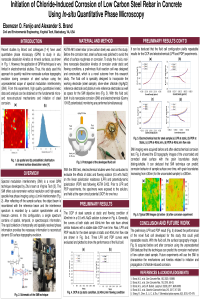
Corrosion-related degradation is a major durability challenge and incurs a significant cost to civil infrastructure and society. Of crucial concern is chloride-induced corrosion of low carbon steel rebar in concrete structures. An estimated 70 to 90% of premature failures in concrete structures are caused by corrosion. From reviewing the state-of-the-art, civil engineers, materials scientists, physical metallurgists, and chemists have made considerable advancements towards understanding corrosion of steel in concrete, but many questions are still open in the understanding of chloride-induced corrosion initiation. For instance, the empirical critical chloride content for corrosion to initiate has been reported to range from 0.04% to 8.34% total chloride by weight of cement, which demonstrates the variability from research. Indeed, this range may also suggest the chloride-induced corrosion is influenced by several factors, thereby necessitating the research need to define the fundamental kinetic rate laws and mechanisms. To deal with these knowledge gaps, research around the globe is recently orienting towards methods that evaluate the corrosion kinetics and mechanisms of steel in concrete at meso-, micro-, and nanoscale. Therefore, this study presents a novel multi-dimensional experimental technique to study in situ corrosion at the nanoscale. The unprecedented scope of this study uses spectral modulation interferometry (SMI), an advanced quantitative phase microscopy technique, for real-time quantification of nanoscale surface topography evolution during corrosion to evaluate the temporally- and spatially-heterogeneous dissolution rates on a polished ASTM A615 steel surface. With a novel additive-manufactured fluid cell, experiments are performed in situ with flowing solution conditions to promote surface-controlled kinetics. Using inductively coupled plasma mass spectrometry (ICP-MS), the elemental analysis of aliquots of outflow solution from the fluid cell is evaluated, providing simultaneous, time-resolved detection and quantitative concentration measurement of the dissolved elements. Furthermore, the steel sample is connected to a potentiostat for electrochemical monitoring, allowing for a third corrosion measurement by polarization resistance. The in situ nanoscale approach of corrosion monitoring directly quantify the kinetics of corrosion, even at low chloride concentrations. Also, the integration of these techniques provide detailed quantitative and qualitative data on the corrosion mechanism and corrosion rate of ASTM A615 steel reinforcement, bringing solutions to many questions raised from the literature.
Keywords
Chloride-Induced Corrosion
SMI
Steel rebar
In situ
Corrosion Initiation
Manuscript
sciforum-045240.pdf
Poster
CMDWC2021_Poster_EF and AB.pdf
Unveiling the self-healing effect of cerium ions in PMMA-silica coatings on AA7075: a comparative study of Ce(III) and Ce(IV)
Characterization of zinc phosphate coatings: influence of the pH and temperature in
morphology and corrosion resistance
morphology and corrosion resistance