Event submissions
Published
 10.3390/I3S2021Dresden-10075 (registering DOI)
 This submission belongs to the session S6 - Special session. Flexible and Stretchable Sensors of the event 8th International Symposium on Sensor Science
Published date
17 May, 2021
Citation
Wenbo Xin, Rong Yang, Weichen Fang, Xiao Zuo, Igor M. De Rosa, Flexible SERS Sensors based on Carbon Nanomaterials-Supported Au Nanostructures, in Proceedings of 8th International Symposium on Sensor Science, 17 May–28 May 2021, MDPI: Basel, Switzerland, doi: 10.3390/I3S2021Dresden-10075
Share
Email
Facebook
Twitter
LinkedIn
Flexible SERS Sensors based on Carbon Nanomaterials-Supported Au Nanostructures
'%3e%3cpath%20d='M12.6647%2010.9104C12.4176%2010.325%2012.0589%209.7933%2011.6088%209.34485C11.16%208.89511%2010.6283%208.53653%2010.0432%208.28891C10.038%208.28629%2010.0327%208.28498%2010.0275%208.28236C10.8437%207.69282%2011.3743%206.73252%2011.3743%205.64907C11.3743%203.85423%209.92005%202.40002%208.12522%202.40002C6.33038%202.40002%204.87618%203.85423%204.87618%205.64907C4.87618%206.73252%205.40677%207.69282%206.22296%208.28367C6.21772%208.28629%206.21248%208.2876%206.20724%208.29022C5.62031%208.53783%205.09365%208.89287%204.64167%209.34616C4.19192%209.79496%203.83334%2010.3266%203.58573%2010.9117C3.34247%2011.4846%203.21128%2012.0987%203.19925%2012.721C3.1989%2012.735%203.20135%2012.7489%203.20646%2012.7619C3.21157%2012.7749%203.21924%2012.7868%203.22901%2012.7968C3.23877%2012.8068%203.25045%2012.8148%203.26334%2012.8202C3.27623%2012.8256%203.29007%2012.8284%203.30406%2012.8284H4.09012C4.14776%2012.8284%204.19362%2012.7825%204.19493%2012.7262C4.22113%2011.7148%204.62726%2010.7676%205.34519%2010.0497C6.08802%209.30686%207.07452%208.89811%208.12522%208.89811C9.17592%208.89811%2010.1624%209.30686%2010.9052%2010.0497C11.6232%2010.7676%2012.0293%2011.7148%2012.0555%2012.7262C12.0568%2012.7839%2012.1027%2012.8284%2012.1603%2012.8284H12.9464C12.9604%2012.8284%2012.9742%2012.8256%2012.9871%2012.8202C13%2012.8148%2013.0117%2012.8068%2013.0214%2012.7968C13.0312%2012.7868%2013.0389%2012.7749%2013.044%2012.7619C13.0491%2012.7489%2013.0515%2012.735%2013.0512%2012.721C13.0381%2012.0947%2012.9084%2011.4856%2012.6647%2010.9104ZM8.12522%207.90243C7.52388%207.90243%206.95792%207.66793%206.53214%207.24215C6.10636%206.81636%205.87185%206.2504%205.87185%205.64907C5.87185%205.04773%206.10636%204.48177%206.53214%204.05599C6.95792%203.63021%207.52388%203.3957%208.12522%203.3957C8.72655%203.3957%209.29252%203.63021%209.7183%204.05599C10.1441%204.48177%2010.3786%205.04773%2010.3786%205.64907C10.3786%206.2504%2010.1441%206.81636%209.7183%207.24215C9.29252%207.66793%208.72655%207.90243%208.12522%207.90243Z'%20fill='%235D1EE1'/%3e%3c/g%3e%3c/svg%3e)
Wenbo Xin 1,2
Rong Yang 1
Weichen Fang 1
Xiao Zuo 1

Igor M. De Rosa 2
1. College of Materials Science and Engineering, Nanjing Tech University, Nanjing 211816, China
2. Department of Materials Science and Engineering, University of California, Los Angeles, CA 90095, USA
Abstract
Surface-enhanced Raman scattering (SERS) is a powerful technique to detect analytes in a label-free and non-destructive way at extremely low concentrations, even down to the single-molecule level. In the present study, a series of anisotropic Au nanostructures are integrated onto the platforms of carbon nanomaterials, mainly carbon nanotubes (CNT) and graphene, in order to fabricate high-performance flexible SERS sensors. Sizes, dimensions and shapes of Au nanostructures can be well controlled through this strategy, based on which Au nanowires, nanoribbons, nanoplates, nanobelts, and nanoframes are successfully deposited onto CNT and graphene templates, respectively. Significantly enhanced plasmonic activity originates from these Au nanocrystals, which provide increased SERS signals of the analytes by many orders of magnitude, while CNT films or graphene substrates offer the superior flexibility and accessibility. For instance, A flexible SERS sensor made of graphene supported Au nanoframes can detect the analyte R6G at the concentration as low as 10-9 M. The mechanism for the sensitivity enhancement could be attributed to the homogenous distribution of Au nanoframes on the graphene support as well as the strong molecule adsorption to the graphene nanoporous network.
Keywords
flexible SERS sensors
carbon nanomaterials
au nanostructures
graphene
Manuscript
sciforum-043265.pdf
Poster
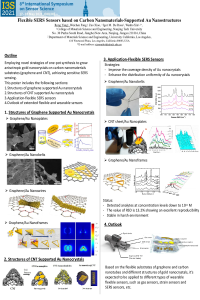
sciforum - 043265-Flexible SERS Sensors based on Carbon Nanomaterials-Supported Au Nanostructures.pdf
Multiple Camera Fluorescence Detection for Real Time PCR
LATE-PCR for LoC molecular diagnostics devices and its application to the sensitive detection of SARS-CoV-2