Event submissions
Published
 10.3390/I3S2021Dresden-10076 (registering DOI)
 This submission belongs to the session S1. Nano(bio)Sensors and Bioelectronics of the event 8th International Symposium on Sensor Science
Published date
17 May, 2021
Citation
DIMITRIS KARADIMAS, GEORGE TSEKENIS, LATE-PCR for LoC molecular diagnostics devices and its application to the sensitive detection of SARS-CoV-2, in Proceedings of 8th International Symposium on Sensor Science, 17 May–28 May 2021, MDPI: Basel, Switzerland, doi: 10.3390/I3S2021Dresden-10076
Share
Email
Facebook
Twitter
LinkedIn
LATE-PCR for LoC molecular diagnostics devices and its application to the sensitive detection of SARS-CoV-2
'%3e%3cpath%20d='M12.6647%2010.9104C12.4176%2010.325%2012.0589%209.7933%2011.6088%209.34485C11.16%208.89511%2010.6283%208.53653%2010.0432%208.28891C10.038%208.28629%2010.0327%208.28498%2010.0275%208.28236C10.8437%207.69282%2011.3743%206.73252%2011.3743%205.64907C11.3743%203.85423%209.92005%202.40002%208.12522%202.40002C6.33038%202.40002%204.87618%203.85423%204.87618%205.64907C4.87618%206.73252%205.40677%207.69282%206.22296%208.28367C6.21772%208.28629%206.21248%208.2876%206.20724%208.29022C5.62031%208.53783%205.09365%208.89287%204.64167%209.34616C4.19192%209.79496%203.83334%2010.3266%203.58573%2010.9117C3.34247%2011.4846%203.21128%2012.0987%203.19925%2012.721C3.1989%2012.735%203.20135%2012.7489%203.20646%2012.7619C3.21157%2012.7749%203.21924%2012.7868%203.22901%2012.7968C3.23877%2012.8068%203.25045%2012.8148%203.26334%2012.8202C3.27623%2012.8256%203.29007%2012.8284%203.30406%2012.8284H4.09012C4.14776%2012.8284%204.19362%2012.7825%204.19493%2012.7262C4.22113%2011.7148%204.62726%2010.7676%205.34519%2010.0497C6.08802%209.30686%207.07452%208.89811%208.12522%208.89811C9.17592%208.89811%2010.1624%209.30686%2010.9052%2010.0497C11.6232%2010.7676%2012.0293%2011.7148%2012.0555%2012.7262C12.0568%2012.7839%2012.1027%2012.8284%2012.1603%2012.8284H12.9464C12.9604%2012.8284%2012.9742%2012.8256%2012.9871%2012.8202C13%2012.8148%2013.0117%2012.8068%2013.0214%2012.7968C13.0312%2012.7868%2013.0389%2012.7749%2013.044%2012.7619C13.0491%2012.7489%2013.0515%2012.735%2013.0512%2012.721C13.0381%2012.0947%2012.9084%2011.4856%2012.6647%2010.9104ZM8.12522%207.90243C7.52388%207.90243%206.95792%207.66793%206.53214%207.24215C6.10636%206.81636%205.87185%206.2504%205.87185%205.64907C5.87185%205.04773%206.10636%204.48177%206.53214%204.05599C6.95792%203.63021%207.52388%203.3957%208.12522%203.3957C8.72655%203.3957%209.29252%203.63021%209.7183%204.05599C10.1441%204.48177%2010.3786%205.04773%2010.3786%205.64907C10.3786%206.2504%2010.1441%206.81636%209.7183%207.24215C9.29252%207.66793%208.72655%207.90243%208.12522%207.90243Z'%20fill='%235D1EE1'/%3e%3c/g%3e%3c/svg%3e)
DIMITRIS KARADIMAS 1

GEORGE TSEKENIS 1
1. Biomedical Research Foundation of the Academy of Athens, Athens 115 27, Greece
Abstract
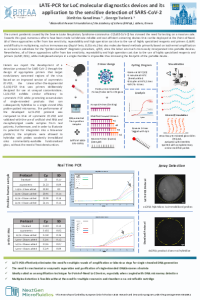
The emergence of the novel coronavirus, SARS-CoV-2, has highlighted the need for rapid, accurate, and point-of-care diagnostic testing. Lab-on-a-Chip (LoC) devices offer the possibility to run such tests at a low cost while at the same time permitting the multiplexed detection of several viruses when coupled with microarray detection of the amplified products. Herein, we report the development of a protocol for the qualitative detection of SARS-CoV-2 through the design of appropriate primers that target evolutionary conserved regions of the virus. The proposed protocol relies on .an improved version of asymmetric RT-PCR, the Linear-After-The-Exponential (LATE)-PCR that uses primers that are deliberately designed for use at unequal concentrations. As a result, LATE-PCR exhibits similar efficiency to symmetric PCR while promoting accumulation of single-stranded products that can subsequently hybridize to a single strand DNA probe-spotted microarray. The performance of the developed LATE-PCR protocol was compared to that of symmetric RT-PCR and validated with the use of artificial viral RNA and nasopharyngeal swabs samples from real patients. Furthermore, and in order to illustrate its potential for integration into a biosensor platform, the amplicons were allowed to hybridize with probes covalently immobilized onto commercially-available functionalized glass, without the need of heat denaturation.
Keywords
SARS-CoV-2
asymmetric PCR
LATE PCR
microarray detection
molecular diagnostics
Manuscript
sciforum-043260.pdf
Poster
sciforum-043260 Poster.pdf
Flexible SERS Sensors based on Carbon Nanomaterials-Supported Au Nanostructures
Development of enzymatic biosensors to detect biocides disinfectants to strengthen self-monitoring in industry