Event submissions
Published
 10.3390/I3S2021Dresden-10083 (registering DOI)
 This submission belongs to the session S4. Sensor Applications and Smart Systems of the event 8th International Symposium on Sensor Science
Published date
17 May, 2021
Citation
Tayssir Limam, Florian Vogl, William R. Taylor, Small Force Sensor to Measure the Three Components of the Ground Reaction Forces in Mice, in Proceedings of 8th International Symposium on Sensor Science, 17 May–28 May 2021, MDPI: Basel, Switzerland, doi: 10.3390/I3S2021Dresden-10083
Share
Email
Facebook
Twitter
LinkedIn
Small Force Sensor to Measure the Three Components of the Ground Reaction Forces in Mice

Tayssir Limam 1
'%3e%3cpath%20d='M12.6647%2010.9104C12.4176%2010.325%2012.0589%209.7933%2011.6088%209.34485C11.16%208.89511%2010.6283%208.53653%2010.0432%208.28891C10.038%208.28629%2010.0327%208.28498%2010.0275%208.28236C10.8437%207.69282%2011.3743%206.73252%2011.3743%205.64907C11.3743%203.85423%209.92005%202.40002%208.12522%202.40002C6.33038%202.40002%204.87618%203.85423%204.87618%205.64907C4.87618%206.73252%205.40677%207.69282%206.22296%208.28367C6.21772%208.28629%206.21248%208.2876%206.20724%208.29022C5.62031%208.53783%205.09365%208.89287%204.64167%209.34616C4.19192%209.79496%203.83334%2010.3266%203.58573%2010.9117C3.34247%2011.4846%203.21128%2012.0987%203.19925%2012.721C3.1989%2012.735%203.20135%2012.7489%203.20646%2012.7619C3.21157%2012.7749%203.21924%2012.7868%203.22901%2012.7968C3.23877%2012.8068%203.25045%2012.8148%203.26334%2012.8202C3.27623%2012.8256%203.29007%2012.8284%203.30406%2012.8284H4.09012C4.14776%2012.8284%204.19362%2012.7825%204.19493%2012.7262C4.22113%2011.7148%204.62726%2010.7676%205.34519%2010.0497C6.08802%209.30686%207.07452%208.89811%208.12522%208.89811C9.17592%208.89811%2010.1624%209.30686%2010.9052%2010.0497C11.6232%2010.7676%2012.0293%2011.7148%2012.0555%2012.7262C12.0568%2012.7839%2012.1027%2012.8284%2012.1603%2012.8284H12.9464C12.9604%2012.8284%2012.9742%2012.8256%2012.9871%2012.8202C13%2012.8148%2013.0117%2012.8068%2013.0214%2012.7968C13.0312%2012.7868%2013.0389%2012.7749%2013.044%2012.7619C13.0491%2012.7489%2013.0515%2012.735%2013.0512%2012.721C13.0381%2012.0947%2012.9084%2011.4856%2012.6647%2010.9104ZM8.12522%207.90243C7.52388%207.90243%206.95792%207.66793%206.53214%207.24215C6.10636%206.81636%205.87185%206.2504%205.87185%205.64907C5.87185%205.04773%206.10636%204.48177%206.53214%204.05599C6.95792%203.63021%207.52388%203.3957%208.12522%203.3957C8.72655%203.3957%209.29252%203.63021%209.7183%204.05599C10.1441%204.48177%2010.3786%205.04773%2010.3786%205.64907C10.3786%206.2504%2010.1441%206.81636%209.7183%207.24215C9.29252%207.66793%208.72655%207.90243%208.12522%207.90243Z'%20fill='%235D1EE1'/%3e%3c/g%3e%3c/svg%3e)
Florian Vogl 1

William R. Taylor 1
1. Institute of Biomechanics, ETH Zürich, 8093 Zürich, Switzerland
Abstract
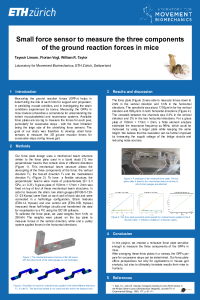
The measurement of the ground reaction forces (GRFs) helps in determining the role of each limb for support and propulsion, in predicting muscle activities, and in determining the strain conditions experienced by bones. Measuring the GRFs in mice models is therefore a cornerstone for understanding the rodent musculoskeletal and neuromotor systems, as well as for improved translation of knowledge to humans. Current force plates are too big in size to allow the measurement of forces for each paw. This limitation is mainly due to the large size of the used sensors. The goal of our study was therefore to develop a small 3D force sensor for application in rodent gait analysis. We designed a flexible and small mechanical structure (8 mm × 8 mm) to isolate force components. Using FEM simulation, we chose the area with the highest strain to fix two strain gauges for each direction. The small size of the sensor allows us to fix four of them under a plate on the mouse paw size (approximately 17 mm). According to our primarily results the force plate has a resolution of 2mN in the vertical direction and 1mN in the fore-aft and mediolateral directions. The construction of a runway with such a force plate will allow the measurement of GRFs and the center of pressure of each rodent paw for different steps. Such techniques thus provide a basis for assessing functionality in mice models, towards improved translation of rodent research.
Keywords
3D ground reaction forces
Manuscript
sciforum-029518.pdf
Poster
sciforum-029518poster .pdf
Aspects Regarding of a UGV Fire Fighting thermal shield
Electrical Control of the Receptor Affinity