Event submissions
Published
 10.3390/I3S2021Dresden-10084 (registering DOI)
 This submission belongs to the session S2. Chemical Sensors of the event 8th International Symposium on Sensor Science
Published date
17 May, 2021
Citation
Julia Efremenko, Vladimir M. Mirsky, Electrical Control of the Receptor Affinity, in Proceedings of 8th International Symposium on Sensor Science, 17 May–28 May 2021, MDPI: Basel, Switzerland, doi: 10.3390/I3S2021Dresden-10084
Share
Email
Facebook
Twitter
LinkedIn
Electrical Control of the Receptor Affinity
'%3e%3cpath%20d='M12.6647%2010.9104C12.4176%2010.325%2012.0589%209.7933%2011.6088%209.34485C11.16%208.89511%2010.6283%208.53653%2010.0432%208.28891C10.038%208.28629%2010.0327%208.28498%2010.0275%208.28236C10.8437%207.69282%2011.3743%206.73252%2011.3743%205.64907C11.3743%203.85423%209.92005%202.40002%208.12522%202.40002C6.33038%202.40002%204.87618%203.85423%204.87618%205.64907C4.87618%206.73252%205.40677%207.69282%206.22296%208.28367C6.21772%208.28629%206.21248%208.2876%206.20724%208.29022C5.62031%208.53783%205.09365%208.89287%204.64167%209.34616C4.19192%209.79496%203.83334%2010.3266%203.58573%2010.9117C3.34247%2011.4846%203.21128%2012.0987%203.19925%2012.721C3.1989%2012.735%203.20135%2012.7489%203.20646%2012.7619C3.21157%2012.7749%203.21924%2012.7868%203.22901%2012.7968C3.23877%2012.8068%203.25045%2012.8148%203.26334%2012.8202C3.27623%2012.8256%203.29007%2012.8284%203.30406%2012.8284H4.09012C4.14776%2012.8284%204.19362%2012.7825%204.19493%2012.7262C4.22113%2011.7148%204.62726%2010.7676%205.34519%2010.0497C6.08802%209.30686%207.07452%208.89811%208.12522%208.89811C9.17592%208.89811%2010.1624%209.30686%2010.9052%2010.0497C11.6232%2010.7676%2012.0293%2011.7148%2012.0555%2012.7262C12.0568%2012.7839%2012.1027%2012.8284%2012.1603%2012.8284H12.9464C12.9604%2012.8284%2012.9742%2012.8256%2012.9871%2012.8202C13%2012.8148%2013.0117%2012.8068%2013.0214%2012.7968C13.0312%2012.7868%2013.0389%2012.7749%2013.044%2012.7619C13.0491%2012.7489%2013.0515%2012.735%2013.0512%2012.721C13.0381%2012.0947%2012.9084%2011.4856%2012.6647%2010.9104ZM8.12522%207.90243C7.52388%207.90243%206.95792%207.66793%206.53214%207.24215C6.10636%206.81636%205.87185%206.2504%205.87185%205.64907C5.87185%205.04773%206.10636%204.48177%206.53214%204.05599C6.95792%203.63021%207.52388%203.3957%208.12522%203.3957C8.72655%203.3957%209.29252%203.63021%209.7183%204.05599C10.1441%204.48177%2010.3786%205.04773%2010.3786%205.64907C10.3786%206.2504%2010.1441%206.81636%209.7183%207.24215C9.29252%207.66793%208.72655%207.90243%208.12522%207.90243Z'%20fill='%235D1EE1'/%3e%3c/g%3e%3c/svg%3e)
Julia Efremenko 1

Vladimir M. Mirsky 1
1. Department of Nanobiotechnology, Institute of Biotechnology, Brandenburgische Technische Universität Cottbus – Senftenberg, University square 1, 01968 Senftenberg, Germany
Abstract
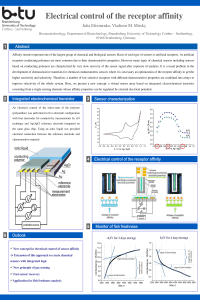
A concept of virtual sensor array based on electrically controlled variation of affinity properties of the receptor layer was realized on the base of integrated electrochemical chemotransistor containing conducting polymer as the receptor layer. An electrical control of the redox-state of the polymer (polyaniline) was performed in five-electrode configuration with four electrodes for conductivity measurements and Ag/AgCl reference electrode integrated on the same glass chip. Using an ionic liquid was provided electrical connection between the reference electrode and chemosensitive material. Conductivity measurements demonstrated potential controlled electrochemical conversions of the receptor material between different redox-states. Binding of trimethylamine at three different potentials, corresponding to these states was studied. The results demonstrated that both kinetic- and equilibrium binding properties of the receptor are controlled by electrical potential thus providing a possibility to form a virtual sensor array using only a single sensing element. The concept was applied for monitoring of fish headspace. Using three characteristics of the sensor response measured at three different redox states of the same sensor material, we have obtained signals from a virtual sensor array consisting of nine chemosensitive elements. The sensor displays systematic changes of its nine signals during fish degradation. This approach can be applied also for the electrical control of affinity of immunoglobulins. A development of a new materials with conducting electrically controlled affinity is in progress.
Keywords
affnity
virtual sensor array
Manuscript
sciforum-029630.pdf
Poster
sciforum-029630 Poster.pdf
Small Force Sensor to Measure the Three Components of the Ground Reaction Forces in Mice
Hardware Passwords Manager Based on Biometric Authentication