Event submissions
Published
 10.3390/I3S2021Dresden-10086 (registering DOI)
 This submission belongs to the session S3. Physical Sensors of the event 8th International Symposium on Sensor Science
Published date
17 May, 2021
Citation
Ingo Tobehn-Steinhäuser, Manfred Reiche, Matthias Schmelz, Ronny Stolz, Thomas Fröhlich, Thomas Ortlepp, Carrier mobility in semiconductors at very low temperatures, in Proceedings of 8th International Symposium on Sensor Science, 17 May–28 May 2021, MDPI: Basel, Switzerland, doi: 10.3390/I3S2021Dresden-10086
Share
Email
Facebook
Twitter
LinkedIn
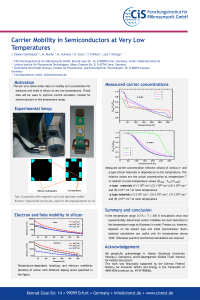
Carrier mobility in semiconductors at very low temperatures
'%3e%3cpath%20d='M12.6647%2010.9104C12.4176%2010.325%2012.0589%209.7933%2011.6088%209.34485C11.16%208.89511%2010.6283%208.53653%2010.0432%208.28891C10.038%208.28629%2010.0327%208.28498%2010.0275%208.28236C10.8437%207.69282%2011.3743%206.73252%2011.3743%205.64907C11.3743%203.85423%209.92005%202.40002%208.12522%202.40002C6.33038%202.40002%204.87618%203.85423%204.87618%205.64907C4.87618%206.73252%205.40677%207.69282%206.22296%208.28367C6.21772%208.28629%206.21248%208.2876%206.20724%208.29022C5.62031%208.53783%205.09365%208.89287%204.64167%209.34616C4.19192%209.79496%203.83334%2010.3266%203.58573%2010.9117C3.34247%2011.4846%203.21128%2012.0987%203.19925%2012.721C3.1989%2012.735%203.20135%2012.7489%203.20646%2012.7619C3.21157%2012.7749%203.21924%2012.7868%203.22901%2012.7968C3.23877%2012.8068%203.25045%2012.8148%203.26334%2012.8202C3.27623%2012.8256%203.29007%2012.8284%203.30406%2012.8284H4.09012C4.14776%2012.8284%204.19362%2012.7825%204.19493%2012.7262C4.22113%2011.7148%204.62726%2010.7676%205.34519%2010.0497C6.08802%209.30686%207.07452%208.89811%208.12522%208.89811C9.17592%208.89811%2010.1624%209.30686%2010.9052%2010.0497C11.6232%2010.7676%2012.0293%2011.7148%2012.0555%2012.7262C12.0568%2012.7839%2012.1027%2012.8284%2012.1603%2012.8284H12.9464C12.9604%2012.8284%2012.9742%2012.8256%2012.9871%2012.8202C13%2012.8148%2013.0117%2012.8068%2013.0214%2012.7968C13.0312%2012.7868%2013.0389%2012.7749%2013.044%2012.7619C13.0491%2012.7489%2013.0515%2012.735%2013.0512%2012.721C13.0381%2012.0947%2012.9084%2011.4856%2012.6647%2010.9104ZM8.12522%207.90243C7.52388%207.90243%206.95792%207.66793%206.53214%207.24215C6.10636%206.81636%205.87185%206.2504%205.87185%205.64907C5.87185%205.04773%206.10636%204.48177%206.53214%204.05599C6.95792%203.63021%207.52388%203.3957%208.12522%203.3957C8.72655%203.3957%209.29252%203.63021%209.7183%204.05599C10.1441%204.48177%2010.3786%205.04773%2010.3786%205.64907C10.3786%206.2504%2010.1441%206.81636%209.7183%207.24215C9.29252%207.66793%208.72655%207.90243%208.12522%207.90243Z'%20fill='%235D1EE1'/%3e%3c/g%3e%3c/svg%3e)
Ingo Tobehn-Steinhäuser 1
Manfred Reiche 1
Matthias Schmelz 2
Ronny Stolz 2
Thomas Fröhlich 3
Thomas Ortlepp 1
1. CIS Forschungsinstitut für Mikrosensorik GmbH, Konrad-Zuse-Str. 14, D-99099 Erfurt, Germany
2. Leibniz-Institut für Photonische Technologien, Albert-Einstein-Str. 9, D-07745 Jena, Germany
3. Technische Universität Ilmenau, Institut für Prozessmess- und Sensortechnik, Ehrenbergstr. 29, D-98693 Ilmenau, Germany
Abstract
Carrier mobilities and concentrations were measured for different p- and n-type silicon materials in the temperature range 0.3–300 K. Simulations show that experimentally determined carrier mobilities are best described in this temperature range by Klaassen´s model. Freeze out reduce the carrier concentration with decreasing temperature. Freeze out, however, depends on the dopant type and initial concentration. Semi-classical calculations are useful only for temperatures above 100 K. Otherwise quantum mechanical calculations are required.
Keywords
silicon
carrier mobility
carrier concentration
low-temperature measurements
Manuscript
sciforum-043208.pdf
Poster
Poster_12.pdf
Hardware Passwords Manager Based on Biometric Authentication
A High-Resolution Fully Inkjet Printed Resonant Mass Sensor