Event submissions
Published
 10.3390/I3S2021Dresden-10087 (registering DOI)
 This submission belongs to the session S6 - Special session. Flexible and Stretchable Sensors of the event 8th International Symposium on Sensor Science
Published date
17 May, 2021
Citation
Bruno Ando, Ruben Crispino, Salvatore Baglio, Vincenzo Marletta, A High-Resolution Fully Inkjet Printed Resonant Mass Sensor, in Proceedings of 8th International Symposium on Sensor Science, 17 May–28 May 2021, MDPI: Basel, Switzerland, doi: 10.3390/I3S2021Dresden-10087
Share
Email
Facebook
Twitter
LinkedIn
A High-Resolution Fully Inkjet Printed Resonant Mass Sensor

Bruno Ando 1
'%3e%3cpath%20d='M12.6647%2010.9104C12.4176%2010.325%2012.0589%209.7933%2011.6088%209.34485C11.16%208.89511%2010.6283%208.53653%2010.0432%208.28891C10.038%208.28629%2010.0327%208.28498%2010.0275%208.28236C10.8437%207.69282%2011.3743%206.73252%2011.3743%205.64907C11.3743%203.85423%209.92005%202.40002%208.12522%202.40002C6.33038%202.40002%204.87618%203.85423%204.87618%205.64907C4.87618%206.73252%205.40677%207.69282%206.22296%208.28367C6.21772%208.28629%206.21248%208.2876%206.20724%208.29022C5.62031%208.53783%205.09365%208.89287%204.64167%209.34616C4.19192%209.79496%203.83334%2010.3266%203.58573%2010.9117C3.34247%2011.4846%203.21128%2012.0987%203.19925%2012.721C3.1989%2012.735%203.20135%2012.7489%203.20646%2012.7619C3.21157%2012.7749%203.21924%2012.7868%203.22901%2012.7968C3.23877%2012.8068%203.25045%2012.8148%203.26334%2012.8202C3.27623%2012.8256%203.29007%2012.8284%203.30406%2012.8284H4.09012C4.14776%2012.8284%204.19362%2012.7825%204.19493%2012.7262C4.22113%2011.7148%204.62726%2010.7676%205.34519%2010.0497C6.08802%209.30686%207.07452%208.89811%208.12522%208.89811C9.17592%208.89811%2010.1624%209.30686%2010.9052%2010.0497C11.6232%2010.7676%2012.0293%2011.7148%2012.0555%2012.7262C12.0568%2012.7839%2012.1027%2012.8284%2012.1603%2012.8284H12.9464C12.9604%2012.8284%2012.9742%2012.8256%2012.9871%2012.8202C13%2012.8148%2013.0117%2012.8068%2013.0214%2012.7968C13.0312%2012.7868%2013.0389%2012.7749%2013.044%2012.7619C13.0491%2012.7489%2013.0515%2012.735%2013.0512%2012.721C13.0381%2012.0947%2012.9084%2011.4856%2012.6647%2010.9104ZM8.12522%207.90243C7.52388%207.90243%206.95792%207.66793%206.53214%207.24215C6.10636%206.81636%205.87185%206.2504%205.87185%205.64907C5.87185%205.04773%206.10636%204.48177%206.53214%204.05599C6.95792%203.63021%207.52388%203.3957%208.12522%203.3957C8.72655%203.3957%209.29252%203.63021%209.7183%204.05599C10.1441%204.48177%2010.3786%205.04773%2010.3786%205.64907C10.3786%206.2504%2010.1441%206.81636%209.7183%207.24215C9.29252%207.66793%208.72655%207.90243%208.12522%207.90243Z'%20fill='%235D1EE1'/%3e%3c/g%3e%3c/svg%3e)
Ruben Crispino 1
Salvatore Baglio 1
Vincenzo Marletta 1
1. Dipartimento di Ingegneria Elettrica, Elettronica e Informatica, Università degli Studi di Catania, 95125 Catania, Italy
Abstract
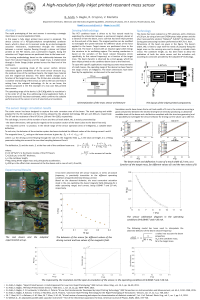
The rapid prototyping of low cost sensors is assuming a strategic importance in several application fields. In this paper a fully inkjet printed mass sensor is proposed. The device consists of a PET (poly-ethylene terephthalate) cantilever beam, which is driven to its resonant mode by an electromagnetic actuation mechanism, implemented through the interaction between a current impulse flowing through a planar coil (inkjet printed on the PET beam), and a permanent magnet, facing the actuation coil. Target masses are positioned close to the beam end. The sensing methodology, based on the relationship between the beam first natural frequency and the target mass, is implemented through a Strain Gauge (inkjet printed across the fixed end of the cantilever). The resonant operating mode of the sensor confers intrinsic robustness against instabilities of the strain sensor structure (e.g., the residual stress of the cantilever beam), the target mass material and the magnet-coil distance. The latter indeed changes as a function of the target mass values. The friction-less actuation mode is another shortcoming of the sensor, as well as the low cost feature arising from the adopted technology. As far as we know, the solution proposed is the first example of a low cost fully printed mass sensor. The operating range of the device is 0–0.36 g while its resolution is in the order of 1.0 mg, thus addressing crucial application fields. A Q factor around 35 has been estimated, which confirms the suitable performances of the sensor in term of selectivity and resolution.
Keywords
mass sensor
inkjet printing
flexible
resonant operation
Manuscript
sciforum-029643.pdf
Poster
Poster_029643.pdf
Carrier mobility in semiconductors at very low temperatures
A Novel Vision-Based Approach for the Analysis of Volcanic Ash Granulometry