Event submissions
Published
 10.3390/I3S2021Dresden-10098 (registering DOI)
 This submission belongs to the session S4. Sensor Applications and Smart Systems of the event 8th International Symposium on Sensor Science
Published date
17 May, 2021
Citation
Tetiana Lavrenko, Timo Gessler, Jonas Breuninger, Thomas Walter, Hubert Mantz, Radar-Based Detection and Classification of Vulnerable Road Users, in Proceedings of 8th International Symposium on Sensor Science, 17 May–28 May 2021, MDPI: Basel, Switzerland, doi: 10.3390/I3S2021Dresden-10098
Share
Email
Facebook
Twitter
LinkedIn
Radar-Based Detection and Classification of Vulnerable Road Users
'%3e%3cpath%20d='M12.6647%2010.9104C12.4176%2010.325%2012.0589%209.7933%2011.6088%209.34485C11.16%208.89511%2010.6283%208.53653%2010.0432%208.28891C10.038%208.28629%2010.0327%208.28498%2010.0275%208.28236C10.8437%207.69282%2011.3743%206.73252%2011.3743%205.64907C11.3743%203.85423%209.92005%202.40002%208.12522%202.40002C6.33038%202.40002%204.87618%203.85423%204.87618%205.64907C4.87618%206.73252%205.40677%207.69282%206.22296%208.28367C6.21772%208.28629%206.21248%208.2876%206.20724%208.29022C5.62031%208.53783%205.09365%208.89287%204.64167%209.34616C4.19192%209.79496%203.83334%2010.3266%203.58573%2010.9117C3.34247%2011.4846%203.21128%2012.0987%203.19925%2012.721C3.1989%2012.735%203.20135%2012.7489%203.20646%2012.7619C3.21157%2012.7749%203.21924%2012.7868%203.22901%2012.7968C3.23877%2012.8068%203.25045%2012.8148%203.26334%2012.8202C3.27623%2012.8256%203.29007%2012.8284%203.30406%2012.8284H4.09012C4.14776%2012.8284%204.19362%2012.7825%204.19493%2012.7262C4.22113%2011.7148%204.62726%2010.7676%205.34519%2010.0497C6.08802%209.30686%207.07452%208.89811%208.12522%208.89811C9.17592%208.89811%2010.1624%209.30686%2010.9052%2010.0497C11.6232%2010.7676%2012.0293%2011.7148%2012.0555%2012.7262C12.0568%2012.7839%2012.1027%2012.8284%2012.1603%2012.8284H12.9464C12.9604%2012.8284%2012.9742%2012.8256%2012.9871%2012.8202C13%2012.8148%2013.0117%2012.8068%2013.0214%2012.7968C13.0312%2012.7868%2013.0389%2012.7749%2013.044%2012.7619C13.0491%2012.7489%2013.0515%2012.735%2013.0512%2012.721C13.0381%2012.0947%2012.9084%2011.4856%2012.6647%2010.9104ZM8.12522%207.90243C7.52388%207.90243%206.95792%207.66793%206.53214%207.24215C6.10636%206.81636%205.87185%206.2504%205.87185%205.64907C5.87185%205.04773%206.10636%204.48177%206.53214%204.05599C6.95792%203.63021%207.52388%203.3957%208.12522%203.3957C8.72655%203.3957%209.29252%203.63021%209.7183%204.05599C10.1441%204.48177%2010.3786%205.04773%2010.3786%205.64907C10.3786%206.2504%2010.1441%206.81636%209.7183%207.24215C9.29252%207.66793%208.72655%207.90243%208.12522%207.90243Z'%20fill='%235D1EE1'/%3e%3c/g%3e%3c/svg%3e)
Tetiana Lavrenko 1
Timo Gessler 1
Jonas Breuninger 2

Thomas Walter 2
Hubert Mantz 1
1. Institute for Applied Research, Department of Mechatronics and Medical Engineering, University of Applied Sciences Ulm, Albert-Einstein-Allee 55, 89081 Ulm, Germany
2. Institute of Automation Systems, University of Applied Sciences Ulm, Albert-Einstein-Allee 53, 89081 Ulm, Germany
Abstract
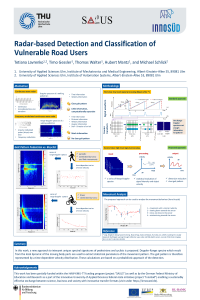
Safe and sustainable mobility in urban and rural regions can be fostered by developing intelligent road infrastructure to avoid accidents by warning drivers about approaching vulnerable traffic participants. Radar sensors accurately detect different objects, however the reliable classification still remains challenging. In this paper, a new approach to extract and interpret unique spectral signatures of pedestrians and cyclists is proposed. Moreover, this approach can be also extended to any moving object including wild animals. This method uses Doppler-Range measurements in real time which result from the local dynamic of the moving parts in order to extract statistical parameters of the movement pattern. The movement pattern is represented by a time dependent velocity distribution which can be further analyzed by conventional signal processing techniques. In this work, the intensity-normalized average velocity calculations are based on a probabilistic approach of the detection. Such a velocity series can be further analyzed by applying Fast-Fourier-Transform in order to extract spectral information of the movement. In case of more than one detected object, a spectrogram can be built, therewith it is possible to determine average velocities as well as periodicities of the measured movement patterns. Machine learning algorithms can be also applied to the discussed time series in order to automate the classification.
Keywords
radar sensor
FMCW
detection
classification
vulnerable road users
range-Doppler measurements
movement pattern
Manuscript
sciforum-029764.pdf
Poster
sciforum-029764 I3S_2021_Poster_Lavrenko.pdf
A soft pneumatic actuator with integrated deformation sensing elements produced exclusively with extrusion based additive manufacturing
Probabilistic Modelling for Unsupervised Analysis of Human Behaviour in Smart Cities