Event submissions
Published
 10.3390/I3S2021Dresden-10103 (registering DOI)
 This submission belongs to the session S3. Physical Sensors of the event 8th International Symposium on Sensor Science
Published date
17 May, 2021
Citation
Julius Harms, Thorsten Alexander Kern, Theory and Modeling of Eddy-Current Type Inductive Conductivity Sensors for Salinity Measurement, in Proceedings of 8th International Symposium on Sensor Science, 17 May–28 May 2021, MDPI: Basel, Switzerland, doi: 10.3390/I3S2021Dresden-10103
Share
Email
Facebook
Twitter
LinkedIn
Theory and Modeling of Eddy-Current Type Inductive Conductivity Sensors for Salinity Measurement
'%3e%3cpath%20d='M12.6647%2010.9104C12.4176%2010.325%2012.0589%209.7933%2011.6088%209.34485C11.16%208.89511%2010.6283%208.53653%2010.0432%208.28891C10.038%208.28629%2010.0327%208.28498%2010.0275%208.28236C10.8437%207.69282%2011.3743%206.73252%2011.3743%205.64907C11.3743%203.85423%209.92005%202.40002%208.12522%202.40002C6.33038%202.40002%204.87618%203.85423%204.87618%205.64907C4.87618%206.73252%205.40677%207.69282%206.22296%208.28367C6.21772%208.28629%206.21248%208.2876%206.20724%208.29022C5.62031%208.53783%205.09365%208.89287%204.64167%209.34616C4.19192%209.79496%203.83334%2010.3266%203.58573%2010.9117C3.34247%2011.4846%203.21128%2012.0987%203.19925%2012.721C3.1989%2012.735%203.20135%2012.7489%203.20646%2012.7619C3.21157%2012.7749%203.21924%2012.7868%203.22901%2012.7968C3.23877%2012.8068%203.25045%2012.8148%203.26334%2012.8202C3.27623%2012.8256%203.29007%2012.8284%203.30406%2012.8284H4.09012C4.14776%2012.8284%204.19362%2012.7825%204.19493%2012.7262C4.22113%2011.7148%204.62726%2010.7676%205.34519%2010.0497C6.08802%209.30686%207.07452%208.89811%208.12522%208.89811C9.17592%208.89811%2010.1624%209.30686%2010.9052%2010.0497C11.6232%2010.7676%2012.0293%2011.7148%2012.0555%2012.7262C12.0568%2012.7839%2012.1027%2012.8284%2012.1603%2012.8284H12.9464C12.9604%2012.8284%2012.9742%2012.8256%2012.9871%2012.8202C13%2012.8148%2013.0117%2012.8068%2013.0214%2012.7968C13.0312%2012.7868%2013.0389%2012.7749%2013.044%2012.7619C13.0491%2012.7489%2013.0515%2012.735%2013.0512%2012.721C13.0381%2012.0947%2012.9084%2011.4856%2012.6647%2010.9104ZM8.12522%207.90243C7.52388%207.90243%206.95792%207.66793%206.53214%207.24215C6.10636%206.81636%205.87185%206.2504%205.87185%205.64907C5.87185%205.04773%206.10636%204.48177%206.53214%204.05599C6.95792%203.63021%207.52388%203.3957%208.12522%203.3957C8.72655%203.3957%209.29252%203.63021%209.7183%204.05599C10.1441%204.48177%2010.3786%205.04773%2010.3786%205.64907C10.3786%206.2504%2010.1441%206.81636%209.7183%207.24215C9.29252%207.66793%208.72655%207.90243%208.12522%207.90243Z'%20fill='%235D1EE1'/%3e%3c/g%3e%3c/svg%3e)
Julius Harms 1
Thorsten Alexander Kern 1
1. Institute for Mechatronics in Mechanics, Hamburg University of Technology, 21073 Hamburg, Germany
Abstract
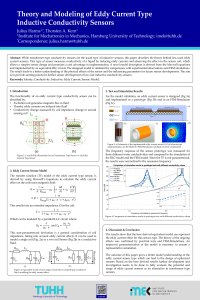
To measure salinity in solutions, many applications make use of inductive sensors. Compared to electrode-based conductive sensors, inductive sensors are less prone to biofouling and polarization. Although inductive sensors are well suited for long time operations, distributed monitoring applications, such as low-cost sensor drifter, suffer under high costs. Industrial standard for inductive sensors is the transformer type sensor. An alternative approach is a design based on the eddy current effect, which is different by using magnetic flux through the water. However, the research presented until now is mostly of empirical nature. This paper presents a new theoretical description for inductive eddy current sensors. The fundamental functionality is based on Maxwell’s equations and allows an equivalent electrical RLC-circuit representation. The derived model proves that rather than a changing permeability of the fluid, the damping effect by the eddy currents determines the behavior of the sensor. For model validation, magnetic FEM-Simulations and practical experiments with prototypes were conducted. The results confirmed the modeling approach. With the aim to provide fundamentals for future development of more cost-efficient and smaller sensors, this paper gives a better understanding of the physical effects of this sensor type.
Keywords
salinity
conductivity
inductive
eddy current
sensor
model
Manuscript
sciforum-029852 - Extended Abstract.pdf
Poster
sciforum-029852_POSTER.pdf
Development of a metrological atomic force microscope system with improved signal quality
Towards Integrated Plasmonic Gas-Sensors in the MWIR