Event submissions
Published
 10.3390/I3S2021Dresden-10106 (registering DOI)
 This submission belongs to the session S2. Chemical Sensors of the event 8th International Symposium on Sensor Science
Published date
17 May, 2021
Citation
Liliana Norocel, Sonia Amariei, Gheorghe Gutt, SENSING OF NICKEL(II) IONS BY IMMOBILIZING LIGANDS AND USING DIFFERENT SPEs, in Proceedings of 8th International Symposium on Sensor Science, 17 May–28 May 2021, MDPI: Basel, Switzerland, doi: 10.3390/I3S2021Dresden-10106
Share
Email
Facebook
Twitter
LinkedIn
SENSING OF NICKEL(II) IONS BY IMMOBILIZING LIGANDS AND USING DIFFERENT SPEs
'%3e%3cpath%20d='M12.6647%2010.9104C12.4176%2010.325%2012.0589%209.7933%2011.6088%209.34485C11.16%208.89511%2010.6283%208.53653%2010.0432%208.28891C10.038%208.28629%2010.0327%208.28498%2010.0275%208.28236C10.8437%207.69282%2011.3743%206.73252%2011.3743%205.64907C11.3743%203.85423%209.92005%202.40002%208.12522%202.40002C6.33038%202.40002%204.87618%203.85423%204.87618%205.64907C4.87618%206.73252%205.40677%207.69282%206.22296%208.28367C6.21772%208.28629%206.21248%208.2876%206.20724%208.29022C5.62031%208.53783%205.09365%208.89287%204.64167%209.34616C4.19192%209.79496%203.83334%2010.3266%203.58573%2010.9117C3.34247%2011.4846%203.21128%2012.0987%203.19925%2012.721C3.1989%2012.735%203.20135%2012.7489%203.20646%2012.7619C3.21157%2012.7749%203.21924%2012.7868%203.22901%2012.7968C3.23877%2012.8068%203.25045%2012.8148%203.26334%2012.8202C3.27623%2012.8256%203.29007%2012.8284%203.30406%2012.8284H4.09012C4.14776%2012.8284%204.19362%2012.7825%204.19493%2012.7262C4.22113%2011.7148%204.62726%2010.7676%205.34519%2010.0497C6.08802%209.30686%207.07452%208.89811%208.12522%208.89811C9.17592%208.89811%2010.1624%209.30686%2010.9052%2010.0497C11.6232%2010.7676%2012.0293%2011.7148%2012.0555%2012.7262C12.0568%2012.7839%2012.1027%2012.8284%2012.1603%2012.8284H12.9464C12.9604%2012.8284%2012.9742%2012.8256%2012.9871%2012.8202C13%2012.8148%2013.0117%2012.8068%2013.0214%2012.7968C13.0312%2012.7868%2013.0389%2012.7749%2013.044%2012.7619C13.0491%2012.7489%2013.0515%2012.735%2013.0512%2012.721C13.0381%2012.0947%2012.9084%2011.4856%2012.6647%2010.9104ZM8.12522%207.90243C7.52388%207.90243%206.95792%207.66793%206.53214%207.24215C6.10636%206.81636%205.87185%206.2504%205.87185%205.64907C5.87185%205.04773%206.10636%204.48177%206.53214%204.05599C6.95792%203.63021%207.52388%203.3957%208.12522%203.3957C8.72655%203.3957%209.29252%203.63021%209.7183%204.05599C10.1441%204.48177%2010.3786%205.04773%2010.3786%205.64907C10.3786%206.2504%2010.1441%206.81636%209.7183%207.24215C9.29252%207.66793%208.72655%207.90243%208.12522%207.90243Z'%20fill='%235D1EE1'/%3e%3c/g%3e%3c/svg%3e)
Liliana Norocel 1
Sonia Amariei 2
Gheorghe Gutt 2
1. Department of Health and Human Development, Stefan cel Mare University of Suceava, 13, University Street, 720229 Suceava, Romania
2. Faculty of Food Engineering, "Stefan cel Mare" University of Suceava, Suceava 720229, Romania
Abstract
The aim of this paper is the development of a sensor for the quantification of nickel ions in food raw materials and foods. It seems that about 15% of the human population suffers from nickel allergy. In addition to digestive manifestations, food intolerance to nickel may also have systemic manifestations, such as: diffuse dermatitis, diffuse itching, fever, rhinitis, headache, altered general condition. Therefore, it is necessary to control this content of nickel ions for the health of the human population by developing this new method that brings advantages such as: it is fast, not expensive, in situ and provides accurate analysis. For this purpose, bismuth oxide –SPEs (screen-printed electrodes) and graphene modified SPEs were used with very small amount of dimethylglyoxime and amino acid L-histidine which were deposited. A potentiostat which displays the response in the form of a cyclic voltammogram was used to study the electrochemical properties of nickel standard solution with different concentration. The results were compared and the most sensitive sensor proved to be bismuth oxide –SPEs with dimethylglyoxime (Bi2O3/C - dmgH2) with a linear response over a wide range (0.1–10 ppm) of nickel concentrations. Furthermore, the sensor shows excellent selectivity in the presence of common interfering species. The Bi2O3/C - dmgH2 sensor showed good viability for nickel analysis in food samples (cocoa, spinach, cabbage and red wine) and demonstrated significant advancement in sensor technology for practical applications.
Keywords
bismuth (III) oxide
cyclic voltammetry
nickel sensor
screen-printed electrodes
Manuscript
sciforum-029879.pdf
Poster
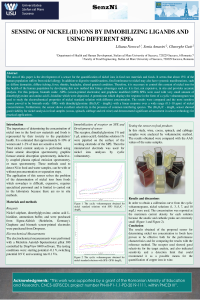
sciforum-029879 Poster-Norocel Liliana-Chemical sensor.pdf
Two orders of magnitude improvement in the detection limit of droplet-based micro-magnetofluidics with planar Hall Effect sensors
Optoelectronic sensory system for Raman spectromicroscopes