Event submissions
Published
 10.3390/I3S2021Dresden-10109 (registering DOI)
 This submission belongs to the session S1. Nano(bio)Sensors and Bioelectronics of the event 8th International Symposium on Sensor Science
Published date
17 May, 2021
Citation
Trang Anh Nguyen, Diana Isabel Sandoval Bojorquez, Arnau Pérez Roig, Bergoi Ibarlucea, Anja Feldmann, Gianaurelio Cuniberti, Michael Bachmann, Larysa Baraban, Highly sensitive silicon nanowire biosensor devices for the investigation of UniCAR platform in immunotherapy, in Proceedings of 8th International Symposium on Sensor Science, 17 May–28 May 2021, MDPI: Basel, Switzerland, doi: 10.3390/I3S2021Dresden-10109
Share
Email
Facebook
Twitter
LinkedIn
Highly sensitive silicon nanowire biosensor devices for the investigation of UniCAR platform in immunotherapy
'%3e%3cpath%20d='M12.6647%2010.9104C12.4176%2010.325%2012.0589%209.7933%2011.6088%209.34485C11.16%208.89511%2010.6283%208.53653%2010.0432%208.28891C10.038%208.28629%2010.0327%208.28498%2010.0275%208.28236C10.8437%207.69282%2011.3743%206.73252%2011.3743%205.64907C11.3743%203.85423%209.92005%202.40002%208.12522%202.40002C6.33038%202.40002%204.87618%203.85423%204.87618%205.64907C4.87618%206.73252%205.40677%207.69282%206.22296%208.28367C6.21772%208.28629%206.21248%208.2876%206.20724%208.29022C5.62031%208.53783%205.09365%208.89287%204.64167%209.34616C4.19192%209.79496%203.83334%2010.3266%203.58573%2010.9117C3.34247%2011.4846%203.21128%2012.0987%203.19925%2012.721C3.1989%2012.735%203.20135%2012.7489%203.20646%2012.7619C3.21157%2012.7749%203.21924%2012.7868%203.22901%2012.7968C3.23877%2012.8068%203.25045%2012.8148%203.26334%2012.8202C3.27623%2012.8256%203.29007%2012.8284%203.30406%2012.8284H4.09012C4.14776%2012.8284%204.19362%2012.7825%204.19493%2012.7262C4.22113%2011.7148%204.62726%2010.7676%205.34519%2010.0497C6.08802%209.30686%207.07452%208.89811%208.12522%208.89811C9.17592%208.89811%2010.1624%209.30686%2010.9052%2010.0497C11.6232%2010.7676%2012.0293%2011.7148%2012.0555%2012.7262C12.0568%2012.7839%2012.1027%2012.8284%2012.1603%2012.8284H12.9464C12.9604%2012.8284%2012.9742%2012.8256%2012.9871%2012.8202C13%2012.8148%2013.0117%2012.8068%2013.0214%2012.7968C13.0312%2012.7868%2013.0389%2012.7749%2013.044%2012.7619C13.0491%2012.7489%2013.0515%2012.735%2013.0512%2012.721C13.0381%2012.0947%2012.9084%2011.4856%2012.6647%2010.9104ZM8.12522%207.90243C7.52388%207.90243%206.95792%207.66793%206.53214%207.24215C6.10636%206.81636%205.87185%206.2504%205.87185%205.64907C5.87185%205.04773%206.10636%204.48177%206.53214%204.05599C6.95792%203.63021%207.52388%203.3957%208.12522%203.3957C8.72655%203.3957%209.29252%203.63021%209.7183%204.05599C10.1441%204.48177%2010.3786%205.04773%2010.3786%205.64907C10.3786%206.2504%2010.1441%206.81636%209.7183%207.24215C9.29252%207.66793%208.72655%207.90243%208.12522%207.90243Z'%20fill='%235D1EE1'/%3e%3c/g%3e%3c/svg%3e)
Trang Anh Nguyen 1
Diana Isabel Sandoval Bojorquez 1
Arnau Pérez Roig 2

Bergoi Ibarlucea 3
Anja Feldmann 1

Gianaurelio Cuniberti 3

Michael Bachmann 1

Larysa Baraban 1
1. Helmholtz-Zentrum Dresden-Rossendorf, Institute of Radiopharmaceutical Cancer Research, 01328 Dresden, Germany
2. Biotechnology Center, Technische Universität Dresden, 01307 Dresden, Germany
3. Institute of Materials Science, Max Bergmann Center for Biomaterials, Technische Universität Dresden, 01069 Dresden, Germany
Abstract
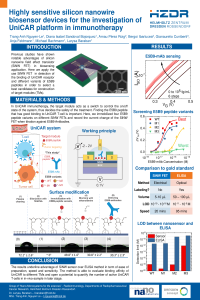
Although showing impressive therapeutic potential, treatments of leukemias with T-cells expressing chimeric antigen receptors (CARs) is limited by their risk of several severe side effects [1,2]. To overcome these problem, a switchable CAR platform has been developed termed UniCAR [2-4]. Unlike conventional CAR which directed against tumor-associated antigens, UniCAR treatment involve an intermediate target module (TM) which can cross-link UniCAR T cells with tumor cells and lead to destruction [4]. The development of these novel TMs against different tumor targets require numerous repetitive tests on different synthesizing trials which is usually limited in quantity and time-consuming. Meanwhile, nano-biosensors are lately known as analytical tools which are highly sensitive, label-free, rapid and reagent-saving [5]. Among them, silicon nanowire (SiNW) sensor is extensively investigated by researchers over the past decades thanks to its compability with CMOS technology enabling mass production [6,7]. In this work, we demonstrated the application of previously published SiNW biosensor [8] on detection of the binding of UniCAR and a part of different TMs. The results underline advantage of SiNW sensor over ELISA method in term of ease of preparation, speed and sensitivity. The method is able to evaluate binding affinity of UniCAR to different TMs and open a potential to quantify the number of active UniCAR T-cells in in-vivo-sample in later stage. In the end, the application of nanosensor may speed up the R&D process of UniCAR concept and later play an important role in clinical monitoring of immunotherapy, especially, in the era of precision medicine.
Keywords
biosensor
immunotherapy
Manuscript
sciforum-029904.pdf
Poster
I3S poster-sciforum-029904.pdf
Fix-Wavelength Multi-Analyte Detection with serial SOI Ring Resonators
Impedance characterization of particles one by one using a nanosensor electronic platform