Event submissions
Published
 10.3390/I3S2021Dresden-10126 (registering DOI)
 This submission belongs to the session S1. Nano(bio)Sensors and Bioelectronics of the event 8th International Symposium on Sensor Science
Published date
17 May, 2021
Citation
Serigne Modou Die Mbacke, Mohammed EL GIBARI, Benjamin Lauzier, Chantal GAUTIER, Hongwu Li, Implantable blood pressure sensors with an analogic thermal drift compensation, in Proceedings of 8th International Symposium on Sensor Science, 17 May–28 May 2021, MDPI: Basel, Switzerland, doi: 10.3390/I3S2021Dresden-10126
Share
Email
Facebook
Twitter
LinkedIn
Implantable blood pressure sensors with an analogic thermal drift compensation
'%3e%3cpath%20d='M12.6647%2010.9104C12.4176%2010.325%2012.0589%209.7933%2011.6088%209.34485C11.16%208.89511%2010.6283%208.53653%2010.0432%208.28891C10.038%208.28629%2010.0327%208.28498%2010.0275%208.28236C10.8437%207.69282%2011.3743%206.73252%2011.3743%205.64907C11.3743%203.85423%209.92005%202.40002%208.12522%202.40002C6.33038%202.40002%204.87618%203.85423%204.87618%205.64907C4.87618%206.73252%205.40677%207.69282%206.22296%208.28367C6.21772%208.28629%206.21248%208.2876%206.20724%208.29022C5.62031%208.53783%205.09365%208.89287%204.64167%209.34616C4.19192%209.79496%203.83334%2010.3266%203.58573%2010.9117C3.34247%2011.4846%203.21128%2012.0987%203.19925%2012.721C3.1989%2012.735%203.20135%2012.7489%203.20646%2012.7619C3.21157%2012.7749%203.21924%2012.7868%203.22901%2012.7968C3.23877%2012.8068%203.25045%2012.8148%203.26334%2012.8202C3.27623%2012.8256%203.29007%2012.8284%203.30406%2012.8284H4.09012C4.14776%2012.8284%204.19362%2012.7825%204.19493%2012.7262C4.22113%2011.7148%204.62726%2010.7676%205.34519%2010.0497C6.08802%209.30686%207.07452%208.89811%208.12522%208.89811C9.17592%208.89811%2010.1624%209.30686%2010.9052%2010.0497C11.6232%2010.7676%2012.0293%2011.7148%2012.0555%2012.7262C12.0568%2012.7839%2012.1027%2012.8284%2012.1603%2012.8284H12.9464C12.9604%2012.8284%2012.9742%2012.8256%2012.9871%2012.8202C13%2012.8148%2013.0117%2012.8068%2013.0214%2012.7968C13.0312%2012.7868%2013.0389%2012.7749%2013.044%2012.7619C13.0491%2012.7489%2013.0515%2012.735%2013.0512%2012.721C13.0381%2012.0947%2012.9084%2011.4856%2012.6647%2010.9104ZM8.12522%207.90243C7.52388%207.90243%206.95792%207.66793%206.53214%207.24215C6.10636%206.81636%205.87185%206.2504%205.87185%205.64907C5.87185%205.04773%206.10636%204.48177%206.53214%204.05599C6.95792%203.63021%207.52388%203.3957%208.12522%203.3957C8.72655%203.3957%209.29252%203.63021%209.7183%204.05599C10.1441%204.48177%2010.3786%205.04773%2010.3786%205.64907C10.3786%206.2504%2010.1441%206.81636%209.7183%207.24215C9.29252%207.66793%208.72655%207.90243%208.12522%207.90243Z'%20fill='%235D1EE1'/%3e%3c/g%3e%3c/svg%3e)
Serigne Modou Die Mbacke 1

Mohammed EL GIBARI 1
Benjamin Lauzier 2
Chantal GAUTIER 2
Hongwu Li 1
1. Faculté des Sciences et Techniques, Université de Nantes, CNRS, IETR UMR 6164, 2 Chemin de la Houssinière, 44322 Nantes, France
2. l’institut du thorax, Université de Nantes, INSERM, CNRS, INSERM UMR 1087/CNRS UMR 6291, 8 quai Moncousu, 44007 Nantes, France
Abstract
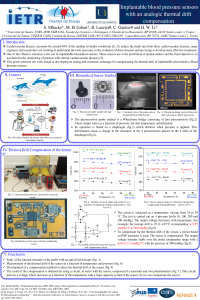
Implantable pressure sensors represent an important part of research activity in laboratories. Unfortunately, their use is limited by cost, autonomy and temperature-related drifts. The cost of use depends on several parameters, in particular the low battery life and the need for miniaturization to be able to implant the animals and monitor them over time that is long enough to be physiologically relevant. This paper study the possibility to reduce the thermal drift of implantable sensors. To quantify and compensate for thermal drift, we have developed the equivalent model of the piezoresistive probe by using the cadence software. Our model takes into account the temperature [34°C – 39°C] and also the pressure [0 - 300 mmHg]. We were thus able to identify the source of the drift and thanks to our model we were able to compensate for it thanks to compensation circuits added to the conditioning circuits of the sensor. The maximum relative drift of the sensor is (0.1 mV/°C)/3.6mV (2.7%), a drift of the conditioning circuit is (0.98 mV/°C)/916mV (0.1%) and the whole is (13.4 mV/°C)/420mV (32 %). The compensated sensor show a relative maximum drift of (0.371 mV/°C)/405 mV (0.09%). The output voltage remains stable over the measurement temperature range.
Keywords
thermal drift
cadence simulation
blood pressure sensors
analogic compensation
piezoresistive
Manuscript
sciforum-030748.pdf
Poster
MBACKE_Poster_ID_sciforum-030748.pdf
A Novel Microneedle Biosensor Based on Lignin Nanoparticles for Real Time Monitoring of Glucose
Flexible piezoelectric sensor for podiatric applications with wireless communication