Event submissions
Published
 10.3390/I3S2021Dresden-10128 (registering DOI)
 This submission belongs to the session S4. Sensor Applications and Smart Systems of the event 8th International Symposium on Sensor Science
Published date
17 May, 2021
Citation
Vilma Ratautaite, Almira Ramanavičienė, Arunas Ramanavicius, Evaluation of the Electrochromic Response of Polypyrrole in the Presence of CO₂ in the Solution, in Proceedings of 8th International Symposium on Sensor Science, 17 May–28 May 2021, MDPI: Basel, Switzerland, doi: 10.3390/I3S2021Dresden-10128
Share
Email
Facebook
Twitter
LinkedIn
Evaluation of the Electrochromic Response of Polypyrrole in the Presence of CO2 in the Solution

Vilma Ratautaite 1,2

Almira Ramanavičienė 3

Arunas Ramanavicius 1,2,3
1. Department of Functional Materials and Electronics, State Research Institute Centre for Physical Sciences and Technology, Sauletekio Ave. 3, LT-10257 Vilnius, Lithuania
2. Department of Physical Chemistry, Faculty of Chemistry and Geosciences, Vilnius University, Naugarduko Str. 24, LT-03225 Vilnius, Lithuania
3. NanoTechnas—Nanotechnology and Materials Science Center, Faculty of Chemistry and Geosciences, Vilnius University, Naugarduko Str. 24, LT-03225 Vilnius, Lithuania
Abstract
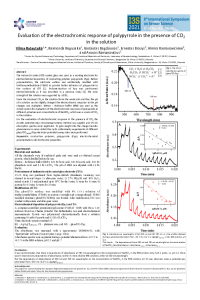
The indium tin oxide (ITO) coated glass was used as a working electrode for electrochemical deposition of conducting polymer polypyrrole (Ppy). Before polymerization, the electrode surface was additionally modified with triethoxymethylsilane (TEMS) to provide better adhesion of polypyrrole to the surface of ITO. Polymerization of Ppy was performed electrochemically as it was described in a previous study. The ionic strength of the solution was supported by LiClO4. Since the dissolved CO2 in the solution forms the weak acid and thus the pH of a solution can be slightly changed the electrochromic response to the pH changes was evaluated. Britton – Robinson buffer (BRB) was used as the model system for evaluation of the electrochromic response of polypyrrole at different pH values and concentrations of NaHCO3, which was a source of CO2 in the solution. For the evaluation of electrochromic response in the presence of CO2 the double potential step chronoamperometry method was applied and UV-Vis absorption spectra were registered. To gain insight into the charge transfer phenomenon in more detail, the cyclic voltammetry experiments at different glass/ITO(TEMS)/Ppy electrode potential sweep rates were performed.
Keywords
conductive polymer
polypyrrole (Ppy)
electrochemical polymerization
electrochromic properties.
Manuscript
sciforum-030775.pdf
Poster
sciforum-030775 _ppt-2.pdf
Flexible piezoelectric sensor for podiatric applications with wireless communication
Measurement of PM10 and PM2.5 Using SAW Sensors-Based Rayleigh Wave and Love Wave