Event submissions
Published
 10.3390/I3S2021Dresden-10129 (registering DOI)
 This submission belongs to the session S3. Physical Sensors of the event 8th International Symposium on Sensor Science
Published date
17 May, 2021
Citation
Fatima-Ezzahraa Dbibih, Meddy Vanotti, Valerie Soumann, Jean-Marc Cote, Lyes Djoumi, Virginie Blondeau-Pâtissier, Measurement of PM10 and PM2.5 Using SAW Sensors-Based Rayleigh Wave and Love Wave, in Proceedings of 8th International Symposium on Sensor Science, 17 May–28 May 2021, MDPI: Basel, Switzerland, doi: 10.3390/I3S2021Dresden-10129
Share
Email
Facebook
Twitter
LinkedIn
Measurement of PM10 and PM2.5 Using SAW Sensors-Based Rayleigh Wave and Love Wave
'%3e%3cpath%20d='M12.6647%2010.9104C12.4176%2010.325%2012.0589%209.7933%2011.6088%209.34485C11.16%208.89511%2010.6283%208.53653%2010.0432%208.28891C10.038%208.28629%2010.0327%208.28498%2010.0275%208.28236C10.8437%207.69282%2011.3743%206.73252%2011.3743%205.64907C11.3743%203.85423%209.92005%202.40002%208.12522%202.40002C6.33038%202.40002%204.87618%203.85423%204.87618%205.64907C4.87618%206.73252%205.40677%207.69282%206.22296%208.28367C6.21772%208.28629%206.21248%208.2876%206.20724%208.29022C5.62031%208.53783%205.09365%208.89287%204.64167%209.34616C4.19192%209.79496%203.83334%2010.3266%203.58573%2010.9117C3.34247%2011.4846%203.21128%2012.0987%203.19925%2012.721C3.1989%2012.735%203.20135%2012.7489%203.20646%2012.7619C3.21157%2012.7749%203.21924%2012.7868%203.22901%2012.7968C3.23877%2012.8068%203.25045%2012.8148%203.26334%2012.8202C3.27623%2012.8256%203.29007%2012.8284%203.30406%2012.8284H4.09012C4.14776%2012.8284%204.19362%2012.7825%204.19493%2012.7262C4.22113%2011.7148%204.62726%2010.7676%205.34519%2010.0497C6.08802%209.30686%207.07452%208.89811%208.12522%208.89811C9.17592%208.89811%2010.1624%209.30686%2010.9052%2010.0497C11.6232%2010.7676%2012.0293%2011.7148%2012.0555%2012.7262C12.0568%2012.7839%2012.1027%2012.8284%2012.1603%2012.8284H12.9464C12.9604%2012.8284%2012.9742%2012.8256%2012.9871%2012.8202C13%2012.8148%2013.0117%2012.8068%2013.0214%2012.7968C13.0312%2012.7868%2013.0389%2012.7749%2013.044%2012.7619C13.0491%2012.7489%2013.0515%2012.735%2013.0512%2012.721C13.0381%2012.0947%2012.9084%2011.4856%2012.6647%2010.9104ZM8.12522%207.90243C7.52388%207.90243%206.95792%207.66793%206.53214%207.24215C6.10636%206.81636%205.87185%206.2504%205.87185%205.64907C5.87185%205.04773%206.10636%204.48177%206.53214%204.05599C6.95792%203.63021%207.52388%203.3957%208.12522%203.3957C8.72655%203.3957%209.29252%203.63021%209.7183%204.05599C10.1441%204.48177%2010.3786%205.04773%2010.3786%205.64907C10.3786%206.2504%2010.1441%206.81636%209.7183%207.24215C9.29252%207.66793%208.72655%207.90243%208.12522%207.90243Z'%20fill='%235D1EE1'/%3e%3c/g%3e%3c/svg%3e)
Fatima-Ezzahraa Dbibih 1
Meddy Vanotti 1
Valerie Soumann 1
Jean-Marc Cote 2
Lyes Djoumi 1
Virginie Blondeau-Pâtissier 1
1. Franche-Comté Electronics Mechanics Thermal Science and Optics – Sciences and Technologies Institute (FEMTO-ST), Time and Frequency Department, 26, Chemin de l’Epitaphe, 25030 Besançon, France
2. Franche-Comté Electronics Mechanics Thermal Science and Optics – Sciences and Technologies Institute (FEMTO-ST),MN2S Departement;
15B avenue des Montboucons
25030 BESANCON cedex
Abstract
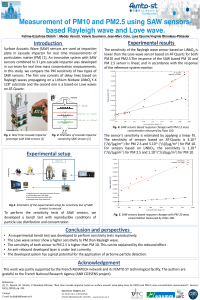
Particulate matter (PM) is reported as dangerous and can cause respiratory and health issues. Regulations, based on PM concentration, have been implemented to limit human exposition to air pollution. An innovative system with Surface Acoustic Wave (SAW) sensors combined to 3 Lpm cascade impactor was developed in our team for real time mass concentration measurements. In this study, we compare the PM sensitivity of two types of SAW sensors. The first one consists of delay lines based on Rayleigh waves propagating on a Lithium Niobate Y-X 128° substrate and the second one is a based-on Love waves on AT-Quartz. The aerosols were generated from NaCl for PM2.5 and from Silicon carbide for PM10. The sensor’s response was compared to a reference sensor based on optical measurement. The sensitivity of the Rayleigh wave based sensor is clearly lower than the Love wave sensor for both PM. Although less sensitive, Rayleigh wave sensors are very promising for the development of self-cleaning sensors using RF power due to their high electromechanical factor. To check the performance of our system in real conditions, we tested the sensitivity to PM from cigarette smoke using Rayleigh SAW. The PM2.5 stage shows a phase shift while the PM10 does not respond. This result agrees with previous studies which report that the size of particles from cigarette smoke varies between 0.1 to 1.5 µm. A good correlation between the reference sensor’s response and the phase variation of SAW sensors was obtained.
Keywords
PM
SAW sensors
cascade impactor
mainstream smoke
Love waves
Rayleigh waves
Manuscript
sciforum-030784.pdf
Poster
sciforum-030784 Poster i3se.pdf
Evaluation of the Electrochromic Response of Polypyrrole in the Presence of CO2 in the Solution
Needleless Electrospun Magnetic Carbon Nanofiber Mats for Sensor Applications