Event submissions
Published
 10.3390/I3S2021Dresden-10131 (registering DOI)
 This submission belongs to the session S2. Chemical Sensors of the event 8th International Symposium on Sensor Science
Published date
17 May, 2021
Citation
Anna Kulis-Kapuscinska, Monika Kwoka, Michal Adam Borysiewicz, Massimo Sgarzi, Gianaurelio Cuniberti, ZnO Low-Dimensional Thin Films Used as a Potential Material for Water Treatment, in Proceedings of 8th International Symposium on Sensor Science, 17 May–28 May 2021, MDPI: Basel, Switzerland, doi: 10.3390/I3S2021Dresden-10131
Share
Email
Facebook
Twitter
LinkedIn
ZnO Low-Dimensional Thin Films Used as a Potential Material for Water Treatment
'%3e%3cpath%20d='M12.6647%2010.9104C12.4176%2010.325%2012.0589%209.7933%2011.6088%209.34485C11.16%208.89511%2010.6283%208.53653%2010.0432%208.28891C10.038%208.28629%2010.0327%208.28498%2010.0275%208.28236C10.8437%207.69282%2011.3743%206.73252%2011.3743%205.64907C11.3743%203.85423%209.92005%202.40002%208.12522%202.40002C6.33038%202.40002%204.87618%203.85423%204.87618%205.64907C4.87618%206.73252%205.40677%207.69282%206.22296%208.28367C6.21772%208.28629%206.21248%208.2876%206.20724%208.29022C5.62031%208.53783%205.09365%208.89287%204.64167%209.34616C4.19192%209.79496%203.83334%2010.3266%203.58573%2010.9117C3.34247%2011.4846%203.21128%2012.0987%203.19925%2012.721C3.1989%2012.735%203.20135%2012.7489%203.20646%2012.7619C3.21157%2012.7749%203.21924%2012.7868%203.22901%2012.7968C3.23877%2012.8068%203.25045%2012.8148%203.26334%2012.8202C3.27623%2012.8256%203.29007%2012.8284%203.30406%2012.8284H4.09012C4.14776%2012.8284%204.19362%2012.7825%204.19493%2012.7262C4.22113%2011.7148%204.62726%2010.7676%205.34519%2010.0497C6.08802%209.30686%207.07452%208.89811%208.12522%208.89811C9.17592%208.89811%2010.1624%209.30686%2010.9052%2010.0497C11.6232%2010.7676%2012.0293%2011.7148%2012.0555%2012.7262C12.0568%2012.7839%2012.1027%2012.8284%2012.1603%2012.8284H12.9464C12.9604%2012.8284%2012.9742%2012.8256%2012.9871%2012.8202C13%2012.8148%2013.0117%2012.8068%2013.0214%2012.7968C13.0312%2012.7868%2013.0389%2012.7749%2013.044%2012.7619C13.0491%2012.7489%2013.0515%2012.735%2013.0512%2012.721C13.0381%2012.0947%2012.9084%2011.4856%2012.6647%2010.9104ZM8.12522%207.90243C7.52388%207.90243%206.95792%207.66793%206.53214%207.24215C6.10636%206.81636%205.87185%206.2504%205.87185%205.64907C5.87185%205.04773%206.10636%204.48177%206.53214%204.05599C6.95792%203.63021%207.52388%203.3957%208.12522%203.3957C8.72655%203.3957%209.29252%203.63021%209.7183%204.05599C10.1441%204.48177%2010.3786%205.04773%2010.3786%205.64907C10.3786%206.2504%2010.1441%206.81636%209.7183%207.24215C9.29252%207.66793%208.72655%207.90243%208.12522%207.90243Z'%20fill='%235D1EE1'/%3e%3c/g%3e%3c/svg%3e)
Anna Kulis-Kapuscinska 1

Monika Kwoka 1
Michal Adam Borysiewicz 2

Massimo Sgarzi 3

Gianaurelio Cuniberti 4
1. Department of Cybernetics, Nanotechnology and Data Processing, Faculty of Automatic Control, Electronics and Computer Science, Silesian University of Technology, 44-100 Gliwice, Poland
2. Institute of Electron Technology, 02-668 Warsaw, Poland
3. Institute for Materials Science, Dresden University of Technology, Dresden, Germany
4. Institute for Materials Science and Max Bergmann Center of Biomaterials, Dresden University of Technology, Dresden, Germany
Abstract
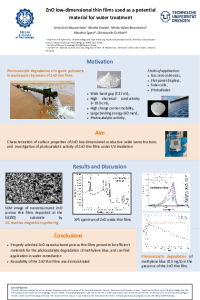
In this paper the properties of zinc oxide (ZnO) low-dimensional conductive oxide nanostructures in the aspect of their potential applications in microelectronics, in toxic gas sensors as well as checking whether they can be also used in water treatment has been determined. ZnO nanostructured porous thin films deposited by DC reactive sputtering (RS) have been deposited on Si substrates at different temperature conditions. For the surface properties and chemical morphology analysis the X-ray photoelectron spectroscopy (XPS) and atomic force microscopy (AFM) have been used. Thanks to those methods, it is possible to obtain information on changes in the structure caused by the adsorption of various gases from the atmosphere, mainly C pollution from air, but also from the water. Investigated ZnO thin films were also tested for their photocatalytic properties performed in UV light. For this purpose the methylene blue as a dye pollutant to evaluate the activity of the nanostructures has been used. Within this work it has been observed that the ZnO thin films, which were used, react in the selected environment and their presence reduces the amount of dye. This shows that in addition to sensor properties, properly selected zinc oxide nanostructures, used so far in toxic gas sensors, can also be used in the process of water purification and treatment, which is crucial in protecting the natural environment primarily from various types of dyes or also medicines.
Keywords
ZnO nanostructures
surface chemistry
XPS
surface morphology
AFM
photocatalysis
Manuscript
sciforum-030800.pdf
Poster
sciforum-030800 Poster_i3S2021_Anna_Kulis-Kapuscinska.pdf
Needleless Electrospun Magnetic Carbon Nanofiber Mats for Sensor Applications
Design of Wireless and Traceable Sensors for Internally Illuminated Photoreactors