Event submissions
Published
 10.3390/I3S2021Dresden-10134 (registering DOI)
 This submission belongs to the session S1. Nano(bio)Sensors and Bioelectronics of the event 8th International Symposium on Sensor Science
Published date
17 May, 2021
Citation
Saurabh Parmar, Bishakha Ray, Suwarna Datar, Detection of Breath Biomarkers for Alzheimer’s and Parkinson’s disease using Quartz Tuning Forks Based Gas Sensors, in Proceedings of 8th International Symposium on Sensor Science, 17 May–28 May 2021, MDPI: Basel, Switzerland, doi: 10.3390/I3S2021Dresden-10134
Share
Email
Facebook
Twitter
LinkedIn
Detection of Breath Biomarkers for Alzheimer’s and Parkinson’s disease using Quartz Tuning Forks Based Gas Sensors
'%3e%3cpath%20d='M12.6647%2010.9104C12.4176%2010.325%2012.0589%209.7933%2011.6088%209.34485C11.16%208.89511%2010.6283%208.53653%2010.0432%208.28891C10.038%208.28629%2010.0327%208.28498%2010.0275%208.28236C10.8437%207.69282%2011.3743%206.73252%2011.3743%205.64907C11.3743%203.85423%209.92005%202.40002%208.12522%202.40002C6.33038%202.40002%204.87618%203.85423%204.87618%205.64907C4.87618%206.73252%205.40677%207.69282%206.22296%208.28367C6.21772%208.28629%206.21248%208.2876%206.20724%208.29022C5.62031%208.53783%205.09365%208.89287%204.64167%209.34616C4.19192%209.79496%203.83334%2010.3266%203.58573%2010.9117C3.34247%2011.4846%203.21128%2012.0987%203.19925%2012.721C3.1989%2012.735%203.20135%2012.7489%203.20646%2012.7619C3.21157%2012.7749%203.21924%2012.7868%203.22901%2012.7968C3.23877%2012.8068%203.25045%2012.8148%203.26334%2012.8202C3.27623%2012.8256%203.29007%2012.8284%203.30406%2012.8284H4.09012C4.14776%2012.8284%204.19362%2012.7825%204.19493%2012.7262C4.22113%2011.7148%204.62726%2010.7676%205.34519%2010.0497C6.08802%209.30686%207.07452%208.89811%208.12522%208.89811C9.17592%208.89811%2010.1624%209.30686%2010.9052%2010.0497C11.6232%2010.7676%2012.0293%2011.7148%2012.0555%2012.7262C12.0568%2012.7839%2012.1027%2012.8284%2012.1603%2012.8284H12.9464C12.9604%2012.8284%2012.9742%2012.8256%2012.9871%2012.8202C13%2012.8148%2013.0117%2012.8068%2013.0214%2012.7968C13.0312%2012.7868%2013.0389%2012.7749%2013.044%2012.7619C13.0491%2012.7489%2013.0515%2012.735%2013.0512%2012.721C13.0381%2012.0947%2012.9084%2011.4856%2012.6647%2010.9104ZM8.12522%207.90243C7.52388%207.90243%206.95792%207.66793%206.53214%207.24215C6.10636%206.81636%205.87185%206.2504%205.87185%205.64907C5.87185%205.04773%206.10636%204.48177%206.53214%204.05599C6.95792%203.63021%207.52388%203.3957%208.12522%203.3957C8.72655%203.3957%209.29252%203.63021%209.7183%204.05599C10.1441%204.48177%2010.3786%205.04773%2010.3786%205.64907C10.3786%206.2504%2010.1441%206.81636%209.7183%207.24215C9.29252%207.66793%208.72655%207.90243%208.12522%207.90243Z'%20fill='%235D1EE1'/%3e%3c/g%3e%3c/svg%3e)
Saurabh Parmar 1
Bishakha Ray 1
Suwarna Datar 1
1. Department of Applied Physics, Defence Institute of Advanced Technology (DIAT), Deemed University, Girinagar, Pune 411021, Maharashtra, India
Abstract
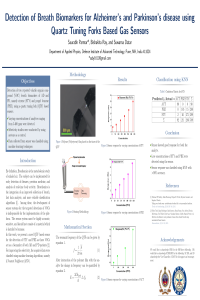
Alzheimer’s (AD) and Parkinson’s (PD) disease are two of the most life-threatening neuro-degenerative diseases. Due to the complex nature of the diseases, diagnosis of AD and PD in the initial stages is very difficult. Recently, studies concentrating on detection of diseases with the help of breath biomarkers have proven to be effective. In this work, we detect two reported volatile organic compound (VOC) breath biomarkers of AD and PD namely styrene (STY) and propyl benzene (PBZ) using quartz tuning fork (QTF) based sensors. These QTFs are modified using polymer films to achieve selectivity. We demonstrate that polymer modified QTF based sensors can detect these analytes with high accuracy even at low (ppm) concentrations. The polymer was selected based on results obtained from Force Spectroscopy studies where we detect the change in elastic modulus of the polymer film upon interaction with the VOCs. Based on the working principle of the sensor, few parameters like recovery time (RcT), response time (RpT) and drop in frequency (Δf) among others can be utilized for better classification. The data collected from the sensor is used to classify the behaviour of the two analytes using machine learning techniques with approximately 90–95% accuracy.
Keywords
biomarkers
quartz tuning fork
machine learning
Alzheimer's (AD)
Parkinson's (PD)
Manuscript
sciforum-031282.pdf
Poster
sciforum-031282 poster.pdf
Using Interdigitated Organic Electrochemical Transistors as Electrophysiological and Biochemical Sensors
Metabolic rate monitoring using Quartz tuning fork based Sensors