Event submissions
Published
 10.3390/I3S2021Dresden-10136 (registering DOI)
 This submission belongs to the session S1. Nano(bio)Sensors and Bioelectronics of the event 8th International Symposium on Sensor Science
Published date
17 May, 2021
Citation
Rahat Morad Talukder, Victoria Shpacovitch, Rakib Hossain Al Shahriar, Zohair Usfoor, Katharina Kaufmann, Roland Hergenröder, Julija Skolnik, Modifications of the PAMONO-Sensor Help to Size and Quantify Low Number of Individual Biological and Non-Biological Nano-Particles, in Proceedings of 8th International Symposium on Sensor Science, 17 May–28 May 2021, MDPI: Basel, Switzerland, doi: 10.3390/I3S2021Dresden-10136
Share
Email
Facebook
Twitter
LinkedIn
Modifications of the PAMONO-Sensor Help to Size and Quantify Low Number of Individual Biological and Non-Biological Nano-Particles
'%3e%3cpath%20d='M12.6647%2010.9104C12.4176%2010.325%2012.0589%209.7933%2011.6088%209.34485C11.16%208.89511%2010.6283%208.53653%2010.0432%208.28891C10.038%208.28629%2010.0327%208.28498%2010.0275%208.28236C10.8437%207.69282%2011.3743%206.73252%2011.3743%205.64907C11.3743%203.85423%209.92005%202.40002%208.12522%202.40002C6.33038%202.40002%204.87618%203.85423%204.87618%205.64907C4.87618%206.73252%205.40677%207.69282%206.22296%208.28367C6.21772%208.28629%206.21248%208.2876%206.20724%208.29022C5.62031%208.53783%205.09365%208.89287%204.64167%209.34616C4.19192%209.79496%203.83334%2010.3266%203.58573%2010.9117C3.34247%2011.4846%203.21128%2012.0987%203.19925%2012.721C3.1989%2012.735%203.20135%2012.7489%203.20646%2012.7619C3.21157%2012.7749%203.21924%2012.7868%203.22901%2012.7968C3.23877%2012.8068%203.25045%2012.8148%203.26334%2012.8202C3.27623%2012.8256%203.29007%2012.8284%203.30406%2012.8284H4.09012C4.14776%2012.8284%204.19362%2012.7825%204.19493%2012.7262C4.22113%2011.7148%204.62726%2010.7676%205.34519%2010.0497C6.08802%209.30686%207.07452%208.89811%208.12522%208.89811C9.17592%208.89811%2010.1624%209.30686%2010.9052%2010.0497C11.6232%2010.7676%2012.0293%2011.7148%2012.0555%2012.7262C12.0568%2012.7839%2012.1027%2012.8284%2012.1603%2012.8284H12.9464C12.9604%2012.8284%2012.9742%2012.8256%2012.9871%2012.8202C13%2012.8148%2013.0117%2012.8068%2013.0214%2012.7968C13.0312%2012.7868%2013.0389%2012.7749%2013.044%2012.7619C13.0491%2012.7489%2013.0515%2012.735%2013.0512%2012.721C13.0381%2012.0947%2012.9084%2011.4856%2012.6647%2010.9104ZM8.12522%207.90243C7.52388%207.90243%206.95792%207.66793%206.53214%207.24215C6.10636%206.81636%205.87185%206.2504%205.87185%205.64907C5.87185%205.04773%206.10636%204.48177%206.53214%204.05599C6.95792%203.63021%207.52388%203.3957%208.12522%203.3957C8.72655%203.3957%209.29252%203.63021%209.7183%204.05599C10.1441%204.48177%2010.3786%205.04773%2010.3786%205.64907C10.3786%206.2504%2010.1441%206.81636%209.7183%207.24215C9.29252%207.66793%208.72655%207.90243%208.12522%207.90243Z'%20fill='%235D1EE1'/%3e%3c/g%3e%3c/svg%3e)
Rahat Morad Talukder 1

Victoria Shpacovitch 1
Rakib Hossain Al Shahriar 1
Zohair Usfoor 1
Katharina Kaufmann 1

Roland Hergenröder 1
Julija Skolnik 1
1. Leibniz Institut für Analytische Wissenschaften-ISAS-e.V.; Bunsen-Kirchhoff-Straße 11, 44139 Dortmund, Germany
Abstract
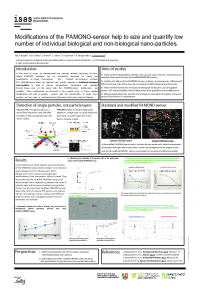
In the series of recently published works, we demonstrated that plasmon assisted microscopy of nano-objects (PAMONO) technique can be successfully employed for the sizing and quantification of single viruses, virus-like particles, microvesicles and charged non-biological particles. This approach enables label-free, but specific detection of biological nano-vesicles. Hence, the sensor, which was built up utilizing plasmon-assisted microscopy, possesses relative versatility and it can be used as a platform for cell-based assays. However, one of the challenging tasks for such a sensor was the ability to reach a homogeneous illumination of the whole surface of the gold sensor slide. Moreover, in order to enable the detection of even relatively low concentrations of nano-particles the focused image area had to be expanded. Both tasks were solved via modifications of previously described PAMONO-sensor set up. Taken together, our latest findings can help to develop a research and diagnostic platform based on the principles of the surface plasmon resonance (SPR)-assisted microscopy of nano-objects.
Keywords
surface plasmon resonance
virus-like particles
extracellular vesicles
liquid biopsies
Manuscript
sciforum-031295.pdf
Poster
Shpacovitch_sciforum031295_i3s_Poster.pdf
Metabolic rate monitoring using Quartz tuning fork based Sensors
Possibility Non-Invasive Detection Magnetic Particles in Biological Objects