Event submissions
Published
 10.3390/I3S2021Dresden-10137 (registering DOI)
 This submission belongs to the session S1. Nano(bio)Sensors and Bioelectronics of the event 8th International Symposium on Sensor Science
Published date
17 May, 2021
Citation
Levan Ichkitidze, Mikhail Belodedov, Alexander Gerasimenko, Dmitry Telyshev, Sergei Selishchev, Possibility Non-Invasive Detection Magnetic Particles in Biological Objects, in Proceedings of 8th International Symposium on Sensor Science, 17 May–28 May 2021, MDPI: Basel, Switzerland, doi: 10.3390/I3S2021Dresden-10137
Share
Email
Facebook
Twitter
LinkedIn
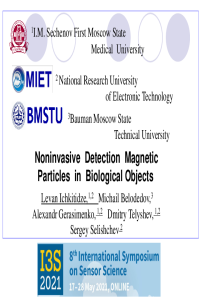
Possibility Non-Invasive Detection Magnetic Particles in Biological Objects
'%3e%3cpath%20d='M12.6647%2010.9104C12.4176%2010.325%2012.0589%209.7933%2011.6088%209.34485C11.16%208.89511%2010.6283%208.53653%2010.0432%208.28891C10.038%208.28629%2010.0327%208.28498%2010.0275%208.28236C10.8437%207.69282%2011.3743%206.73252%2011.3743%205.64907C11.3743%203.85423%209.92005%202.40002%208.12522%202.40002C6.33038%202.40002%204.87618%203.85423%204.87618%205.64907C4.87618%206.73252%205.40677%207.69282%206.22296%208.28367C6.21772%208.28629%206.21248%208.2876%206.20724%208.29022C5.62031%208.53783%205.09365%208.89287%204.64167%209.34616C4.19192%209.79496%203.83334%2010.3266%203.58573%2010.9117C3.34247%2011.4846%203.21128%2012.0987%203.19925%2012.721C3.1989%2012.735%203.20135%2012.7489%203.20646%2012.7619C3.21157%2012.7749%203.21924%2012.7868%203.22901%2012.7968C3.23877%2012.8068%203.25045%2012.8148%203.26334%2012.8202C3.27623%2012.8256%203.29007%2012.8284%203.30406%2012.8284H4.09012C4.14776%2012.8284%204.19362%2012.7825%204.19493%2012.7262C4.22113%2011.7148%204.62726%2010.7676%205.34519%2010.0497C6.08802%209.30686%207.07452%208.89811%208.12522%208.89811C9.17592%208.89811%2010.1624%209.30686%2010.9052%2010.0497C11.6232%2010.7676%2012.0293%2011.7148%2012.0555%2012.7262C12.0568%2012.7839%2012.1027%2012.8284%2012.1603%2012.8284H12.9464C12.9604%2012.8284%2012.9742%2012.8256%2012.9871%2012.8202C13%2012.8148%2013.0117%2012.8068%2013.0214%2012.7968C13.0312%2012.7868%2013.0389%2012.7749%2013.044%2012.7619C13.0491%2012.7489%2013.0515%2012.735%2013.0512%2012.721C13.0381%2012.0947%2012.9084%2011.4856%2012.6647%2010.9104ZM8.12522%207.90243C7.52388%207.90243%206.95792%207.66793%206.53214%207.24215C6.10636%206.81636%205.87185%206.2504%205.87185%205.64907C5.87185%205.04773%206.10636%204.48177%206.53214%204.05599C6.95792%203.63021%207.52388%203.3957%208.12522%203.3957C8.72655%203.3957%209.29252%203.63021%209.7183%204.05599C10.1441%204.48177%2010.3786%205.04773%2010.3786%205.64907C10.3786%206.2504%2010.1441%206.81636%209.7183%207.24215C9.29252%207.66793%208.72655%207.90243%208.12522%207.90243Z'%20fill='%235D1EE1'/%3e%3c/g%3e%3c/svg%3e)
Levan Ichkitidze 1,2
Mikhail Belodedov 3
Alexander Gerasimenko 2,4
Dmitry Telyshev 2,4
Sergei Selishchev 5
1. Institute for Bionic Technologies and Engineering of I.M. Sechenov First Moscow State Medical University, Moscow, 119991 Russian Federation
2. Institute of Biomedical Systems of National Research University of Electronic Technology “MIET”, Zelenograd, 124498 Moscow, Russian Federation
3. Bauman Moscow State Technical University, Moscow, 105005 Russian
Federation
4. Institute for Bionic Technologies and Engineering of I.M. Sechenov First Moscow State Medical University, 119991 Moscow, Russian Federation
5. Institute of Biomedical Systems of National Research University of
Electronic Technology “MIET”,Zelenograd, Moscow, 124498 Russian Federation
Abstract
We evaluated the minimum concentration and minimum size of magnetic particles (MPs) within which modern ultra-sensitive magnetic field sensors (MFS) can detect them. Calculations showed that magnetite MPs with specific magnetization with characteristic sizes of ≥50 nm and a concentration of CV ~ 0.1 vol.% Can be detected at a distance l ≤ 0.1 mm using MFS with a magnetic field resolution of SB ≥1nT. However, at such a close distance it is impossible to non-invasively approach the biological object of study. On the other hand, the same MPs are easily detected at l ≤ 30 mm using supersensitive MFS based on the phenomena of superconductivity (SQUID) or superconductivity and spintronics (combined MFS (CMFS)). These sensors require cryogenic operating temperatures (4–77 K), and SB ~ 10–100 fT are realized in them. Note that superparamagnetic particles or carbon nanotubes (CNTs) can also be non-invasively detected by SQUID or CMFS sensors, assuming that their concentration in the material is CV ≥ 0.0000001 vol.%. It is believed that CNTs may contain catalytic iron particles or encapsulated magnetic nanoparticles in nanotubes. Thus, modern supersensitive magnetic field sensors with SB ≤ 100 fT make it possible to detect MPs in nanoscale, submicron, and micron sizes in biological objects. They can be used for non-invasive control of organs, implants, prostheses and drug carriers in the necessary parts of the body. Particularly important is the non-invasive control of CNTs in functional biocompatible nanomaterials, which have good prospects for widespread use in medical practice.
Keywords
magnetic particles
magnetic field sensor
magnetic field resolution
carbon nanotubes
Manuscript
sciforum-031448.pdf
Poster
Ichkitidze-031448- MDPI-2021.pdf
Modifications of the PAMONO-Sensor Help to Size and Quantify Low Number of Individual Biological and Non-Biological Nano-Particles
Hafnium Zirconium Oxide Thin Films for CMOS Compatible Pyroelectric Infrared Sensors