Event submissions
Published
 10.3390/I3S2021Dresden-10140 (registering DOI)
 This submission belongs to the session S6 - Special session. Flexible and Stretchable Sensors of the event 8th International Symposium on Sensor Science
Published date
17 May, 2021
Citation
Johannes Mersch, Henriette Probst, Andreas Nocke, Chokri Cherif, Gerald Gerlach, Non-monotonic sensor behavior of carbon particle-filled textile strain sensors, in Proceedings of 8th International Symposium on Sensor Science, 17 May–28 May 2021, MDPI: Basel, Switzerland, doi: 10.3390/I3S2021Dresden-10140
Share
Email
Facebook
Twitter
LinkedIn
Non-monotonic sensor behavior of carbon particle-filled textile strain sensors
'%3e%3cpath%20d='M12.6647%2010.9104C12.4176%2010.325%2012.0589%209.7933%2011.6088%209.34485C11.16%208.89511%2010.6283%208.53653%2010.0432%208.28891C10.038%208.28629%2010.0327%208.28498%2010.0275%208.28236C10.8437%207.69282%2011.3743%206.73252%2011.3743%205.64907C11.3743%203.85423%209.92005%202.40002%208.12522%202.40002C6.33038%202.40002%204.87618%203.85423%204.87618%205.64907C4.87618%206.73252%205.40677%207.69282%206.22296%208.28367C6.21772%208.28629%206.21248%208.2876%206.20724%208.29022C5.62031%208.53783%205.09365%208.89287%204.64167%209.34616C4.19192%209.79496%203.83334%2010.3266%203.58573%2010.9117C3.34247%2011.4846%203.21128%2012.0987%203.19925%2012.721C3.1989%2012.735%203.20135%2012.7489%203.20646%2012.7619C3.21157%2012.7749%203.21924%2012.7868%203.22901%2012.7968C3.23877%2012.8068%203.25045%2012.8148%203.26334%2012.8202C3.27623%2012.8256%203.29007%2012.8284%203.30406%2012.8284H4.09012C4.14776%2012.8284%204.19362%2012.7825%204.19493%2012.7262C4.22113%2011.7148%204.62726%2010.7676%205.34519%2010.0497C6.08802%209.30686%207.07452%208.89811%208.12522%208.89811C9.17592%208.89811%2010.1624%209.30686%2010.9052%2010.0497C11.6232%2010.7676%2012.0293%2011.7148%2012.0555%2012.7262C12.0568%2012.7839%2012.1027%2012.8284%2012.1603%2012.8284H12.9464C12.9604%2012.8284%2012.9742%2012.8256%2012.9871%2012.8202C13%2012.8148%2013.0117%2012.8068%2013.0214%2012.7968C13.0312%2012.7868%2013.0389%2012.7749%2013.044%2012.7619C13.0491%2012.7489%2013.0515%2012.735%2013.0512%2012.721C13.0381%2012.0947%2012.9084%2011.4856%2012.6647%2010.9104ZM8.12522%207.90243C7.52388%207.90243%206.95792%207.66793%206.53214%207.24215C6.10636%206.81636%205.87185%206.2504%205.87185%205.64907C5.87185%205.04773%206.10636%204.48177%206.53214%204.05599C6.95792%203.63021%207.52388%203.3957%208.12522%203.3957C8.72655%203.3957%209.29252%203.63021%209.7183%204.05599C10.1441%204.48177%2010.3786%205.04773%2010.3786%205.64907C10.3786%206.2504%2010.1441%206.81636%209.7183%207.24215C9.29252%207.66793%208.72655%207.90243%208.12522%207.90243Z'%20fill='%235D1EE1'/%3e%3c/g%3e%3c/svg%3e)
Johannes Mersch 1,2
Henriette Probst 3

Andreas Nocke 2

Chokri Cherif 2
Gerald Gerlach 1
1. Technische Universität Dresden, Insitute of Solid State Electronics, 01062 Dresden, Germany
2. Technische Universität Dresden, Institute of Textile Machinery and High Performance Material Technology, 01062 Dresden, Germany
3. Institute of Textile Machinery and High Performance Material Technology, TU Dresden, 01062 Dresden, Germany
Abstract
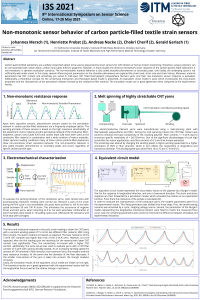
Carbon particle-filled elastomers are a widely researched option to be used as piezoresistive strain sensors for soft robotics or human motion monitoring. Therefore, various polymers can be compounded with carbon black, carbon nano tubes (CNT) or graphene. However, in many studies the electrical resistance’s strain response of the carbon-particle filled elastomers is non-monotonic in dynamic evaluation scenarios. The non-monotonic material behavior is also called shoulder phenomenon or secondary peak. Until today, the underlying cause is not sufficiently well understood. In this study, several influencing test parameters on the shoulder phenomena are explored like strain level, strain rate and strain history. Moreover, material parameters like CNT content and anisotropy are varied in melt-spun CNT filled thermoplastic polyurethane filament yarns and their non-monotonic sensor response is evaluated. Additionally, a theoretical concept for the underlying mechanism and thereupon-based model is developed. An equivalent circuit model is used, which incorporates the visco-elastic properties and the characteristic of the percolation network formed by the conductive filler material. The simulation results are in good agreement when compared to the experimental results.
Keywords
soft electronics
stretchable strain sensor
carbon particle-filled elastomer
shoulder phenomenon
Manuscript
sciforum-042998.pdf
Poster
sciforum-042998 Poster-I3S-Mersch_Probst.pdf
A washable silver-printed textile electrode for electrocardiography monitoring
Recognizing Eating Activities in Free-living Environment using Consumer Wearable Sensors