Event submissions
Published
 10.3390/I3S2021Dresden-10144 (registering DOI)
 This submission belongs to the session S1. Nano(bio)Sensors and Bioelectronics of the event 8th International Symposium on Sensor Science
Published date
17 May, 2021
Citation
Tatiana Simonyan, Anastasia Mamontova, Alexey Bogdanov, Konstantin Lukyanov, FLIM indicators for quantitative measurement of рН, in Proceedings of 8th International Symposium on Sensor Science, 17 May–28 May 2021, MDPI: Basel, Switzerland, doi: 10.3390/I3S2021Dresden-10144
Share
Email
Facebook
Twitter
LinkedIn
FLIM indicators for quantitative measurement of рН
'%3e%3cpath%20d='M12.6647%2010.9104C12.4176%2010.325%2012.0589%209.7933%2011.6088%209.34485C11.16%208.89511%2010.6283%208.53653%2010.0432%208.28891C10.038%208.28629%2010.0327%208.28498%2010.0275%208.28236C10.8437%207.69282%2011.3743%206.73252%2011.3743%205.64907C11.3743%203.85423%209.92005%202.40002%208.12522%202.40002C6.33038%202.40002%204.87618%203.85423%204.87618%205.64907C4.87618%206.73252%205.40677%207.69282%206.22296%208.28367C6.21772%208.28629%206.21248%208.2876%206.20724%208.29022C5.62031%208.53783%205.09365%208.89287%204.64167%209.34616C4.19192%209.79496%203.83334%2010.3266%203.58573%2010.9117C3.34247%2011.4846%203.21128%2012.0987%203.19925%2012.721C3.1989%2012.735%203.20135%2012.7489%203.20646%2012.7619C3.21157%2012.7749%203.21924%2012.7868%203.22901%2012.7968C3.23877%2012.8068%203.25045%2012.8148%203.26334%2012.8202C3.27623%2012.8256%203.29007%2012.8284%203.30406%2012.8284H4.09012C4.14776%2012.8284%204.19362%2012.7825%204.19493%2012.7262C4.22113%2011.7148%204.62726%2010.7676%205.34519%2010.0497C6.08802%209.30686%207.07452%208.89811%208.12522%208.89811C9.17592%208.89811%2010.1624%209.30686%2010.9052%2010.0497C11.6232%2010.7676%2012.0293%2011.7148%2012.0555%2012.7262C12.0568%2012.7839%2012.1027%2012.8284%2012.1603%2012.8284H12.9464C12.9604%2012.8284%2012.9742%2012.8256%2012.9871%2012.8202C13%2012.8148%2013.0117%2012.8068%2013.0214%2012.7968C13.0312%2012.7868%2013.0389%2012.7749%2013.044%2012.7619C13.0491%2012.7489%2013.0515%2012.735%2013.0512%2012.721C13.0381%2012.0947%2012.9084%2011.4856%2012.6647%2010.9104ZM8.12522%207.90243C7.52388%207.90243%206.95792%207.66793%206.53214%207.24215C6.10636%206.81636%205.87185%206.2504%205.87185%205.64907C5.87185%205.04773%206.10636%204.48177%206.53214%204.05599C6.95792%203.63021%207.52388%203.3957%208.12522%203.3957C8.72655%203.3957%209.29252%203.63021%209.7183%204.05599C10.1441%204.48177%2010.3786%205.04773%2010.3786%205.64907C10.3786%206.2504%2010.1441%206.81636%209.7183%207.24215C9.29252%207.66793%208.72655%207.90243%208.12522%207.90243Z'%20fill='%235D1EE1'/%3e%3c/g%3e%3c/svg%3e)
Tatiana Simonyan 1
Anastasia Mamontova 1
Alexey Bogdanov 2
Konstantin Lukyanov 3
1. Center of Life Sciences, Skoltech, Moscow, Russian Federation
2. Shemyakin and Ovchinnikov Institute of Bioorganic Chemistry , RAS, Moscow, Russian Federation
3. Center of Life Sciences, Skoltech, Moscow, Russian Federation.
Abstract
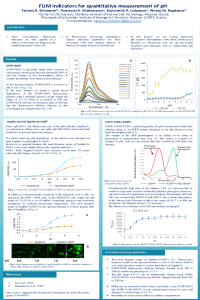
Monitoring of intracellular pH changes in situ can provide valuable information about cellular metabolism and a deeper understanding of physiological processes. Most traditional fluorescent indicators are only capable of a relative assessment of changes in the studied parameter in the cell. We associate the possibility of measuring the absolute values that characterize the analyte with the detection of the indicator signal in the time domain, where its quantitative measure is the fluorescence lifetime (tau). In this project, we are testing promising pH-sensitive fluorophores with labile fluorescence lifetimes-EYFP-G65T and EGFP-Y145L/S205V– both as fluorescent core for the previously described pH indicators and as independent pH indicators. Measurement of the fluorescence attenuation kinetics of four structures (EYFP-G65T, EGFP-Y145L/S205V, SypHer3s, and SypHer3s-G65T) over a wide pH range revealed areas where tau is linearly dependent on pH. The differences in the fluorescence excitation modes of these molecules makes it possible to use them in one experimental system to assess pH changes in a wide range 4.0–9.0. We showed that under the conditions of traditional fluorescence microscopy (in the cytoplasm of HEK293 cells), the SypHer3s-G65T indicator shows a dynamic response range approximately 3 times wider than the original SypHer3s.
Keywords
fluorescence lifetime
time-resolved microscopy
fluorescence lifetime imaging microscopy
FLIM
fluorescence imaging
fluorescent proteins
fluorescent biosensors
genetically encoded indicators
small molecules visualization
Manuscript
sciforum-043158.pdf
Poster
SimonyanTR_sciforum-043158.pdf
Wearable xAI: a knowledge-based federated learning framework
Uncertainty Analysis for Low-Cost Transformer Type Inductive Conductivity Sensors