Event submissions
Published
 10.3390/I3S2021Dresden-10146 (registering DOI)
 This submission belongs to the session S4. Sensor Applications and Smart Systems of the event 8th International Symposium on Sensor Science
Published date
17 May, 2021
Citation
Samuel Zeising, Rebecca Seidl, Angelika Thalmayer, Georg Fischer, Jens Kirchner, Low-Frequency Magnetic Localization of Capsule Endoscopes with an Integrated Coil, in Proceedings of 8th International Symposium on Sensor Science, 17 May–28 May 2021, MDPI: Basel, Switzerland, doi: 10.3390/I3S2021Dresden-10146
Share
Email
Facebook
Twitter
LinkedIn
Low-Frequency Magnetic Localization of Capsule Endoscopes with an Integrated Coil
'%3e%3cpath%20d='M12.6647%2010.9104C12.4176%2010.325%2012.0589%209.7933%2011.6088%209.34485C11.16%208.89511%2010.6283%208.53653%2010.0432%208.28891C10.038%208.28629%2010.0327%208.28498%2010.0275%208.28236C10.8437%207.69282%2011.3743%206.73252%2011.3743%205.64907C11.3743%203.85423%209.92005%202.40002%208.12522%202.40002C6.33038%202.40002%204.87618%203.85423%204.87618%205.64907C4.87618%206.73252%205.40677%207.69282%206.22296%208.28367C6.21772%208.28629%206.21248%208.2876%206.20724%208.29022C5.62031%208.53783%205.09365%208.89287%204.64167%209.34616C4.19192%209.79496%203.83334%2010.3266%203.58573%2010.9117C3.34247%2011.4846%203.21128%2012.0987%203.19925%2012.721C3.1989%2012.735%203.20135%2012.7489%203.20646%2012.7619C3.21157%2012.7749%203.21924%2012.7868%203.22901%2012.7968C3.23877%2012.8068%203.25045%2012.8148%203.26334%2012.8202C3.27623%2012.8256%203.29007%2012.8284%203.30406%2012.8284H4.09012C4.14776%2012.8284%204.19362%2012.7825%204.19493%2012.7262C4.22113%2011.7148%204.62726%2010.7676%205.34519%2010.0497C6.08802%209.30686%207.07452%208.89811%208.12522%208.89811C9.17592%208.89811%2010.1624%209.30686%2010.9052%2010.0497C11.6232%2010.7676%2012.0293%2011.7148%2012.0555%2012.7262C12.0568%2012.7839%2012.1027%2012.8284%2012.1603%2012.8284H12.9464C12.9604%2012.8284%2012.9742%2012.8256%2012.9871%2012.8202C13%2012.8148%2013.0117%2012.8068%2013.0214%2012.7968C13.0312%2012.7868%2013.0389%2012.7749%2013.044%2012.7619C13.0491%2012.7489%2013.0515%2012.735%2013.0512%2012.721C13.0381%2012.0947%2012.9084%2011.4856%2012.6647%2010.9104ZM8.12522%207.90243C7.52388%207.90243%206.95792%207.66793%206.53214%207.24215C6.10636%206.81636%205.87185%206.2504%205.87185%205.64907C5.87185%205.04773%206.10636%204.48177%206.53214%204.05599C6.95792%203.63021%207.52388%203.3957%208.12522%203.3957C8.72655%203.3957%209.29252%203.63021%209.7183%204.05599C10.1441%204.48177%2010.3786%205.04773%2010.3786%205.64907C10.3786%206.2504%2010.1441%206.81636%209.7183%207.24215C9.29252%207.66793%208.72655%207.90243%208.12522%207.90243Z'%20fill='%235D1EE1'/%3e%3c/g%3e%3c/svg%3e)
Samuel Zeising 1
Rebecca Seidl 1

Angelika Thalmayer 1

Georg Fischer 1
Jens Kirchner 1
1. Institute for Electronics Engineering, Friedrich-Alexander-Universität Erlangen-Nürnberg (FAU), 91058 Erlangen, Germany
Abstract
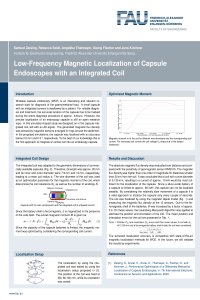
Wireless capsule endoscopy is a promising and less invasive alternative to conventional endoscopy. A patient swallows a small capsule with an integrated camera to capture a video of the gastrointestinal tract. For accurate diagnosis and therapy, the capsule position in terms of the travelled distance must be known for each video frame. However, up to now, there is no reliable localization method for endoscopy capsules. In this paper, a novel magnetic localization method is proposed. A coil as a magnetic field source is integrated into a capsule and fed with a low-frequency alternating current to prevent static geomagnetic field interference. This alternating magnetic field is measured by twelve magnetic sensors arranged in rings around the abdomen. The coil and the capsule batteries were designed based on the geometry and power supply of a commercially available endoscopy capsule and simulated by COMSOL Multiphysics software. In this way, the coil position and orientation were determined with an accuracy below 1 mm and 1°, respectively. As an analytic model for the magnetic flux density of the coil in that setup, a modified dipole model was derived. It was used to show that the batteries help to increase the amplitude of the magnetic flux density. The model is valid when signals below 100 Hz are applied, and no eddy currents are generated within the batteries. It is concluded that the magnetic flux density generated by the developed coil would be measurable with state-of-the-art magnetic sensors.
Keywords
wireless capsule endoscopy
magnetic localization
coil design
low-frequency
Manuscript
sciforum-042716.pdf
Poster
sciforum-042716 poster.pdf
Uncertainty Analysis for Low-Cost Transformer Type Inductive Conductivity Sensors
System Architecture for IIoT-based POC Molecular Diagnostic Device