Event submissions
Published
 10.3390/I3S2021Dresden-10147 (registering DOI)
 This submission belongs to the session S4. Sensor Applications and Smart Systems of the event 8th International Symposium on Sensor Science
Published date
17 May, 2021
Citation
Byeong-Heon Kil, Ji-Seong Park, Chan-Young Park, Yu-Seop Kim, Jong-Dae Kim, System Architecture for IIoT-based POC Molecular Diagnostic Device, in Proceedings of 8th International Symposium on Sensor Science, 17 May–28 May 2021, MDPI: Basel, Switzerland, doi: 10.3390/I3S2021Dresden-10147
Share
Email
Facebook
Twitter
LinkedIn
System Architecture for IIoT-based POC Molecular Diagnostic Device
'%3e%3cpath%20d='M12.6647%2010.9104C12.4176%2010.325%2012.0589%209.7933%2011.6088%209.34485C11.16%208.89511%2010.6283%208.53653%2010.0432%208.28891C10.038%208.28629%2010.0327%208.28498%2010.0275%208.28236C10.8437%207.69282%2011.3743%206.73252%2011.3743%205.64907C11.3743%203.85423%209.92005%202.40002%208.12522%202.40002C6.33038%202.40002%204.87618%203.85423%204.87618%205.64907C4.87618%206.73252%205.40677%207.69282%206.22296%208.28367C6.21772%208.28629%206.21248%208.2876%206.20724%208.29022C5.62031%208.53783%205.09365%208.89287%204.64167%209.34616C4.19192%209.79496%203.83334%2010.3266%203.58573%2010.9117C3.34247%2011.4846%203.21128%2012.0987%203.19925%2012.721C3.1989%2012.735%203.20135%2012.7489%203.20646%2012.7619C3.21157%2012.7749%203.21924%2012.7868%203.22901%2012.7968C3.23877%2012.8068%203.25045%2012.8148%203.26334%2012.8202C3.27623%2012.8256%203.29007%2012.8284%203.30406%2012.8284H4.09012C4.14776%2012.8284%204.19362%2012.7825%204.19493%2012.7262C4.22113%2011.7148%204.62726%2010.7676%205.34519%2010.0497C6.08802%209.30686%207.07452%208.89811%208.12522%208.89811C9.17592%208.89811%2010.1624%209.30686%2010.9052%2010.0497C11.6232%2010.7676%2012.0293%2011.7148%2012.0555%2012.7262C12.0568%2012.7839%2012.1027%2012.8284%2012.1603%2012.8284H12.9464C12.9604%2012.8284%2012.9742%2012.8256%2012.9871%2012.8202C13%2012.8148%2013.0117%2012.8068%2013.0214%2012.7968C13.0312%2012.7868%2013.0389%2012.7749%2013.044%2012.7619C13.0491%2012.7489%2013.0515%2012.735%2013.0512%2012.721C13.0381%2012.0947%2012.9084%2011.4856%2012.6647%2010.9104ZM8.12522%207.90243C7.52388%207.90243%206.95792%207.66793%206.53214%207.24215C6.10636%206.81636%205.87185%206.2504%205.87185%205.64907C5.87185%205.04773%206.10636%204.48177%206.53214%204.05599C6.95792%203.63021%207.52388%203.3957%208.12522%203.3957C8.72655%203.3957%209.29252%203.63021%209.7183%204.05599C10.1441%204.48177%2010.3786%205.04773%2010.3786%205.64907C10.3786%206.2504%2010.1441%206.81636%209.7183%207.24215C9.29252%207.66793%208.72655%207.90243%208.12522%207.90243Z'%20fill='%235D1EE1'/%3e%3c/g%3e%3c/svg%3e)
Byeong-Heon Kil 1
Ji-Seong Park 2,3
Chan-Young Park 2,3
Yu-Seop Kim 2,3
Jong-Dae Kim 2,3
1. Department of Electrical and Computer Engineering, North Carolina State University, Raleigh, NC 27695, USA
2. Department of Convergence Software, Hallym University, Chuncheon-si 24252, Gangwon-do, Korea
3. BIT Research Center, Hallym University, Chuncheon-si 24252, Gangwon-do, Korea
Abstract
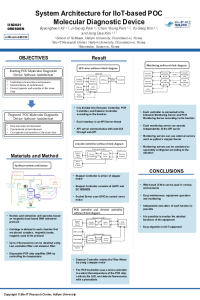
In this paper, we investigate the efficient structure for point-of-care (POC) molecular diagnostic system based on of the industrial-internet-of-things (IIoT). The target system can perform automated molecular diagnosis including DNA extraction, PCR amplification, and fluorescence detection. Samples and reagents are placed in a multi-room cartridge and loaded into the system. A rotating motor and a syringe motor control the cartridge to extract DNA from the sample. The extracted DNA is transferred to a polymerase chain reaction (PCR) chamber for DNA amplification and detection. The proposed system provides multiplexing of up to 4 colors. For POC molecular diagnostics, World Health Organization demands features such as low volume, low cost, fast results, and user-friendly interface. In this paper, we propose a system structure that can satisfy these requirements by using PCR chip and open platform. A distributed structure is adopted for the convenience of maintenance, and a web-based GUI is adopted for the user’s convenience. We also investigated communication problems that may occur between system components. Using the proposed structure, the user can conveniently control from standard computing devices including a smartphone.
Keywords
point-of-care molecular diagnosis device
industrial-internet-of-thing
system architecture
distribute computing
Manuscript
sciforum-043150.pdf
Poster
sciforum043150_210417jdkim.pdf
Low-Frequency Magnetic Localization of Capsule Endoscopes with an Integrated Coil
Electrochemical and Hydrodynamic Characterization of a 3D-Printed Electrochemical Flow-Cell