Event submissions
Published
 10.3390/I3S2021Dresden-10148 (registering DOI)
 This submission belongs to the session S4. Sensor Applications and Smart Systems of the event 8th International Symposium on Sensor Science
Published date
17 May, 2021
Citation
Jesús Eduardo Contreras-Naranjo, Víctor Hugo Perez-Gonzalez, Marco Arnulfo Mata-Gomez, Oscar Aguilar, Electrochemical and Hydrodynamic Characterization of a 3D-Printed Electrochemical Flow-Cell, in Proceedings of 8th International Symposium on Sensor Science, 17 May–28 May 2021, MDPI: Basel, Switzerland, doi: 10.3390/I3S2021Dresden-10148
Share
Email
Facebook
Twitter
LinkedIn
Electrochemical and Hydrodynamic Characterization of a 3D-Printed Electrochemical Flow-Cell
'%3e%3cpath%20d='M12.6647%2010.9104C12.4176%2010.325%2012.0589%209.7933%2011.6088%209.34485C11.16%208.89511%2010.6283%208.53653%2010.0432%208.28891C10.038%208.28629%2010.0327%208.28498%2010.0275%208.28236C10.8437%207.69282%2011.3743%206.73252%2011.3743%205.64907C11.3743%203.85423%209.92005%202.40002%208.12522%202.40002C6.33038%202.40002%204.87618%203.85423%204.87618%205.64907C4.87618%206.73252%205.40677%207.69282%206.22296%208.28367C6.21772%208.28629%206.21248%208.2876%206.20724%208.29022C5.62031%208.53783%205.09365%208.89287%204.64167%209.34616C4.19192%209.79496%203.83334%2010.3266%203.58573%2010.9117C3.34247%2011.4846%203.21128%2012.0987%203.19925%2012.721C3.1989%2012.735%203.20135%2012.7489%203.20646%2012.7619C3.21157%2012.7749%203.21924%2012.7868%203.22901%2012.7968C3.23877%2012.8068%203.25045%2012.8148%203.26334%2012.8202C3.27623%2012.8256%203.29007%2012.8284%203.30406%2012.8284H4.09012C4.14776%2012.8284%204.19362%2012.7825%204.19493%2012.7262C4.22113%2011.7148%204.62726%2010.7676%205.34519%2010.0497C6.08802%209.30686%207.07452%208.89811%208.12522%208.89811C9.17592%208.89811%2010.1624%209.30686%2010.9052%2010.0497C11.6232%2010.7676%2012.0293%2011.7148%2012.0555%2012.7262C12.0568%2012.7839%2012.1027%2012.8284%2012.1603%2012.8284H12.9464C12.9604%2012.8284%2012.9742%2012.8256%2012.9871%2012.8202C13%2012.8148%2013.0117%2012.8068%2013.0214%2012.7968C13.0312%2012.7868%2013.0389%2012.7749%2013.044%2012.7619C13.0491%2012.7489%2013.0515%2012.735%2013.0512%2012.721C13.0381%2012.0947%2012.9084%2011.4856%2012.6647%2010.9104ZM8.12522%207.90243C7.52388%207.90243%206.95792%207.66793%206.53214%207.24215C6.10636%206.81636%205.87185%206.2504%205.87185%205.64907C5.87185%205.04773%206.10636%204.48177%206.53214%204.05599C6.95792%203.63021%207.52388%203.3957%208.12522%203.3957C8.72655%203.3957%209.29252%203.63021%209.7183%204.05599C10.1441%204.48177%2010.3786%205.04773%2010.3786%205.64907C10.3786%206.2504%2010.1441%206.81636%209.7183%207.24215C9.29252%207.66793%208.72655%207.90243%208.12522%207.90243Z'%20fill='%235D1EE1'/%3e%3c/g%3e%3c/svg%3e)
Jesús Eduardo Contreras-Naranjo 1
Víctor Hugo Perez-Gonzalez 1
Marco Arnulfo Mata-Gomez 1

Oscar Aguilar 1
1. Tecnológico de Monterrey, Escuela de Ingeniería y Ciencias, Av. Eugenio Garza Sada 2501 Sur, Monterrey 64849, Nuevo León, Mexico
Abstract
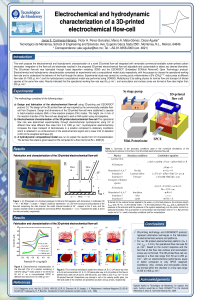
Additive Manufacturing (AM) also known as 3D-printing comprise a group of versatile technologies that has been used in electrochemistry last years. Among the 3D-printing technologies, Fused Deposition Modelling (FDM) highlights in the fabrication of reliable portable point of need platforms for its rapid prototyping, low cost, design customization, and ease of integration of diverse components as microfluidics, and electrodes. This work propose the electrochemical and hydrodynamic characterization of a novel 3D-printed flow-cell integrated with removable commercial-available screen-printed carbon electrodes. Integration of flow-cell and electrodes resulted in the proposed 3D-printed electrochemical flow-cell adjustable and customizable to detect any desired biomarker. The 3D-printed flow cell was fabricated through FDM and the ESCARGOT (Embedded SCAffold RemovinG Open Technology) protocol. Electrochemical and hydrodynamic characterization comprised an experimental and a computational model study respectively, with the purpose to choose the best working flow rate and to understand the behavior of the fluid through the device. Experimental study was carried out running cyclic voltammetries of [Fe (CN)6]4−/3− redox probe at different flow rates (0, 50, 100, 200, 300, 400, 500 and 1000 μL min−1) and the hydrodynamic computational model was performed using COMSOL Multiphysics 5.3a setting physics for laminar flow and transport of diluted species at the same flow rates. Results indicated that the best working flow rate was 50 μL min−1, and recirculation and vortices zones are formed at flow rates higher than 200 μL min−1.
Keywords
3D-printing
flow-cell
screen-printed carbon electrodes
electrochemical and hydrodynamic characterization
Manuscript
sciforum-043098.pdf
Poster
sciforum-043098 Póster_sensors_mdpi_2021_JECN_congress.pdf
System Architecture for IIoT-based POC Molecular Diagnostic Device
A study of visible-blind properties of a SnO2’s nanowires network photodetector