Event submissions
Published
 10.3390/I3S2021Dresden-10152 (registering DOI)
 This submission belongs to the session S4. Sensor Applications and Smart Systems of the event 8th International Symposium on Sensor Science
Published date
18 May, 2021
Citation
Jorge Jimenez, Antoni Grau, Integration of an optical setup for the characterization of near-infrared detectors used in ground and space-based astronomy, in Proceedings of 8th International Symposium on Sensor Science, 17 May–28 May 2021, MDPI: Basel, Switzerland, doi: 10.3390/I3S2021Dresden-10152
Share
Email
Facebook
Twitter
LinkedIn
Integration of an optical setup for the characterization of near-infrared detectors used in ground and space-based astronomy
'%3e%3cpath%20d='M12.6647%2010.9104C12.4176%2010.325%2012.0589%209.7933%2011.6088%209.34485C11.16%208.89511%2010.6283%208.53653%2010.0432%208.28891C10.038%208.28629%2010.0327%208.28498%2010.0275%208.28236C10.8437%207.69282%2011.3743%206.73252%2011.3743%205.64907C11.3743%203.85423%209.92005%202.40002%208.12522%202.40002C6.33038%202.40002%204.87618%203.85423%204.87618%205.64907C4.87618%206.73252%205.40677%207.69282%206.22296%208.28367C6.21772%208.28629%206.21248%208.2876%206.20724%208.29022C5.62031%208.53783%205.09365%208.89287%204.64167%209.34616C4.19192%209.79496%203.83334%2010.3266%203.58573%2010.9117C3.34247%2011.4846%203.21128%2012.0987%203.19925%2012.721C3.1989%2012.735%203.20135%2012.7489%203.20646%2012.7619C3.21157%2012.7749%203.21924%2012.7868%203.22901%2012.7968C3.23877%2012.8068%203.25045%2012.8148%203.26334%2012.8202C3.27623%2012.8256%203.29007%2012.8284%203.30406%2012.8284H4.09012C4.14776%2012.8284%204.19362%2012.7825%204.19493%2012.7262C4.22113%2011.7148%204.62726%2010.7676%205.34519%2010.0497C6.08802%209.30686%207.07452%208.89811%208.12522%208.89811C9.17592%208.89811%2010.1624%209.30686%2010.9052%2010.0497C11.6232%2010.7676%2012.0293%2011.7148%2012.0555%2012.7262C12.0568%2012.7839%2012.1027%2012.8284%2012.1603%2012.8284H12.9464C12.9604%2012.8284%2012.9742%2012.8256%2012.9871%2012.8202C13%2012.8148%2013.0117%2012.8068%2013.0214%2012.7968C13.0312%2012.7868%2013.0389%2012.7749%2013.044%2012.7619C13.0491%2012.7489%2013.0515%2012.735%2013.0512%2012.721C13.0381%2012.0947%2012.9084%2011.4856%2012.6647%2010.9104ZM8.12522%207.90243C7.52388%207.90243%206.95792%207.66793%206.53214%207.24215C6.10636%206.81636%205.87185%206.2504%205.87185%205.64907C5.87185%205.04773%206.10636%204.48177%206.53214%204.05599C6.95792%203.63021%207.52388%203.3957%208.12522%203.3957C8.72655%203.3957%209.29252%203.63021%209.7183%204.05599C10.1441%204.48177%2010.3786%205.04773%2010.3786%205.64907C10.3786%206.2504%2010.1441%206.81636%209.7183%207.24215C9.29252%207.66793%208.72655%207.90243%208.12522%207.90243Z'%20fill='%235D1EE1'/%3e%3c/g%3e%3c/svg%3e)
Jorge Jimenez 1

Antoni Grau 2
1. Institute for High Energy Physics, Universitat Autònoma de Barcelona (UAB), Universitat Autònoma de Barcelona, 08193 Bellaterra, Spain
2. Automatic Control Department, Technical University of Catalonia, 08034 Barcelona, Spain
Abstract
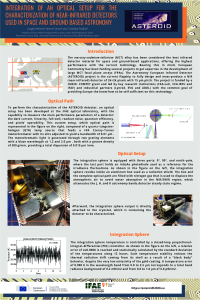
To make Europe competitive in the field of astronomical sensors and detectors, the main goal of this research is to provide the capability to manufacture high performance infrared focal plane arrays (FPA) devoted to scientific and astronomical ground and space telescope missions. This paper presents the main outcome of an international project with the highest standard of quality for this detector. The resulting detector is a sensor with a hybridized MCT (HgCdTe) epilayer on a CdZnTe substrate of 2 k × 2 k pixels and 15 μm of pixel pitch. On this framework, an optical setup has been developed at the IFAE optical laboratory with the capabilities to perform the characterization of a near-infrared (NIR) detector covering the range from 800 to 2500 nm. The optical setup is mainly composed by a power controlled quartz-halogen (QTH) lamp and an astigmatism-corrected Czerny-Turner monochromator with a couple of diffraction gratings covering the detector wavelength range with a minimum resolution of ∼1 nm. A temperature stabilized gold-coated integration sphere provides a uniform and monochromatic illumination while a InGaAs photodiode located at the north-pole of the integration sphere is used to measure the radiant flux toward the detector. The whole setup is fully controlled by a Labview™ application and synchronized with the detector’s readout electronic (ROE).
Keywords
astronomical sensor
focal plane array
optical setup
near-infrared detector
Manuscript
sciforum-029782.pdf
Poster
029782 SENSORS_2021_A1.pdf
Low power multi-sensors for selective gas detection
Investigation of the Thermally Generated Au and Ag Nanoislands for SERS and LSPR Applications