Event submissions
Published
 10.3390/I3S2021Dresden-10154 (registering DOI)
 This submission belongs to the session S2. Chemical Sensors of the event 8th International Symposium on Sensor Science
Published date
18 May, 2021
Citation
Nirmal Kumar, Stanislav Haviar, Jiri Rezek, Jiri Capek, Pavel Baroch, Tungsten Oxide based Hydrogen Gas Sensor Prepared by Advanced Magnetron Sputtering, in Proceedings of 8th International Symposium on Sensor Science, 17 May–28 May 2021, MDPI: Basel, Switzerland, doi: 10.3390/I3S2021Dresden-10154
Share
Email
Facebook
Twitter
LinkedIn
Tungsten Oxide based Hydrogen Gas Sensor Prepared by Advanced Magnetron Sputtering
'%3e%3cpath%20d='M12.6647%2010.9104C12.4176%2010.325%2012.0589%209.7933%2011.6088%209.34485C11.16%208.89511%2010.6283%208.53653%2010.0432%208.28891C10.038%208.28629%2010.0327%208.28498%2010.0275%208.28236C10.8437%207.69282%2011.3743%206.73252%2011.3743%205.64907C11.3743%203.85423%209.92005%202.40002%208.12522%202.40002C6.33038%202.40002%204.87618%203.85423%204.87618%205.64907C4.87618%206.73252%205.40677%207.69282%206.22296%208.28367C6.21772%208.28629%206.21248%208.2876%206.20724%208.29022C5.62031%208.53783%205.09365%208.89287%204.64167%209.34616C4.19192%209.79496%203.83334%2010.3266%203.58573%2010.9117C3.34247%2011.4846%203.21128%2012.0987%203.19925%2012.721C3.1989%2012.735%203.20135%2012.7489%203.20646%2012.7619C3.21157%2012.7749%203.21924%2012.7868%203.22901%2012.7968C3.23877%2012.8068%203.25045%2012.8148%203.26334%2012.8202C3.27623%2012.8256%203.29007%2012.8284%203.30406%2012.8284H4.09012C4.14776%2012.8284%204.19362%2012.7825%204.19493%2012.7262C4.22113%2011.7148%204.62726%2010.7676%205.34519%2010.0497C6.08802%209.30686%207.07452%208.89811%208.12522%208.89811C9.17592%208.89811%2010.1624%209.30686%2010.9052%2010.0497C11.6232%2010.7676%2012.0293%2011.7148%2012.0555%2012.7262C12.0568%2012.7839%2012.1027%2012.8284%2012.1603%2012.8284H12.9464C12.9604%2012.8284%2012.9742%2012.8256%2012.9871%2012.8202C13%2012.8148%2013.0117%2012.8068%2013.0214%2012.7968C13.0312%2012.7868%2013.0389%2012.7749%2013.044%2012.7619C13.0491%2012.7489%2013.0515%2012.735%2013.0512%2012.721C13.0381%2012.0947%2012.9084%2011.4856%2012.6647%2010.9104ZM8.12522%207.90243C7.52388%207.90243%206.95792%207.66793%206.53214%207.24215C6.10636%206.81636%205.87185%206.2504%205.87185%205.64907C5.87185%205.04773%206.10636%204.48177%206.53214%204.05599C6.95792%203.63021%207.52388%203.3957%208.12522%203.3957C8.72655%203.3957%209.29252%203.63021%209.7183%204.05599C10.1441%204.48177%2010.3786%205.04773%2010.3786%205.64907C10.3786%206.2504%2010.1441%206.81636%209.7183%207.24215C9.29252%207.66793%208.72655%207.90243%208.12522%207.90243Z'%20fill='%235D1EE1'/%3e%3c/g%3e%3c/svg%3e)
Nirmal Kumar 1
Stanislav Haviar 1
Jiri Rezek 1
Jiri Capek 1
Pavel Baroch 1
1. Department of Physics and NTIS-European Centre of Excellence, University of West Bohemia, Univerzitni 8, 301 00 Pilsen, Czech Republic
Abstract
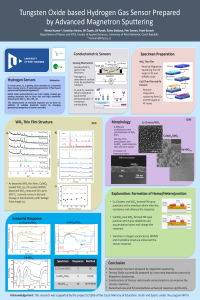
In this study, we demonstrate the advantages of two advanced sputtering techniques for the preparation of a thin-film conductometric gas sensor. We combined tungsten oxide (WO3) thin films with other materials to achieve enhanced sensorial behavior towards hydrogen. Thin films of WO3 were prepared by the DC and HiPIMS technique, which allowed us to tune the phase composition and crystallinity of the oxide by changing the deposition parameters.Then, the second material was added on-top of these films. We used the copper tungstate CuWO4 in a form of nano-islands deposited by reactive rf sputtering and Pd particles formed during conventional dc sputtering.The specimens were tested for the response to a time-varied hydrogen concentration in synthetic air at various temperatures. The sensitivity and response time were evaluated. The performance of individual films is presented as well as the details of the synthesis.Advanced magnetron techniques (such as HiPIMS) allow us to tune the property of the film to improve the sensorial behavior. The method is compatible with the silicon electronics industry, which consists of a few steps that don't require any wet technique and films can be used in an as-deposited state. Therefore, sensorial nanostructured materials prepared by magnetron sputtering are very suitable for use in miniaturized electronic devices.
Keywords
hydrogen sensor
copper tungstate
tungsten oxide
magnetron sputtering
nanostructures
HiPIMS
Manuscript
sciforum-043283.pdf
Poster
Poster sciforum-043283.pdf
Investigation of the Thermally Generated Au and Ag Nanoislands for SERS and LSPR Applications
Enriching low-density terrain maps from satellite with autonomous robots data