Event submissions
Published
 10.3390/I3S2021Dresden-10165 (registering DOI)
 This submission belongs to the session S2. Chemical Sensors of the event 8th International Symposium on Sensor Science
Published date
20 May, 2021
Citation
Takahiro Arakawa, Ming Ye, Kenta Iitani, Koji Toma, Kohji Mitsubayashi, Acetone Bio-Sniffer (Gas-Phase Biosensor) for Monitoring of Human Volatile Using Enzymatic Reaction of Secondary Alcohol Dehydrogenase , in Proceedings of 8th International Symposium on Sensor Science, 17 May–28 May 2021, MDPI: Basel, Switzerland, doi: 10.3390/I3S2021Dresden-10165
Share
Email
Facebook
Twitter
LinkedIn
Acetone Bio-Sniffer (Gas-Phase Biosensor) for Monitoring of Human Volatile Using Enzymatic Reaction of Secondary Alcohol Dehydrogenase
'%3e%3cpath%20d='M12.6647%2010.9104C12.4176%2010.325%2012.0589%209.7933%2011.6088%209.34485C11.16%208.89511%2010.6283%208.53653%2010.0432%208.28891C10.038%208.28629%2010.0327%208.28498%2010.0275%208.28236C10.8437%207.69282%2011.3743%206.73252%2011.3743%205.64907C11.3743%203.85423%209.92005%202.40002%208.12522%202.40002C6.33038%202.40002%204.87618%203.85423%204.87618%205.64907C4.87618%206.73252%205.40677%207.69282%206.22296%208.28367C6.21772%208.28629%206.21248%208.2876%206.20724%208.29022C5.62031%208.53783%205.09365%208.89287%204.64167%209.34616C4.19192%209.79496%203.83334%2010.3266%203.58573%2010.9117C3.34247%2011.4846%203.21128%2012.0987%203.19925%2012.721C3.1989%2012.735%203.20135%2012.7489%203.20646%2012.7619C3.21157%2012.7749%203.21924%2012.7868%203.22901%2012.7968C3.23877%2012.8068%203.25045%2012.8148%203.26334%2012.8202C3.27623%2012.8256%203.29007%2012.8284%203.30406%2012.8284H4.09012C4.14776%2012.8284%204.19362%2012.7825%204.19493%2012.7262C4.22113%2011.7148%204.62726%2010.7676%205.34519%2010.0497C6.08802%209.30686%207.07452%208.89811%208.12522%208.89811C9.17592%208.89811%2010.1624%209.30686%2010.9052%2010.0497C11.6232%2010.7676%2012.0293%2011.7148%2012.0555%2012.7262C12.0568%2012.7839%2012.1027%2012.8284%2012.1603%2012.8284H12.9464C12.9604%2012.8284%2012.9742%2012.8256%2012.9871%2012.8202C13%2012.8148%2013.0117%2012.8068%2013.0214%2012.7968C13.0312%2012.7868%2013.0389%2012.7749%2013.044%2012.7619C13.0491%2012.7489%2013.0515%2012.735%2013.0512%2012.721C13.0381%2012.0947%2012.9084%2011.4856%2012.6647%2010.9104ZM8.12522%207.90243C7.52388%207.90243%206.95792%207.66793%206.53214%207.24215C6.10636%206.81636%205.87185%206.2504%205.87185%205.64907C5.87185%205.04773%206.10636%204.48177%206.53214%204.05599C6.95792%203.63021%207.52388%203.3957%208.12522%203.3957C8.72655%203.3957%209.29252%203.63021%209.7183%204.05599C10.1441%204.48177%2010.3786%205.04773%2010.3786%205.64907C10.3786%206.2504%2010.1441%206.81636%209.7183%207.24215C9.29252%207.66793%208.72655%207.90243%208.12522%207.90243Z'%20fill='%235D1EE1'/%3e%3c/g%3e%3c/svg%3e)
Takahiro Arakawa 1
Ming Ye 1
Kenta Iitani 1
Koji Toma 1
Kohji Mitsubayashi 1
1. Institute of Biomaterials and Bioengineering, Tokyo Medical and Dental University, Tokyo 101-0062, Japan
Abstract
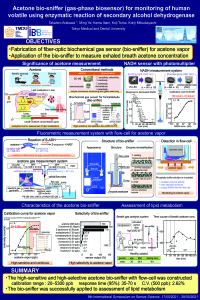
We developed a highly sensitive acetone bio-sniffer (gas-phase biosensor) based on an enzyme reductive reaction to monitor breath acetone concentration. The acetone bio-sniffer device was constructed by attaching a flow-cell with nicotinamide adenine dinucleotide (NADH)-dependent secondary alcohol dehydrogenase (S-ADH) immobilized membrane onto a fiber-optic NADH measurement system. This system utilizes an ultraviolet light emitting diode as an excitation light source. Acetone vapor was measured as fluorescence of NADH consumption by the enzymatic reaction of S-ADH. A phosphate buffer that contained oxidized NADH was circulated into the flow-cell to rinse the products and the excessive substrates from the optode; thus, the bio-sniffer enables real-time monitoring of acetone vapor concentration. A photomultiplier tube detects the change in the fluorescence emitted from NADH.
The relationship between fluorescence intensity and acetone concentration was identified from 20 ppb to 5300 ppb. This encompasses the range of concentration of acetone vapor found in breath of healthy people and of those suffering from disorders of carbohydrate metabolism. Then, the acetone bio-sniffer was used to monitor exhaled breath acetone concentration change before and after meal. When the sensing region was exposed to exhaled breath, fluorescence intensity decreased and reached to saturation immediately. Then it returned to the initial state upon cessation of the exhaled breath flow. We anticipate its future use as a non-invasive analytical tool for assessment of lipid metabolism in exercise, fasting and diabetes mellitus.
Keywords
biosensor
chemical sensor
enzyme
acetone
gas sensor
Poster
043235 210510_arakawa_poster.pdf
Aerial cooperative SLAM for ground mobile robot path planning
Low Cost, High Sensitivity Detection of Waterborne Al3+ Cations and F- Anions Via the Fluorescence Response of a Morin Derivative Dye