Event submissions
Published
 10.3390/CPPC2021-10189 (registering DOI)
 This submission belongs to the session A. Chemical-Biology and Medicinal Chemistry of the event First Canadian Peptide and Protein Community Virtual Symposium
Published date
27 May, 2021
Citation
Yousra Hamdane, Pradeep S. Chauhan, Suresh Vutla, Julien Poupart, Mukandila Mulumba, Huy Ong, William D. Lubell, N-aminoimidazole-2-ones Peptide Mimics Synthesis and Applications, in Proceedings of First Canadian Peptide and Protein Community Virtual Symposium, 27 May–28 May 2021, MDPI: Basel, Switzerland, doi: 10.3390/CPPC2021-10189
Share
Email
Facebook
Twitter
LinkedIn
N-aminoimidazole-2-ones Peptide Mimics Synthesis and Applications
'%3e%3cpath%20d='M12.6647%2010.9104C12.4176%2010.325%2012.0589%209.7933%2011.6088%209.34485C11.16%208.89511%2010.6283%208.53653%2010.0432%208.28891C10.038%208.28629%2010.0327%208.28498%2010.0275%208.28236C10.8437%207.69282%2011.3743%206.73252%2011.3743%205.64907C11.3743%203.85423%209.92005%202.40002%208.12522%202.40002C6.33038%202.40002%204.87618%203.85423%204.87618%205.64907C4.87618%206.73252%205.40677%207.69282%206.22296%208.28367C6.21772%208.28629%206.21248%208.2876%206.20724%208.29022C5.62031%208.53783%205.09365%208.89287%204.64167%209.34616C4.19192%209.79496%203.83334%2010.3266%203.58573%2010.9117C3.34247%2011.4846%203.21128%2012.0987%203.19925%2012.721C3.1989%2012.735%203.20135%2012.7489%203.20646%2012.7619C3.21157%2012.7749%203.21924%2012.7868%203.22901%2012.7968C3.23877%2012.8068%203.25045%2012.8148%203.26334%2012.8202C3.27623%2012.8256%203.29007%2012.8284%203.30406%2012.8284H4.09012C4.14776%2012.8284%204.19362%2012.7825%204.19493%2012.7262C4.22113%2011.7148%204.62726%2010.7676%205.34519%2010.0497C6.08802%209.30686%207.07452%208.89811%208.12522%208.89811C9.17592%208.89811%2010.1624%209.30686%2010.9052%2010.0497C11.6232%2010.7676%2012.0293%2011.7148%2012.0555%2012.7262C12.0568%2012.7839%2012.1027%2012.8284%2012.1603%2012.8284H12.9464C12.9604%2012.8284%2012.9742%2012.8256%2012.9871%2012.8202C13%2012.8148%2013.0117%2012.8068%2013.0214%2012.7968C13.0312%2012.7868%2013.0389%2012.7749%2013.044%2012.7619C13.0491%2012.7489%2013.0515%2012.735%2013.0512%2012.721C13.0381%2012.0947%2012.9084%2011.4856%2012.6647%2010.9104ZM8.12522%207.90243C7.52388%207.90243%206.95792%207.66793%206.53214%207.24215C6.10636%206.81636%205.87185%206.2504%205.87185%205.64907C5.87185%205.04773%206.10636%204.48177%206.53214%204.05599C6.95792%203.63021%207.52388%203.3957%208.12522%203.3957C8.72655%203.3957%209.29252%203.63021%209.7183%204.05599C10.1441%204.48177%2010.3786%205.04773%2010.3786%205.64907C10.3786%206.2504%2010.1441%206.81636%209.7183%207.24215C9.29252%207.66793%208.72655%207.90243%208.12522%207.90243Z'%20fill='%235D1EE1'/%3e%3c/g%3e%3c/svg%3e)
Yousra Hamdane 1
Pradeep S. Chauhan 1
Suresh Vutla 1
Julien Poupart 1
Mukandila Mulumba 1

Huy Ong 1

William D. Lubell 1
1. Université de Montréal
Abstract
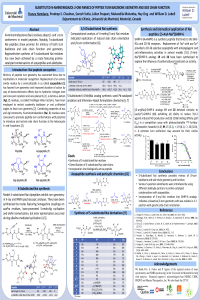
Peptide secondary structures have privileged roles in molecular recognition and therapeutic potential. α-Amino lactam residues have been commonly used as conformational constraints to study peptide structure-activity relationship for drug discovery [1]. N-Aminoimidazolone (Nai) residues offer similar means for constraining peptide backbone geometry [1, 2]. In model peptides, (4-methyl)Nai residues were found to adopt the central position of β- and γ-turn secondary structures. The addition of substituents at the 4- and 5-positions of the Nai residues may be used to mimic side chain function and orientation [3, 4]. Our presentation will feature the synthesis and application of Nai residues in the study of peptide structure-activity relationships [5].
- St-Cyr D.J., García-Ramos Y., Doan N.D., Lubell W.D. Peptidomimetics I. Springer; Cham, Switzerland: 2017. Aminolactam, N-Aminoimidazolone, and N-Aminoimdazolidinone Peptide Mimics; pp. 125–175.
- Proulx, C.; Lubell, W. D. "N-Amino-imidazolin-2-one Peptide Mimic Synthesis and Conformational Analysis" Lett., 2012, 14, 4552.
- Poupart, J., Doan-Ngoc, D., Bérubé, D., Hamdane, Y., Medena, C., Lubell, W. D. "Palladium-Catalyzed Arylation of N-Aminoimidazol-2-ones towards Synthesis of Constrained Phenylalanine Dipeptide Mimics" Heterocycles, 2019, 99, 279-293
- Poupart, J.; Hamdane, Y.; Lubell, W.D. "Synthesis of enantiomerically enriched 4,5-disubstituted N-aminoimidazol-2-one (Nai) peptide turn mimics" J. Chem. 2020, 98, 278–284.
- Hamdane, Y.; Chauhan, S. P.; Vutla, S.; Mulumba, D.; Ong, H.; Lubell, W. D. Submitted.
Keywords
Peptidomimetics
Organocatalysis
medicinal chemistry
Manuscript
sciforum-045332.pdf
Poster
sciforum_045332_manuscript_Yousra_Hamdane_CPPC_Poster.pdf
MALDI/MS as a Tool to Rapidly Screen Peptide Libraries for Novel Substrates of Farnesyltransferase
Evaluation of Redox Peptide Modified Surfaces for Biosensing Applications