Event submissions
Published
 10.3390/CPPC2021-10191 (registering DOI)
 This submission belongs to the session A. Chemical-Biology and Medicinal Chemistry of the event First Canadian Peptide and Protein Community Virtual Symposium
Published date
27 May, 2021
Citation
Sarah Brandão, Adriano dos Santos, Júlia Pinto Piccoli, Paulo Roberto Bueno, Eduardo Maffud Cilli, Evaluation of Redox Peptide Modified Surfaces for Biosensing Applications, in Proceedings of First Canadian Peptide and Protein Community Virtual Symposium, 27 May–28 May 2021, MDPI: Basel, Switzerland, doi: 10.3390/CPPC2021-10191
Share
Email
Facebook
Twitter
LinkedIn
Evaluation of Redox Peptide Modified Surfaces for Biosensing Applications
'%3e%3cpath%20d='M12.6647%2010.9104C12.4176%2010.325%2012.0589%209.7933%2011.6088%209.34485C11.16%208.89511%2010.6283%208.53653%2010.0432%208.28891C10.038%208.28629%2010.0327%208.28498%2010.0275%208.28236C10.8437%207.69282%2011.3743%206.73252%2011.3743%205.64907C11.3743%203.85423%209.92005%202.40002%208.12522%202.40002C6.33038%202.40002%204.87618%203.85423%204.87618%205.64907C4.87618%206.73252%205.40677%207.69282%206.22296%208.28367C6.21772%208.28629%206.21248%208.2876%206.20724%208.29022C5.62031%208.53783%205.09365%208.89287%204.64167%209.34616C4.19192%209.79496%203.83334%2010.3266%203.58573%2010.9117C3.34247%2011.4846%203.21128%2012.0987%203.19925%2012.721C3.1989%2012.735%203.20135%2012.7489%203.20646%2012.7619C3.21157%2012.7749%203.21924%2012.7868%203.22901%2012.7968C3.23877%2012.8068%203.25045%2012.8148%203.26334%2012.8202C3.27623%2012.8256%203.29007%2012.8284%203.30406%2012.8284H4.09012C4.14776%2012.8284%204.19362%2012.7825%204.19493%2012.7262C4.22113%2011.7148%204.62726%2010.7676%205.34519%2010.0497C6.08802%209.30686%207.07452%208.89811%208.12522%208.89811C9.17592%208.89811%2010.1624%209.30686%2010.9052%2010.0497C11.6232%2010.7676%2012.0293%2011.7148%2012.0555%2012.7262C12.0568%2012.7839%2012.1027%2012.8284%2012.1603%2012.8284H12.9464C12.9604%2012.8284%2012.9742%2012.8256%2012.9871%2012.8202C13%2012.8148%2013.0117%2012.8068%2013.0214%2012.7968C13.0312%2012.7868%2013.0389%2012.7749%2013.044%2012.7619C13.0491%2012.7489%2013.0515%2012.735%2013.0512%2012.721C13.0381%2012.0947%2012.9084%2011.4856%2012.6647%2010.9104ZM8.12522%207.90243C7.52388%207.90243%206.95792%207.66793%206.53214%207.24215C6.10636%206.81636%205.87185%206.2504%205.87185%205.64907C5.87185%205.04773%206.10636%204.48177%206.53214%204.05599C6.95792%203.63021%207.52388%203.3957%208.12522%203.3957C8.72655%203.3957%209.29252%203.63021%209.7183%204.05599C10.1441%204.48177%2010.3786%205.04773%2010.3786%205.64907C10.3786%206.2504%2010.1441%206.81636%209.7183%207.24215C9.29252%207.66793%208.72655%207.90243%208.12522%207.90243Z'%20fill='%235D1EE1'/%3e%3c/g%3e%3c/svg%3e)
Sarah Brandão 1
Adriano dos Santos 2
Júlia Pinto Piccoli 1
Paulo Roberto Bueno 2
Eduardo Maffud Cilli 1
1. Department of Biochemistry and Organic Chemistry, Institute of Chemistry, UNESP - Univ Estadual Paulista, São Paulo, Brazil
2. Department of Physical Chemistry, Nanobionics Research Group, Institute of Chemistry, UNESP - Univ Estadual Paulista, São Paulo, Brazil
Abstract
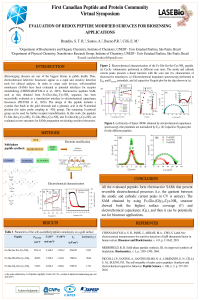
Peptides are promising tools for designing sensitive and stable biosensors. For example, the redox self-assembled monolayer (SAM) based on the sequence Fc-Glu-(Ala)2-Cys-NH2 was successful evaluated as transducing interface in electrochemical biosensors. The design of such peptides includes: 1) cysteine to bind covalently the peptide to the gold electrode; 2) glutamic acid in N-terminal position to bind the ferrocene (Fc) in the amine group, and the antibody in the δ-carboxyl group, and 3) alanine to form a hydrophobic layer. Herein, we present the solid-phase synthesis of three different peptides with structure Fc-Glu-(X)2-Cys-NH2 (X=Ser, Gly or Phe) and the electrochemical behavior of the obtained SAMs. The Gly was chosen because of its smallest side chain, while Ser and Phe present hydroxyl groups (for H-bonds) and aromatic (for π-π interaction), respectively. The synthesis successful of the HPLC purified peptides were confirmed by mass spectroscopy. From cyclic voltammetry and impedance-derived electrochemical capacitance spectroscopy results, all peptides present reversible redox processes, and electron transfer rates (kET ) ranging from 17 to 31 s-1. Since the peptide with Gly residues presented both the highest surface coverage (Γ = 2.6x10⁻¹⁰ mol/cm2) and electrochemical capacitance (Cµ = 270 µF/cm2) values, it can be potentially applied for biosensors designing.
Keywords
Self-assembled monolayer
Biosensor
Ferrocene-tagged Peptide
Electroactive peptide
Manuscript
sciforum-045374.pdf
Poster
sciforum_045374_manuscript_Sarah_poster_First_Canadian_Peptide_and_Protein_Community.pdf
N-aminoimidazole-2-ones Peptide Mimics Synthesis and Applications
Bio-Incorporation of TePhe, a Tellurium-Containing Phenylalanine Analogue, Preserves Protein Structure and Stability