Event submissions
Published
 10.3390/CPPC2021-10196 (registering DOI)
 This submission belongs to the session D. Synthetic and Mimetic Methods of the event First Canadian Peptide and Protein Community Virtual Symposium
Published date
27 May, 2021
Citation
Arvi Puka, Adrian Rotaru, Spencer Smyth, Andrew Beharry, Claudiu Gradinaru, Single-Step, Single-Column Rapid Protein Purification and Labelling for Fluorescence Studies, in Proceedings of First Canadian Peptide and Protein Community Virtual Symposium, 27 May–28 May 2021, MDPI: Basel, Switzerland, doi: 10.3390/CPPC2021-10196
Share
Email
Facebook
Twitter
LinkedIn
Single-Step, Single-Column Rapid Protein Purification and Labelling for Fluorescence Studies

Arvi Puka 1
'%3e%3cpath%20d='M12.6647%2010.9104C12.4176%2010.325%2012.0589%209.7933%2011.6088%209.34485C11.16%208.89511%2010.6283%208.53653%2010.0432%208.28891C10.038%208.28629%2010.0327%208.28498%2010.0275%208.28236C10.8437%207.69282%2011.3743%206.73252%2011.3743%205.64907C11.3743%203.85423%209.92005%202.40002%208.12522%202.40002C6.33038%202.40002%204.87618%203.85423%204.87618%205.64907C4.87618%206.73252%205.40677%207.69282%206.22296%208.28367C6.21772%208.28629%206.21248%208.2876%206.20724%208.29022C5.62031%208.53783%205.09365%208.89287%204.64167%209.34616C4.19192%209.79496%203.83334%2010.3266%203.58573%2010.9117C3.34247%2011.4846%203.21128%2012.0987%203.19925%2012.721C3.1989%2012.735%203.20135%2012.7489%203.20646%2012.7619C3.21157%2012.7749%203.21924%2012.7868%203.22901%2012.7968C3.23877%2012.8068%203.25045%2012.8148%203.26334%2012.8202C3.27623%2012.8256%203.29007%2012.8284%203.30406%2012.8284H4.09012C4.14776%2012.8284%204.19362%2012.7825%204.19493%2012.7262C4.22113%2011.7148%204.62726%2010.7676%205.34519%2010.0497C6.08802%209.30686%207.07452%208.89811%208.12522%208.89811C9.17592%208.89811%2010.1624%209.30686%2010.9052%2010.0497C11.6232%2010.7676%2012.0293%2011.7148%2012.0555%2012.7262C12.0568%2012.7839%2012.1027%2012.8284%2012.1603%2012.8284H12.9464C12.9604%2012.8284%2012.9742%2012.8256%2012.9871%2012.8202C13%2012.8148%2013.0117%2012.8068%2013.0214%2012.7968C13.0312%2012.7868%2013.0389%2012.7749%2013.044%2012.7619C13.0491%2012.7489%2013.0515%2012.735%2013.0512%2012.721C13.0381%2012.0947%2012.9084%2011.4856%2012.6647%2010.9104ZM8.12522%207.90243C7.52388%207.90243%206.95792%207.66793%206.53214%207.24215C6.10636%206.81636%205.87185%206.2504%205.87185%205.64907C5.87185%205.04773%206.10636%204.48177%206.53214%204.05599C6.95792%203.63021%207.52388%203.3957%208.12522%203.3957C8.72655%203.3957%209.29252%203.63021%209.7183%204.05599C10.1441%204.48177%2010.3786%205.04773%2010.3786%205.64907C10.3786%206.2504%2010.1441%206.81636%209.7183%207.24215C9.29252%207.66793%208.72655%207.90243%208.12522%207.90243Z'%20fill='%235D1EE1'/%3e%3c/g%3e%3c/svg%3e)
Adrian Rotaru 1
Spencer Smyth 1
Andrew Beharry 1
Claudiu Gradinaru 1
1. Chemical and Physical Sciences, University of Toronto, Mississauga
Abstract
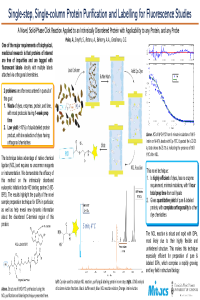
The protocol to purify and fluorescently label proteins typically includes lengthy purification steps and stochastically governed labelling methods. When multi-labelled proteins are required, poor yields, waste of valuable reagents, and lengthy sample preparation times are generally inevitable. In addition, many fluorophore combinations are incompatible, which makes the task of efficiently producing multi-labelled, high-purity proteins very difficult.
Here, we describe a novel method that enables the preparation of purified and labelled proteins in only a few hours. Our protocol gives high yield of the desired protein product using minimal mutations, high specificity of labelling, and ease of chemically orthogonal attachment of other fluorescent probes in later steps. This technique takes advantage of native chemical ligation in a single-step, in one liquid-chromatography column, by the addition of one reagent, with the ability to purify and label any protein using any desired fluorescent probe.
We demonstrate the efficacy of this method on the eukaryotic initiation factor 4E binding partner 2 (4E-BP2). This translational regulation protein is intrinsically disordered and is implicated in autism and neurodegenerative diseases. Proof-of-principle biophysical experiments such as Förster resonance energy transfer (FRET)and fluorescence correlation spectroscopy (FCS) were performed on the 4E-BP2 protein labelled using our new method. The results highlight the quality of the novel sample preparation technique, as well as help reveal new dynamic information about the disordered C-terminal region of this protein.
Keywords
protein purification
protein labelling
fluorescence
protein preparation
biophysical analysis
Manuscript
sciforum-044525.pdf
Poster
044525.pdf
Polyfluorinated Aromatic Porphyrin as a Photoactive Scaffold for Peptide Cyclisation
Constrained Glu‐Gly and Gln‐Gly Dipeptide Surrogates from γ‐Substituted α‐Amino‐δ‐Lactam Synthesis