Event submissions
Published
 10.3390/CPPC2021-10201 (registering DOI)
 This submission belongs to the session A. Chemical-Biology and Medicinal Chemistry of the event First Canadian Peptide and Protein Community Virtual Symposium
Published date
27 May, 2021
Citation
Yasmine Boughanmi, Hamza Olleik, Soioulata Aboudou, Chloé Mollet, Harold de Pomyers, Didier Gigmes, Marc Maresca, Kamel Mabrouk, From Hymenoptera Venom to Bioactive Peptides , in Proceedings of First Canadian Peptide and Protein Community Virtual Symposium, 27 May–28 May 2021, MDPI: Basel, Switzerland, doi: 10.3390/CPPC2021-10201
Share
Email
Facebook
Twitter
LinkedIn
From Hymenoptera Venom to Bioactive Peptides
'%3e%3cpath%20d='M12.6647%2010.9104C12.4176%2010.325%2012.0589%209.7933%2011.6088%209.34485C11.16%208.89511%2010.6283%208.53653%2010.0432%208.28891C10.038%208.28629%2010.0327%208.28498%2010.0275%208.28236C10.8437%207.69282%2011.3743%206.73252%2011.3743%205.64907C11.3743%203.85423%209.92005%202.40002%208.12522%202.40002C6.33038%202.40002%204.87618%203.85423%204.87618%205.64907C4.87618%206.73252%205.40677%207.69282%206.22296%208.28367C6.21772%208.28629%206.21248%208.2876%206.20724%208.29022C5.62031%208.53783%205.09365%208.89287%204.64167%209.34616C4.19192%209.79496%203.83334%2010.3266%203.58573%2010.9117C3.34247%2011.4846%203.21128%2012.0987%203.19925%2012.721C3.1989%2012.735%203.20135%2012.7489%203.20646%2012.7619C3.21157%2012.7749%203.21924%2012.7868%203.22901%2012.7968C3.23877%2012.8068%203.25045%2012.8148%203.26334%2012.8202C3.27623%2012.8256%203.29007%2012.8284%203.30406%2012.8284H4.09012C4.14776%2012.8284%204.19362%2012.7825%204.19493%2012.7262C4.22113%2011.7148%204.62726%2010.7676%205.34519%2010.0497C6.08802%209.30686%207.07452%208.89811%208.12522%208.89811C9.17592%208.89811%2010.1624%209.30686%2010.9052%2010.0497C11.6232%2010.7676%2012.0293%2011.7148%2012.0555%2012.7262C12.0568%2012.7839%2012.1027%2012.8284%2012.1603%2012.8284H12.9464C12.9604%2012.8284%2012.9742%2012.8256%2012.9871%2012.8202C13%2012.8148%2013.0117%2012.8068%2013.0214%2012.7968C13.0312%2012.7868%2013.0389%2012.7749%2013.044%2012.7619C13.0491%2012.7489%2013.0515%2012.735%2013.0512%2012.721C13.0381%2012.0947%2012.9084%2011.4856%2012.6647%2010.9104ZM8.12522%207.90243C7.52388%207.90243%206.95792%207.66793%206.53214%207.24215C6.10636%206.81636%205.87185%206.2504%205.87185%205.64907C5.87185%205.04773%206.10636%204.48177%206.53214%204.05599C6.95792%203.63021%207.52388%203.3957%208.12522%203.3957C8.72655%203.3957%209.29252%203.63021%209.7183%204.05599C10.1441%204.48177%2010.3786%205.04773%2010.3786%205.64907C10.3786%206.2504%2010.1441%206.81636%209.7183%207.24215C9.29252%207.66793%208.72655%207.90243%208.12522%207.90243Z'%20fill='%235D1EE1'/%3e%3c/g%3e%3c/svg%3e)
Yasmine Boughanmi 1
Hamza Olleik 2
Soioulata Aboudou 1
Chloé Mollet 1
Harold de Pomyers 3
Didier Gigmes 1

Marc Maresca 2
Kamel Mabrouk 1
1. ICR UMR 7273, Team CROPS, Aix-Marseille University, 13397 Marseille, France
2. ISM2/Biosciences UMR CNRS 7313, Aix-Marseille University, 13397 Marseille Cedex 20, France
3. LATOXAN SAS, 845 Avenue Pierre Brossolette, 26800 Portes-lès-Valence, France
Abstract
Animal venoms contain hundreds of molecules, the majority of these molecules have pharmacological activity. The medicinal uses of scorpion and snake venoms are well documented in folk remedies and in traditional Western and Chinese medicine (Harvey et al., 1998, Koh et al., 2006). The first AMP from animal venoms was discovered in 1967. Melittin is the main active component of Apis mellifera bee venom with anti-Gram + and Gram- activity but also anti-fungal, anti-parasitic, anti-HIV and anti-cancer activity but is highly toxic to mammalian cells (Fennel et al., 1967). Since then, nearly 2900 AMPs have been identified to date, of which more than 2400 (83%) have antibacterial activity and more than 1300 are derived from animal venoms (Wang et al., 2004; 2009; 2016). We have identified, isolated, and characterised a peptide from hymenopteran venom with gram-acting antibacterial and antitumour activity. In a structure-activity study using several synthetic analogues, the activity and stability of this peptide were improved. Indeed, these analogs inhibit the growth of Pseudomonas (P.) aeruginosa with a MIC ranging from 0.78 to 3.125 micromolar. The novel L- and D- peptides : i) don’t exhibit any hemotoxicity up to 10 mM; ii) they have a strong therapeutic index not only for Gram- bacteria P.aeruginosa (Therapeutic Index of 3200) and E. coli (T .I of 1600), (iii) they showed no cytotoxicity against normal human cells (HUVEC, IMR 90 and BEAS cells) at high concentration; iiv) stability assay showed that only D- aa analogs were not affected by proteases and human serum, demonstrating that they can be used without inactivation by digestive intestinal digestive enzymes; v) the use of HeLa TLR4/IL-8 Renilla Luciferase cell line showed that they inhibit the binding of Gram negative lipopolysaccharide (LPS) to TLR4 and the related inflammation in a dose-dependent way with IC50 ranging from 7.2 μM to 16.8 μM; vi) they do not induce bacterial resistance after 30 days, no variation in MIC being observed unlike in the case of imipenem and Gemifloxacin against P. aeruginosa which increased after exposure to the antibiotic for 10 days. The preliminary results showed that the antibacterial effect of the peptides is related to their ability to rapidly (within few minutes) permeabilize the bacterial membranes (European patent2020 EP19218273.1).
Keywords
Venom
peptide synthesis
antimicrobial peptide AMP
antitumor
antiinflammatory
Manuscript
sciforum-045988.pdf
Poster
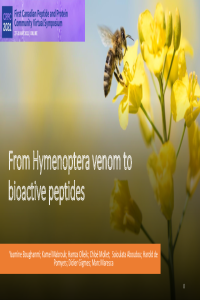
sciforum_045988_slides_CPPC_Yasmine_Boughanmi.pdf
Constrained Glu‐Gly and Gln‐Gly Dipeptide Surrogates from γ‐Substituted α‐Amino‐δ‐Lactam Synthesis
New Cell Penetrating Fluorescent Probes for Cell Delivery and Imaging