Event submissions
Published
 10.3390/CPPC2021-10203 (registering DOI)
 This submission belongs to the session A. Chemical-Biology and Medicinal Chemistry of the event First Canadian Peptide and Protein Community Virtual Symposium
Published date
27 May, 2021
Citation
Gerardo Byk, New Cell Penetrating Fluorescent Probes for Cell Delivery and Imaging, in Proceedings of First Canadian Peptide and Protein Community Virtual Symposium, 27 May–28 May 2021, MDPI: Basel, Switzerland, doi: 10.3390/CPPC2021-10203
Share
Email
Facebook
Twitter
LinkedIn
New Cell Penetrating Fluorescent Probes for Cell Delivery and Imaging

Gerardo Byk 1
1. Bar Ilan University
Abstract
Visualization of specific intracellular biological activities plays a key role in the understanding of cells behavior; therefore the development of new generations of probes and sensors remains an important task. Despite the growing utility of small-molecule fluorophores and a wide variety of fluorescent probes, only few of them are capable of penetrating spontaneously into the cell; thus cell sensors are usually composed of a recognition unit, a cell penetrating unit and a fluorescent unit.
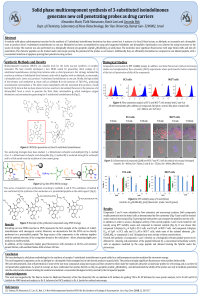
In our laboratory we developed a new versatile methodology for the fast synthesis of fluorescently labelled peptides. The particularity of the strategy is that the fluorescent probe, generated on the peptide backbone, functions both as fluorescent sensor as well as cell penetrating element. Our fluorophores are derivatives of natural products having hexa-substituted benzene obtained by MCR4. Their synthesis is based on the new multicomponent reaction recently developed in our laboratory: the reaction of substituted chiral tetramic acids which together with an aldehyde, an iso-cyanide, a dienophile and a Lewis acid; produce 3-substituted iso-indolinones in one pot.1 We applied this strategy to synthesize a targeted drug model consisting of a permeable fluorophore and D-[KLAKLAK]2 peptide with mitochondrial localization and toxicity that mediates apoptosis. The drug model was tested for biological activity using XTT, flow cytometry and confocal fluorescent microscopy. Together, these experiments proved the ability of the fluorescent molecule to transport a non-permeable cell toxic peptide into the cell with the concomitant recovery of toxicity. Results indicate that the new fluorescent probes are potentially applicable as cell sensors as well as drug delivery carriers.
- Gelman, M; Massarano, T.; Lavi, R.; Byk, G. A New Multicomponent Reaction MCR4 for the Synthesis of Analogs of Staurosporine. Curr. Org. Chem. 2018, 22, 505-517.
- Massarano, T.; Mazir, A.; Lavi, R.; Byk, G. Solid-Phase Multicomponent Synthesis of 3-Substituted Isoindolinones Generates New Cell-Penetrating Probes as Drug Carriers. ChemMedChem 2020, 15(10), 833-838.
Keywords
multicomponent reaction
KLAKLAK
cell penetration
Manuscript
sciforum-044495.pdf
Poster
sciforum_044495_slides_canadian_conference_2021.pdf
From Hymenoptera Venom to Bioactive Peptides
Natural Antimicrobial Based Hydrogel for Hands and Food Contact Surfaces Disinfection