Event submissions
Published
 10.3390/CPPC2021-10208 (registering DOI)
 This submission belongs to the session E. Peptide and Protein Applications in Cosmetic, Agricultural and High-tech Products of the event First Canadian Peptide and Protein Community Virtual Symposium
Published date
27 May, 2021
Citation
Samira Soltani, Ismail Fliss, Eric Biron, Muriel Subirade, Natural Antimicrobial Based Hydrogel for Hands and Food Contact Surfaces Disinfection, in Proceedings of First Canadian Peptide and Protein Community Virtual Symposium, 27 May–28 May 2021, MDPI: Basel, Switzerland, doi: 10.3390/CPPC2021-10208
Share
Email
Facebook
Twitter
LinkedIn
Natural Antimicrobial Based Hydrogel for Hands and Food Contact Surfaces Disinfection
'%3e%3cpath%20d='M12.6647%2010.9104C12.4176%2010.325%2012.0589%209.7933%2011.6088%209.34485C11.16%208.89511%2010.6283%208.53653%2010.0432%208.28891C10.038%208.28629%2010.0327%208.28498%2010.0275%208.28236C10.8437%207.69282%2011.3743%206.73252%2011.3743%205.64907C11.3743%203.85423%209.92005%202.40002%208.12522%202.40002C6.33038%202.40002%204.87618%203.85423%204.87618%205.64907C4.87618%206.73252%205.40677%207.69282%206.22296%208.28367C6.21772%208.28629%206.21248%208.2876%206.20724%208.29022C5.62031%208.53783%205.09365%208.89287%204.64167%209.34616C4.19192%209.79496%203.83334%2010.3266%203.58573%2010.9117C3.34247%2011.4846%203.21128%2012.0987%203.19925%2012.721C3.1989%2012.735%203.20135%2012.7489%203.20646%2012.7619C3.21157%2012.7749%203.21924%2012.7868%203.22901%2012.7968C3.23877%2012.8068%203.25045%2012.8148%203.26334%2012.8202C3.27623%2012.8256%203.29007%2012.8284%203.30406%2012.8284H4.09012C4.14776%2012.8284%204.19362%2012.7825%204.19493%2012.7262C4.22113%2011.7148%204.62726%2010.7676%205.34519%2010.0497C6.08802%209.30686%207.07452%208.89811%208.12522%208.89811C9.17592%208.89811%2010.1624%209.30686%2010.9052%2010.0497C11.6232%2010.7676%2012.0293%2011.7148%2012.0555%2012.7262C12.0568%2012.7839%2012.1027%2012.8284%2012.1603%2012.8284H12.9464C12.9604%2012.8284%2012.9742%2012.8256%2012.9871%2012.8202C13%2012.8148%2013.0117%2012.8068%2013.0214%2012.7968C13.0312%2012.7868%2013.0389%2012.7749%2013.044%2012.7619C13.0491%2012.7489%2013.0515%2012.735%2013.0512%2012.721C13.0381%2012.0947%2012.9084%2011.4856%2012.6647%2010.9104ZM8.12522%207.90243C7.52388%207.90243%206.95792%207.66793%206.53214%207.24215C6.10636%206.81636%205.87185%206.2504%205.87185%205.64907C5.87185%205.04773%206.10636%204.48177%206.53214%204.05599C6.95792%203.63021%207.52388%203.3957%208.12522%203.3957C8.72655%203.3957%209.29252%203.63021%209.7183%204.05599C10.1441%204.48177%2010.3786%205.04773%2010.3786%205.64907C10.3786%206.2504%2010.1441%206.81636%209.7183%207.24215C9.29252%207.66793%208.72655%207.90243%208.12522%207.90243Z'%20fill='%235D1EE1'/%3e%3c/g%3e%3c/svg%3e)
Samira Soltani 1

Ismail Fliss 2

Eric Biron 3
Muriel Subirade 2
1. a Department of Food Science, Laval University, Quebec, Qc, Canada
2. 1) Department of Food Science, Laval University, Quebec, Qc, Canada
2) Institute of nutrition and functional foods (INAF), Quebec, Qc, Canada
3. 1) Institute of nutrition and functional foods (INAF), Quebec, Qc, Canada
2) Faculty of Pharmacy, Laval University, Quebec, Quebec, Canada
Abstract
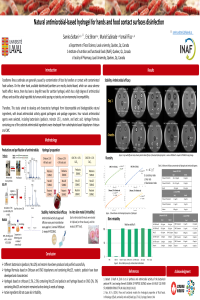
There has been a long-felt need for sanitizer hydrogel, which has a high degree of antimicrobial efficacy while posing no toxicity and environmental incompatibility. This study aims to develop and characterize functional hydrogels from biocompatible and biodegradable natural ingredients, with broad antimicrobial activity against pathogenic and spoilage organisms. Four natural antimicrobial compounds, namely reuterin, pediocin, microcin J25, and lactic acid, were produced, purified, and their antimicrobial activity was evaluated (alone or in combination) using agar well diffusion and microtitration assays. The combined effect among these compounds was investigated by checkerboard assay based on predetermined MIC values against the indicator strains S. Newport ATCC 6962 and L. ivanovii HPB28. A consortium of microcin J25, reuterin, and lactic acid was selected due to its high synergistic interaction. Hydrogel formulas containing the selected consortium were developed from carbohydrate-based biopolymer chitosan and Charboxymethylcellulose (CMC). They were characterized in terms of viscosity, antimicrobial activity, and stability during storage at room temperature. Hydrogels made from chitosan (1.5% and 2.5%) and CMC (3% and 5%) were selected based on their required viscosity and inhibition activity against indicator strains. Both hydrogels were shown to remain stable and active during four-week storage at room temperature. This antimicrobial hydrogel formula represents therefore a promising and safer alternative to commercial chemical products for hands and food surface disinfection.
Keywords
Natural antimicrobial peptide
Hydrogel
Natural Sanitizer
Manuscript
sciforum-045293.pdf
Poster
045293.pdf
New Cell Penetrating Fluorescent Probes for Cell Delivery and Imaging
Mitigation of the Cathelicidin Peptide LL-37 Cytotoxicity Induced by Interaction with the Polysulfonated Drug Suramin