Event submissions
Published
 10.3390/CPPC2021-10210 (registering DOI)
 This submission belongs to the session A. Chemical-Biology and Medicinal Chemistry of the event First Canadian Peptide and Protein Community Virtual Symposium
Published date
27 May, 2021
Citation
Mayra Maritza Quemé-Peña, Maria Ricci, Tünde Juhász, Kata Horváti, Szilvia Bősze, Beáta Biri-Kovács, Bálint Szeder, Ferenc Zsila, Tamás Beke-Somfai, Mitigation of the Cathelicidin Peptide LL-37 Cytotoxicity Induced by Interaction with the Polysulfonated Drug Suramin, in Proceedings of First Canadian Peptide and Protein Community Virtual Symposium, 27 May–28 May 2021, MDPI: Basel, Switzerland, doi: 10.3390/CPPC2021-10210
Share
Email
Facebook
Twitter
LinkedIn
Mitigation of the Cathelicidin Peptide LL-37 Cytotoxicity Induced by Interaction with the Polysulfonated Drug Suramin
'%3e%3cpath%20d='M12.6647%2010.9104C12.4176%2010.325%2012.0589%209.7933%2011.6088%209.34485C11.16%208.89511%2010.6283%208.53653%2010.0432%208.28891C10.038%208.28629%2010.0327%208.28498%2010.0275%208.28236C10.8437%207.69282%2011.3743%206.73252%2011.3743%205.64907C11.3743%203.85423%209.92005%202.40002%208.12522%202.40002C6.33038%202.40002%204.87618%203.85423%204.87618%205.64907C4.87618%206.73252%205.40677%207.69282%206.22296%208.28367C6.21772%208.28629%206.21248%208.2876%206.20724%208.29022C5.62031%208.53783%205.09365%208.89287%204.64167%209.34616C4.19192%209.79496%203.83334%2010.3266%203.58573%2010.9117C3.34247%2011.4846%203.21128%2012.0987%203.19925%2012.721C3.1989%2012.735%203.20135%2012.7489%203.20646%2012.7619C3.21157%2012.7749%203.21924%2012.7868%203.22901%2012.7968C3.23877%2012.8068%203.25045%2012.8148%203.26334%2012.8202C3.27623%2012.8256%203.29007%2012.8284%203.30406%2012.8284H4.09012C4.14776%2012.8284%204.19362%2012.7825%204.19493%2012.7262C4.22113%2011.7148%204.62726%2010.7676%205.34519%2010.0497C6.08802%209.30686%207.07452%208.89811%208.12522%208.89811C9.17592%208.89811%2010.1624%209.30686%2010.9052%2010.0497C11.6232%2010.7676%2012.0293%2011.7148%2012.0555%2012.7262C12.0568%2012.7839%2012.1027%2012.8284%2012.1603%2012.8284H12.9464C12.9604%2012.8284%2012.9742%2012.8256%2012.9871%2012.8202C13%2012.8148%2013.0117%2012.8068%2013.0214%2012.7968C13.0312%2012.7868%2013.0389%2012.7749%2013.044%2012.7619C13.0491%2012.7489%2013.0515%2012.735%2013.0512%2012.721C13.0381%2012.0947%2012.9084%2011.4856%2012.6647%2010.9104ZM8.12522%207.90243C7.52388%207.90243%206.95792%207.66793%206.53214%207.24215C6.10636%206.81636%205.87185%206.2504%205.87185%205.64907C5.87185%205.04773%206.10636%204.48177%206.53214%204.05599C6.95792%203.63021%207.52388%203.3957%208.12522%203.3957C8.72655%203.3957%209.29252%203.63021%209.7183%204.05599C10.1441%204.48177%2010.3786%205.04773%2010.3786%205.64907C10.3786%206.2504%2010.1441%206.81636%209.7183%207.24215C9.29252%207.66793%208.72655%207.90243%208.12522%207.90243Z'%20fill='%235D1EE1'/%3e%3c/g%3e%3c/svg%3e)
Mayra Maritza Quemé-Peña 1,2
Maria Ricci 1
Tünde Juhász 1
Kata Horváti 2,3
Szilvia Bősze 3
Beáta Biri-Kovács 2,3
Bálint Szeder 4
Ferenc Zsila 1
Tamás Beke-Somfai 1
1. Institute of Materials and Environmental Chemistry, Research Centre for Natural Sciences, Biomolecular Self-Assembly Research Group, Budapest H-1117, Hungary.
2. Institute of Chemistry, Eötvös Loránd University, Budapest H-1117, Hungary
3. MTA-ELTE Research Group of Peptide Chemistry, Eötvös Loránd University, Hungarian Academy of Sciences, Budapest H-1117, Hungary
4. Institute of Enzymology, Research Centre for Natural Sciences, Budapest H-1117, Hungary
Abstract
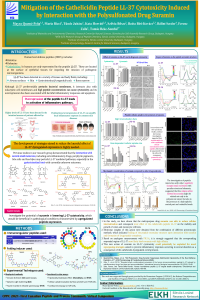
Cathelicidins are host defense peptides (HDPs) widely recognized for their multifaceted functions in the innate and adaptive immune response. Among them, the only human cathelicidin is represented by the 37-residue peptide LL-37, which has pleiotropic activity ranging from immunological to antineoplastic. Some pathological conditions are characterized by the imbalance of the cathelicidin expression and consequent activation of inflammatory pathways and apoptosis. Therefore, the development of strategies aimed to reduce the side-effect of LL-37 dysregulated expression is highly desired. It might be achieved by inducing the rearrangement of the peptide structure and consequent impairment of its binding to the cell surface. In this study, we demonstrated a remarkable attenuation of LL-37 cytotoxicity towards colon and monocytic cell lines in the presence of the drug suramin. Additionally, to unravel the molecular mechanism underlying the alteration of its activity, a detailed analysis of the peptide structure was performed. In this respect, an LL-37 fragment peptide, FK-16, which retains its antibacterial activity, was also used. The study of the molecular mechanisms of peptide-drug interaction revealed the ability of suramin to induce alteration in the peptide structure, aggregation, and formation of complexes. This latter case might hinder the interaction of LL-37 with the cell membrane. Moreover, a comparison with other therapeutic agents having common features revealed the peculiar ability of suramin to optimize the interaction with the studied peptides. The newly discovered suramin action on LL-37 cytotoxicity can contribute to the development of novel repurposing strategies aimed to prevent inflammatory responses triggered by overexpression of host defense peptides.
Acknowledgments: This work was supported through grants provided by the Momentum Program (LP2016‐2), the National Competitiveness and Excellence Program (NVKP_16‐1‐2016‐0007), and GINOP (BIONANO_GINOP‐2.3.2‐15‐2016‐00017).
Keywords
Cathelicidins
reduced cytotoxicity
suramin
mechanism of action
Manuscript
sciforum-045280.pdf
Poster
sciforum_045280_manuscript_Queme_Pena_Poster_Mitigation_of_the_Cathelicidin_Peptide_LL_37_Cytotoxicity.pdf
Natural Antimicrobial Based Hydrogel for Hands and Food Contact Surfaces Disinfection
Membrane Active Peptides and their Interactions with REVs Protein Corona