Event submissions
Published
 10.3390/CPPC2021-10211 (registering DOI)
 This submission belongs to the session A. Chemical-Biology and Medicinal Chemistry of the event First Canadian Peptide and Protein Community Virtual Symposium
Published date
27 May, 2021
Citation
Priyanka Singh, Imola Csilla Szigyártó, Maria Ricci, Mayra Maritza Queme Peña, Anikó Gaál, Diána Kitka, Zoltán Varga, Tamás Beke-Somfai, Membrane Active Peptides and their Interactions with REVs Protein Corona, in Proceedings of First Canadian Peptide and Protein Community Virtual Symposium, 27 May–28 May 2021, MDPI: Basel, Switzerland, doi: 10.3390/CPPC2021-10211
Share
Email
Facebook
Twitter
LinkedIn
Membrane Active Peptides and their Interactions with REVs Protein Corona
'%3e%3cpath%20d='M12.6647%2010.9104C12.4176%2010.325%2012.0589%209.7933%2011.6088%209.34485C11.16%208.89511%2010.6283%208.53653%2010.0432%208.28891C10.038%208.28629%2010.0327%208.28498%2010.0275%208.28236C10.8437%207.69282%2011.3743%206.73252%2011.3743%205.64907C11.3743%203.85423%209.92005%202.40002%208.12522%202.40002C6.33038%202.40002%204.87618%203.85423%204.87618%205.64907C4.87618%206.73252%205.40677%207.69282%206.22296%208.28367C6.21772%208.28629%206.21248%208.2876%206.20724%208.29022C5.62031%208.53783%205.09365%208.89287%204.64167%209.34616C4.19192%209.79496%203.83334%2010.3266%203.58573%2010.9117C3.34247%2011.4846%203.21128%2012.0987%203.19925%2012.721C3.1989%2012.735%203.20135%2012.7489%203.20646%2012.7619C3.21157%2012.7749%203.21924%2012.7868%203.22901%2012.7968C3.23877%2012.8068%203.25045%2012.8148%203.26334%2012.8202C3.27623%2012.8256%203.29007%2012.8284%203.30406%2012.8284H4.09012C4.14776%2012.8284%204.19362%2012.7825%204.19493%2012.7262C4.22113%2011.7148%204.62726%2010.7676%205.34519%2010.0497C6.08802%209.30686%207.07452%208.89811%208.12522%208.89811C9.17592%208.89811%2010.1624%209.30686%2010.9052%2010.0497C11.6232%2010.7676%2012.0293%2011.7148%2012.0555%2012.7262C12.0568%2012.7839%2012.1027%2012.8284%2012.1603%2012.8284H12.9464C12.9604%2012.8284%2012.9742%2012.8256%2012.9871%2012.8202C13%2012.8148%2013.0117%2012.8068%2013.0214%2012.7968C13.0312%2012.7868%2013.0389%2012.7749%2013.044%2012.7619C13.0491%2012.7489%2013.0515%2012.735%2013.0512%2012.721C13.0381%2012.0947%2012.9084%2011.4856%2012.6647%2010.9104ZM8.12522%207.90243C7.52388%207.90243%206.95792%207.66793%206.53214%207.24215C6.10636%206.81636%205.87185%206.2504%205.87185%205.64907C5.87185%205.04773%206.10636%204.48177%206.53214%204.05599C6.95792%203.63021%207.52388%203.3957%208.12522%203.3957C8.72655%203.3957%209.29252%203.63021%209.7183%204.05599C10.1441%204.48177%2010.3786%205.04773%2010.3786%205.64907C10.3786%206.2504%2010.1441%206.81636%209.7183%207.24215C9.29252%207.66793%208.72655%207.90243%208.12522%207.90243Z'%20fill='%235D1EE1'/%3e%3c/g%3e%3c/svg%3e)
Priyanka Singh 1
Imola Csilla Szigyártó 1
Maria Ricci 1
Mayra Maritza Queme Peña 1
Anikó Gaál 1
Diána Kitka 1

Zoltán Varga 1
Tamás Beke-Somfai 1
1. Institute of Materials and Environmental Chemistry, Research Centre for Natural Sciences, Budapest, Hungary
Abstract
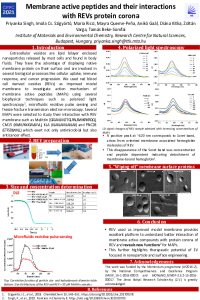
Extracellular vesicles (EVs) are lipid bilayer enclosed nanoparticles secreted by most cells and found in body fluids. They have the advantage of displaying native membrane proteins on their surface and with the ability to interact with other cells play important role in many biological processes like cellular uptake, immune response, and cancer progression. Furthermore, their size distribution makes them promising candidates to expand biophysical understanding of membrane active peptides (MAPs). To study the action mechanism of MAPs we used red blood cell-derived extracellular vesicles (REV) as a model membrane system. We selected well-known MAPs: KLA, PNC28, CM15 and Melittin, and their interaction was investigated using several biophysical techniques such as polarized light spectroscopy (Szigyártó et al. 2018), microfluidic resistive pulse sensing and freeze-fracture transmission electron microscopy.
We observed that CM15 and Melittin efficiently remove the proteins from REV membrane surfaces even at lower 5 µM concentrations, resulting in smoothed membrane surface while leaving the vesicle intact (Singh et al. 2020). Whereas a similar effect was not detected in the case of KLA and PNC28 even at a higher concentration of 160 µM. The overall results indicate that REV as a complex model membrane provides an excellent platform to understand better their interactions with MAPs and reveals novel peptide functions. This further highlights their role in possible future applications for nanoparticle and surface engineering of EV-based therapeutics.
Keywords
extracellular vesicle
membrane active peptide
protein corona
Manuscript
sciforum-045307.pdf
Poster
sciforum_045307_manuscript_CPPC_2021_poster_Singh.pdf
Mitigation of the Cathelicidin Peptide LL-37 Cytotoxicity Induced by Interaction with the Polysulfonated Drug Suramin
Synthesis, Purification and Characterization of Aptamer Peptides to Synthesize Anticancer Bioconjugated