Event submissions
Published
 10.3390/CPPC2021-10213 (registering DOI)
 This submission belongs to the session E. Peptide and Protein Applications in Cosmetic, Agricultural and High-tech Products of the event First Canadian Peptide and Protein Community Virtual Symposium
Published date
27 May, 2021
Citation
Letícia Oliveira Catarin Nunes, Geovana Navegante, Maria Carolina Oliveira De Arruda Brasil, Claudia Tavares Santos, Valéria Valente, Eduardo Maffud Cilli, Norival Alves Santos-Filho, Synthesis, Purification and Characterization of Aptamer Peptides to Synthesize Anticancer Bioconjugated, in Proceedings of First Canadian Peptide and Protein Community Virtual Symposium, 27 May–28 May 2021, MDPI: Basel, Switzerland, doi: 10.3390/CPPC2021-10213
Share
Email
Facebook
Twitter
LinkedIn
Synthesis, Purification and Characterization of Aptamer Peptides to Synthesize Anticancer Bioconjugated
'%3e%3cpath%20d='M12.6647%2010.9104C12.4176%2010.325%2012.0589%209.7933%2011.6088%209.34485C11.16%208.89511%2010.6283%208.53653%2010.0432%208.28891C10.038%208.28629%2010.0327%208.28498%2010.0275%208.28236C10.8437%207.69282%2011.3743%206.73252%2011.3743%205.64907C11.3743%203.85423%209.92005%202.40002%208.12522%202.40002C6.33038%202.40002%204.87618%203.85423%204.87618%205.64907C4.87618%206.73252%205.40677%207.69282%206.22296%208.28367C6.21772%208.28629%206.21248%208.2876%206.20724%208.29022C5.62031%208.53783%205.09365%208.89287%204.64167%209.34616C4.19192%209.79496%203.83334%2010.3266%203.58573%2010.9117C3.34247%2011.4846%203.21128%2012.0987%203.19925%2012.721C3.1989%2012.735%203.20135%2012.7489%203.20646%2012.7619C3.21157%2012.7749%203.21924%2012.7868%203.22901%2012.7968C3.23877%2012.8068%203.25045%2012.8148%203.26334%2012.8202C3.27623%2012.8256%203.29007%2012.8284%203.30406%2012.8284H4.09012C4.14776%2012.8284%204.19362%2012.7825%204.19493%2012.7262C4.22113%2011.7148%204.62726%2010.7676%205.34519%2010.0497C6.08802%209.30686%207.07452%208.89811%208.12522%208.89811C9.17592%208.89811%2010.1624%209.30686%2010.9052%2010.0497C11.6232%2010.7676%2012.0293%2011.7148%2012.0555%2012.7262C12.0568%2012.7839%2012.1027%2012.8284%2012.1603%2012.8284H12.9464C12.9604%2012.8284%2012.9742%2012.8256%2012.9871%2012.8202C13%2012.8148%2013.0117%2012.8068%2013.0214%2012.7968C13.0312%2012.7868%2013.0389%2012.7749%2013.044%2012.7619C13.0491%2012.7489%2013.0515%2012.735%2013.0512%2012.721C13.0381%2012.0947%2012.9084%2011.4856%2012.6647%2010.9104ZM8.12522%207.90243C7.52388%207.90243%206.95792%207.66793%206.53214%207.24215C6.10636%206.81636%205.87185%206.2504%205.87185%205.64907C5.87185%205.04773%206.10636%204.48177%206.53214%204.05599C6.95792%203.63021%207.52388%203.3957%208.12522%203.3957C8.72655%203.3957%209.29252%203.63021%209.7183%204.05599C10.1441%204.48177%2010.3786%205.04773%2010.3786%205.64907C10.3786%206.2504%2010.1441%206.81636%209.7183%207.24215C9.29252%207.66793%208.72655%207.90243%208.12522%207.90243Z'%20fill='%235D1EE1'/%3e%3c/g%3e%3c/svg%3e)
Letícia Oliveira Catarin Nunes 1
Geovana Navegante 2
Maria Carolina Oliveira De Arruda Brasil 2
Claudia Tavares Santos 2
Valéria Valente 2
Eduardo Maffud Cilli 2

Norival Alves Santos-Filho 3
1. Author
2. Employee
3. Counselor
Abstract
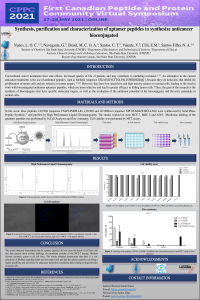
Conventional cancer treatments have side effects, decreased quality of life of patients and may contribute to multidrug resistance. An alternative to the current anticancer treatments is the use of antitumor peptides, such as Melittin, because they are molecules that inhibit the proliferation of tumor cells and are selective to tumor targets. However, they have low specificity and high toxicity relative to normal cells, leading to the need to work with bioconjugated antitumor aptamers peptides, which are more selective and lead to greater efficacy in killing tumor cells. In this work, three peptides (sequences: FNLPLPSRPLLR, GGVSCMQTSPVCENNL, NPGTCKDKWIECLLNG) were synthesized by Solid Phase Peptide Synthesis and purified by High Performance Liquid Chromatography. The strains worked on were MCF-7, MRC-5 and A549. Membrane labeling of the aptamers peptides was performed by In Cell Analyzer and flow cytometry. Cell viability was performed by MTT assays. The results obtained demonstrate that the aptamers peptides did not cause the death of the cell lines and that they present more evident markings on membrane proteins of the MCF-7 strain. Melittin showed cytotoxic action in all cell lines. Aptamers peptides can bring a greater specificity and selectivity for the anticancer molecules, as Melittin, considering its binding to target proteins in tumor cells. Next steps include conjugation of aptamers with Melittin, evaluation of the antitumor potential and mechanism of action of the bioconjugates.
Keywords
Antitumor peptides
Aptamers peptides
Melittin.
Manuscript
sciforum-045297.pdf
Poster
045297.pdf
Membrane Active Peptides and their Interactions with REVs Protein Corona
Modulating the Antigen Density on the Surface of Peptide Nanofibrils by Molecular Co-Assembly