Event submissions
Published
 10.3390/CPPC2021-10216 (registering DOI)
 This submission belongs to the session E. Peptide and Protein Applications in Cosmetic, Agricultural and High-tech Products of the event First Canadian Peptide and Protein Community Virtual Symposium
Published date
27 May, 2021
Citation
Maria Carolina Oliveira de Arruda Brasil, Vanessa dos Santos Rodrigues, Warlley Campos de Oliveira, Paulo Ricardo da Silva Sanches, Norival Alves Santos Filho, Cristiane Duque, Eduardo Maffud Cilli, Antibacterial Activity of DesCys¹¹/Lys¹²/Lys¹³-(p-BthTX-I)₂K Sequence Conjugated to Cell-Penetrating Peptides, in Proceedings of First Canadian Peptide and Protein Community Virtual Symposium, 27 May–28 May 2021, MDPI: Basel, Switzerland, doi: 10.3390/CPPC2021-10216
Share
Email
Facebook
Twitter
LinkedIn
Antibacterial Activity of DesCys11/Lys12/Lys13-(p-BthTX-I)2K Sequence Conjugated to Cell-Penetrating Peptides
'%3e%3cpath%20d='M12.6647%2010.9104C12.4176%2010.325%2012.0589%209.7933%2011.6088%209.34485C11.16%208.89511%2010.6283%208.53653%2010.0432%208.28891C10.038%208.28629%2010.0327%208.28498%2010.0275%208.28236C10.8437%207.69282%2011.3743%206.73252%2011.3743%205.64907C11.3743%203.85423%209.92005%202.40002%208.12522%202.40002C6.33038%202.40002%204.87618%203.85423%204.87618%205.64907C4.87618%206.73252%205.40677%207.69282%206.22296%208.28367C6.21772%208.28629%206.21248%208.2876%206.20724%208.29022C5.62031%208.53783%205.09365%208.89287%204.64167%209.34616C4.19192%209.79496%203.83334%2010.3266%203.58573%2010.9117C3.34247%2011.4846%203.21128%2012.0987%203.19925%2012.721C3.1989%2012.735%203.20135%2012.7489%203.20646%2012.7619C3.21157%2012.7749%203.21924%2012.7868%203.22901%2012.7968C3.23877%2012.8068%203.25045%2012.8148%203.26334%2012.8202C3.27623%2012.8256%203.29007%2012.8284%203.30406%2012.8284H4.09012C4.14776%2012.8284%204.19362%2012.7825%204.19493%2012.7262C4.22113%2011.7148%204.62726%2010.7676%205.34519%2010.0497C6.08802%209.30686%207.07452%208.89811%208.12522%208.89811C9.17592%208.89811%2010.1624%209.30686%2010.9052%2010.0497C11.6232%2010.7676%2012.0293%2011.7148%2012.0555%2012.7262C12.0568%2012.7839%2012.1027%2012.8284%2012.1603%2012.8284H12.9464C12.9604%2012.8284%2012.9742%2012.8256%2012.9871%2012.8202C13%2012.8148%2013.0117%2012.8068%2013.0214%2012.7968C13.0312%2012.7868%2013.0389%2012.7749%2013.044%2012.7619C13.0491%2012.7489%2013.0515%2012.735%2013.0512%2012.721C13.0381%2012.0947%2012.9084%2011.4856%2012.6647%2010.9104ZM8.12522%207.90243C7.52388%207.90243%206.95792%207.66793%206.53214%207.24215C6.10636%206.81636%205.87185%206.2504%205.87185%205.64907C5.87185%205.04773%206.10636%204.48177%206.53214%204.05599C6.95792%203.63021%207.52388%203.3957%208.12522%203.3957C8.72655%203.3957%209.29252%203.63021%209.7183%204.05599C10.1441%204.48177%2010.3786%205.04773%2010.3786%205.64907C10.3786%206.2504%2010.1441%206.81636%209.7183%207.24215C9.29252%207.66793%208.72655%207.90243%208.12522%207.90243Z'%20fill='%235D1EE1'/%3e%3c/g%3e%3c/svg%3e)
Maria Carolina Oliveira de Arruda Brasil 1
Vanessa dos Santos Rodrigues 2
Warlley Campos de Oliveira 2
Paulo Ricardo da Silva Sanches 1

Norival Alves Santos Filho 3,4
Cristiane Duque 5
Eduardo Maffud Cilli 6
1. Institute of Chemistry of Araraquara- UNESP
2. Araçatuba Dental School - São Paulo State University (UNESP)
3. Assistant professor at the São Paulo State University Júlio de Mesquita Filho-Unesp
4. Advisor professor in the postgraduate program in Biosciences and Biotechnology applied to Pharmacy (FCFAR-UNESP)
5. Associate Professor (DDS, PhD), Department of Preventive and Restorative Dentistry, Araçatuba Dental School - São Paulo State University (UNESP)
6. Associate teacher at São Paulo State UniversityJúlio de Mesquita Filho (UNESP).
Abstract
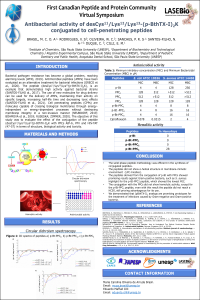
The resistance of microorganisms to antibiotics is occurring worldwide. An alternative against resistant bacteria has been antimicrobial peptides. Cell penetrating peptides are a family of peptides that are able to cross the biological membrane. In the present study, the peptide desCys11/Lys12/Lys13(p-BthTX-I)2K was coupled to the cell penetrating peptides PFVYLI, HIV-TAT (47-57) and AIP-6 to improve its antimicrobial action. The peptides were synthesized by SPPS. Circular dichroism spectroscopy was used to evaluated structure of conjugates. The biological activity was determined by broth microdilution tests and the minimum inhibitory concentration and the minimum bactericidal concentration were obtained. The hemolytic activity was performed to measure the toxicity against erythrocytes. The results obtained demonstrate that the peptides do not have a defined structure, which is consistent with the structure of desCys11/Lys12/Lys13(p-BthTX-I)2K. Conjugates showed activity against Gram-negative E. coli similar to the wild type peptide. However, the MIC decreased from 128 µM to values between 16 µM and 8 µM in Gram-positive S. aureus. Except to PFVYLI conjugate, hemolytic activity was not found. These results showed that the addition of the fusion peptides to the original peptide, improves the activity of the peptide against Gram-positive bacteria, without decrease its activity in Gram-negative bacteria.
Keywords
Antimicrobial peptides
cell penetration peptides
p-BthTX-I
bacterial resistance.
Manuscript
sciforum-045327.pdf
Poster
045327.pdf
Modulating the Antigen Density on the Surface of Peptide Nanofibrils by Molecular Co-Assembly
Quest for a Next Generation Lipopeptide Bio-Control Agent from the Fish Commensal Bacterium ‘Bacillus tequilensis PP1’