Event submissions
Published
 10.3390/CPPC2021-10218 (registering DOI)
 This submission belongs to the session E. Peptide and Protein Applications in Cosmetic, Agricultural and High-tech Products of the event First Canadian Peptide and Protein Community Virtual Symposium
Published date
27 May, 2021
Citation
Prajosh Palanthara, Shabeer Ali H, Akhila P, Sreejith Krishnan, Quest for a Next Generation Lipopeptide Bio-Control Agent from the Fish Commensal Bacterium ‘Bacillus tequilensis PP1’, in Proceedings of First Canadian Peptide and Protein Community Virtual Symposium, 27 May–28 May 2021, MDPI: Basel, Switzerland, doi: 10.3390/CPPC2021-10218
Share
Email
Facebook
Twitter
LinkedIn
Quest for a Next Generation Lipopeptide Bio-Control Agent from the Fish Commensal Bacterium ‘Bacillus tequilensis PP1’
'%3e%3cpath%20d='M12.6647%2010.9104C12.4176%2010.325%2012.0589%209.7933%2011.6088%209.34485C11.16%208.89511%2010.6283%208.53653%2010.0432%208.28891C10.038%208.28629%2010.0327%208.28498%2010.0275%208.28236C10.8437%207.69282%2011.3743%206.73252%2011.3743%205.64907C11.3743%203.85423%209.92005%202.40002%208.12522%202.40002C6.33038%202.40002%204.87618%203.85423%204.87618%205.64907C4.87618%206.73252%205.40677%207.69282%206.22296%208.28367C6.21772%208.28629%206.21248%208.2876%206.20724%208.29022C5.62031%208.53783%205.09365%208.89287%204.64167%209.34616C4.19192%209.79496%203.83334%2010.3266%203.58573%2010.9117C3.34247%2011.4846%203.21128%2012.0987%203.19925%2012.721C3.1989%2012.735%203.20135%2012.7489%203.20646%2012.7619C3.21157%2012.7749%203.21924%2012.7868%203.22901%2012.7968C3.23877%2012.8068%203.25045%2012.8148%203.26334%2012.8202C3.27623%2012.8256%203.29007%2012.8284%203.30406%2012.8284H4.09012C4.14776%2012.8284%204.19362%2012.7825%204.19493%2012.7262C4.22113%2011.7148%204.62726%2010.7676%205.34519%2010.0497C6.08802%209.30686%207.07452%208.89811%208.12522%208.89811C9.17592%208.89811%2010.1624%209.30686%2010.9052%2010.0497C11.6232%2010.7676%2012.0293%2011.7148%2012.0555%2012.7262C12.0568%2012.7839%2012.1027%2012.8284%2012.1603%2012.8284H12.9464C12.9604%2012.8284%2012.9742%2012.8256%2012.9871%2012.8202C13%2012.8148%2013.0117%2012.8068%2013.0214%2012.7968C13.0312%2012.7868%2013.0389%2012.7749%2013.044%2012.7619C13.0491%2012.7489%2013.0515%2012.735%2013.0512%2012.721C13.0381%2012.0947%2012.9084%2011.4856%2012.6647%2010.9104ZM8.12522%207.90243C7.52388%207.90243%206.95792%207.66793%206.53214%207.24215C6.10636%206.81636%205.87185%206.2504%205.87185%205.64907C5.87185%205.04773%206.10636%204.48177%206.53214%204.05599C6.95792%203.63021%207.52388%203.3957%208.12522%203.3957C8.72655%203.3957%209.29252%203.63021%209.7183%204.05599C10.1441%204.48177%2010.3786%205.04773%2010.3786%205.64907C10.3786%206.2504%2010.1441%206.81636%209.7183%207.24215C9.29252%207.66793%208.72655%207.90243%208.12522%207.90243Z'%20fill='%235D1EE1'/%3e%3c/g%3e%3c/svg%3e)
Prajosh Palanthara 1
Shabeer Ali H 2
Akhila P 3
Sreejith Krishnan 3
1. Department of Biotechnology and Microbiology, Dr Janaki Ammal campus, Kannur University, Kerala, India-670661
2. Division of Molecular Microbiology & Immunology, CSIR-CDRI, Lucknow, India-226031
3. Department of Biotechnology and Microbiology
Dr.Janaki Ammal Campus,Kannur University, Kerala,India-670661
Abstract
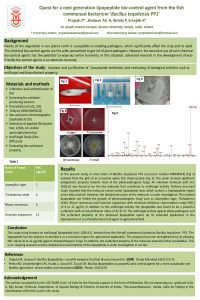
Nearly all the vegetation in our planet earth is susceptible to invading pathogens, which significantly affect the crop and its yield. The chemical bio-control agents are the wide spread tool to get rid of plant pathogens. However, the excessive use of such chemical bio-control agents has the potential to wipe-out entire humanity. In this situation, advanced research in the development of eco-friendly bio-control agents is an absolute necessity. The present study put forward a novel strain Bacillus tequilensis PP1 (accession number MK648314) from the gills of an estuarine water fish Chelon parsia with the potential to counterfeit most relevant phyto-pathogenic fungi. An unknown molecule with m/z 1018.54 was found as the key molecule of antifungal activity, primary structural investigation revealed that the molecule comes under lipopeptide class. The isolated lipopeptide is efficient enough to inhibit the growth of phytopathogens such as Aspergillus niger, Trichoderma viride, Mucor racemosus and Fusarium oxysporum with minimum inhibitory concentration range (MIC) of 6 to 12 µg/ml. The derived lipopeptide exhibits tremendous surfactant property with an emulsification index of 32.21 %, which opens up extended application of the molecule in various fields. It is expected that, with further research, the molecule may serve as a replacement for chemical-biocontrol agents
Keywords
Bacillus tequilensis
Chelon parsia
lipopeptide
Phytopathogens
Biocontrol-agent
Surfactant
Manuscript
sciforum-045360.pdf
Poster
045360.pdf
Antibacterial Activity of DesCys11/Lys12/Lys13-(p-BthTX-I)2K Sequence Conjugated to Cell-Penetrating Peptides
Identification of Allergenic Epitopes in the Sequences of Rapeseed Seed Proteins