Event submissions
Published
 10.3390/CPPC2021-10222 (registering DOI)
 This submission belongs to the session E. Peptide and Protein Applications in Cosmetic, Agricultural and High-tech Products of the event First Canadian Peptide and Protein Community Virtual Symposium
Published date
27 May, 2021
Citation
Mariana Barros de Cerqueira e Silva, Jaff Ribeiro da Silva, Maria Carolina Oliveira de Arruda Brasil, Biane Oliveira Philadelpho, Victória Cruz de Souza, Johnnie Elton Machado dos Santos, Rodrigo Molini Leão, Ricardo David Couto, Francine Johansson Azeredo, Marcelo Santos Castilho, Ederlan de Souza Ferreira, Eduardo Maffud Cilli, Effects Of The Cowpea Gln-Asp-Phe Peptide Daily Administration in Rats Fed A Saturated High-Fat Diet, in Proceedings of First Canadian Peptide and Protein Community Virtual Symposium, 27 May–28 May 2021, MDPI: Basel, Switzerland, doi: 10.3390/CPPC2021-10222
Share
Email
Facebook
Twitter
LinkedIn
Effects Of The Cowpea Gln-Asp-Phe Peptide Daily Administration in Rats Fed A Saturated High-Fat Diet
'%3e%3cpath%20d='M12.6647%2010.9104C12.4176%2010.325%2012.0589%209.7933%2011.6088%209.34485C11.16%208.89511%2010.6283%208.53653%2010.0432%208.28891C10.038%208.28629%2010.0327%208.28498%2010.0275%208.28236C10.8437%207.69282%2011.3743%206.73252%2011.3743%205.64907C11.3743%203.85423%209.92005%202.40002%208.12522%202.40002C6.33038%202.40002%204.87618%203.85423%204.87618%205.64907C4.87618%206.73252%205.40677%207.69282%206.22296%208.28367C6.21772%208.28629%206.21248%208.2876%206.20724%208.29022C5.62031%208.53783%205.09365%208.89287%204.64167%209.34616C4.19192%209.79496%203.83334%2010.3266%203.58573%2010.9117C3.34247%2011.4846%203.21128%2012.0987%203.19925%2012.721C3.1989%2012.735%203.20135%2012.7489%203.20646%2012.7619C3.21157%2012.7749%203.21924%2012.7868%203.22901%2012.7968C3.23877%2012.8068%203.25045%2012.8148%203.26334%2012.8202C3.27623%2012.8256%203.29007%2012.8284%203.30406%2012.8284H4.09012C4.14776%2012.8284%204.19362%2012.7825%204.19493%2012.7262C4.22113%2011.7148%204.62726%2010.7676%205.34519%2010.0497C6.08802%209.30686%207.07452%208.89811%208.12522%208.89811C9.17592%208.89811%2010.1624%209.30686%2010.9052%2010.0497C11.6232%2010.7676%2012.0293%2011.7148%2012.0555%2012.7262C12.0568%2012.7839%2012.1027%2012.8284%2012.1603%2012.8284H12.9464C12.9604%2012.8284%2012.9742%2012.8256%2012.9871%2012.8202C13%2012.8148%2013.0117%2012.8068%2013.0214%2012.7968C13.0312%2012.7868%2013.0389%2012.7749%2013.044%2012.7619C13.0491%2012.7489%2013.0515%2012.735%2013.0512%2012.721C13.0381%2012.0947%2012.9084%2011.4856%2012.6647%2010.9104ZM8.12522%207.90243C7.52388%207.90243%206.95792%207.66793%206.53214%207.24215C6.10636%206.81636%205.87185%206.2504%205.87185%205.64907C5.87185%205.04773%206.10636%204.48177%206.53214%204.05599C6.95792%203.63021%207.52388%203.3957%208.12522%203.3957C8.72655%203.3957%209.29252%203.63021%209.7183%204.05599C10.1441%204.48177%2010.3786%205.04773%2010.3786%205.64907C10.3786%206.2504%2010.1441%206.81636%209.7183%207.24215C9.29252%207.66793%208.72655%207.90243%208.12522%207.90243Z'%20fill='%235D1EE1'/%3e%3c/g%3e%3c/svg%3e)
Mariana Barros de Cerqueira e Silva 1
Jaff Ribeiro da Silva 1
Maria Carolina Oliveira de Arruda Brasil 1
Biane Oliveira Philadelpho 2
Victória Cruz de Souza 2
Johnnie Elton Machado dos Santos 2
Rodrigo Molini Leão 3

Ricardo David Couto 2
Francine Johansson Azeredo 2
Marcelo Santos Castilho 2

Ederlan de Souza Ferreira 2
Eduardo Maffud Cilli 1
1. Department of Biochemistry and Organic Chemistry, Institute of Chemistry, São Paulo State University
2. School of Pharmacy, Federal University of Bahia
3. Department of Pharmacology, Institute of Biomedical Sciences, Federal University of Uberlândia
Abstract
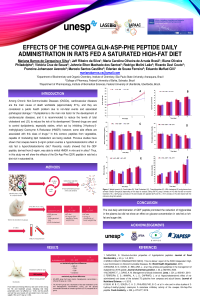
Previous studies showed that the QDF peptide derived from cowpea β-vignin have the potential to lower cholesterol synthesis through a statin-like regulation mechanism, in vitro. In this study, we showed the effects of daily oral administration of the QDF peptide in rats fed high saturated-fat diet (HC) by 21 days. Rats were divided into the following groups: i. Dyslipidemic (DG), received the HC diet (glucose, 30 g/100 g; hydrogenated lard, 30 g/100 g; and cholesterol, 0.5 g/100 g).ii. HC+QDF, received HC diet, plus QDF peptide (10 mg/bw/day), and iii. HC+SVT, received HC diet, plus simvastatin (10 mg/bw/day). Food intake and feeding efficiency ratio were similar among DG group and treatment groups, indicating that these parameters were not affected. The growth animals’ simvastatin treatment had minor (16%) gain weight at 21st day. HC+QDF group had lower (-23%) plasma triglycerides concentration than DG group, but there were no differences between total cholesterol concentration. HC+SVT group had a decrease in the total cholesterol (-21%) and triacylglycerols concentrations (-23%), but glucose concentration showed significant increase (+27%) compared to DG. Results showed that administration of QDF peptide promoted reduction of triglycerides in plasma but didn’t affected glucose concentration in rats fed rich-fat and sugar diet.
Keywords
Cowpea β-vignin peptide
Dyslipidemia
Cholesterol-lowering drugs
Manuscript
sciforum-045375.pdf
Poster
045375.pdf
Mitochondrial VDAC1 Pporin as a Therapeutic Target in Demyelination Process: Investigation of the Interaction Sites between Hexokinase I and VDAC1
NMR-Spectroscopic Screening of Crude Venom of Mesobuthus Cyprius