Event submissions
Published
 10.3390/CPPC2021-10224 (registering DOI)
 This submission belongs to the session E. Peptide and Protein Applications in Cosmetic, Agricultural and High-tech Products of the event First Canadian Peptide and Protein Community Virtual Symposium
Published date
27 May, 2021
Citation
Silvia Cañas, Miguel Rebollo-Hernanz, Paz Cano-Muñoz, Maria Angeles Martin-Cabrejas, Cocoa as a Source of Bioactive Proteins and Peptides: an In Silico Approach, in Proceedings of First Canadian Peptide and Protein Community Virtual Symposium, 27 May–28 May 2021, MDPI: Basel, Switzerland, doi: 10.3390/CPPC2021-10224
Share
Email
Facebook
Twitter
LinkedIn
Cocoa as a Source of Bioactive Proteins and Peptides: an In Silico Approach

Silvia Cañas 1,2

Miguel Rebollo-Hernanz 1,2
'%3e%3cpath%20d='M12.6647%2010.9104C12.4176%2010.325%2012.0589%209.7933%2011.6088%209.34485C11.16%208.89511%2010.6283%208.53653%2010.0432%208.28891C10.038%208.28629%2010.0327%208.28498%2010.0275%208.28236C10.8437%207.69282%2011.3743%206.73252%2011.3743%205.64907C11.3743%203.85423%209.92005%202.40002%208.12522%202.40002C6.33038%202.40002%204.87618%203.85423%204.87618%205.64907C4.87618%206.73252%205.40677%207.69282%206.22296%208.28367C6.21772%208.28629%206.21248%208.2876%206.20724%208.29022C5.62031%208.53783%205.09365%208.89287%204.64167%209.34616C4.19192%209.79496%203.83334%2010.3266%203.58573%2010.9117C3.34247%2011.4846%203.21128%2012.0987%203.19925%2012.721C3.1989%2012.735%203.20135%2012.7489%203.20646%2012.7619C3.21157%2012.7749%203.21924%2012.7868%203.22901%2012.7968C3.23877%2012.8068%203.25045%2012.8148%203.26334%2012.8202C3.27623%2012.8256%203.29007%2012.8284%203.30406%2012.8284H4.09012C4.14776%2012.8284%204.19362%2012.7825%204.19493%2012.7262C4.22113%2011.7148%204.62726%2010.7676%205.34519%2010.0497C6.08802%209.30686%207.07452%208.89811%208.12522%208.89811C9.17592%208.89811%2010.1624%209.30686%2010.9052%2010.0497C11.6232%2010.7676%2012.0293%2011.7148%2012.0555%2012.7262C12.0568%2012.7839%2012.1027%2012.8284%2012.1603%2012.8284H12.9464C12.9604%2012.8284%2012.9742%2012.8256%2012.9871%2012.8202C13%2012.8148%2013.0117%2012.8068%2013.0214%2012.7968C13.0312%2012.7868%2013.0389%2012.7749%2013.044%2012.7619C13.0491%2012.7489%2013.0515%2012.735%2013.0512%2012.721C13.0381%2012.0947%2012.9084%2011.4856%2012.6647%2010.9104ZM8.12522%207.90243C7.52388%207.90243%206.95792%207.66793%206.53214%207.24215C6.10636%206.81636%205.87185%206.2504%205.87185%205.64907C5.87185%205.04773%206.10636%204.48177%206.53214%204.05599C6.95792%203.63021%207.52388%203.3957%208.12522%203.3957C8.72655%203.3957%209.29252%203.63021%209.7183%204.05599C10.1441%204.48177%2010.3786%205.04773%2010.3786%205.64907C10.3786%206.2504%2010.1441%206.81636%209.7183%207.24215C9.29252%207.66793%208.72655%207.90243%208.12522%207.90243Z'%20fill='%235D1EE1'/%3e%3c/g%3e%3c/svg%3e)
Paz Cano-Muñoz 1,2

Maria Angeles Martin-Cabrejas 1,2
1. Department of Agricultural Chemistry and Food Science, Universidad Autónoma de Madrid
2. Institute of Food Science Research (CIAL, UAM-CSIC)
Abstract
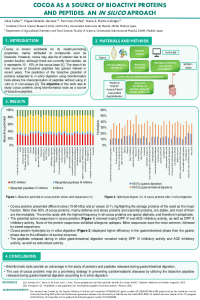
Cocoa is recognized worldwide for its health-promoting properties, mainly attributed to its high phenolic compound content. Cocoa proteins, albeit a minor fraction, could present interesting food and nutrition applications. However, to date, few studies report information about it. This work aimed to investigate the cocoa protein fraction as a source of bioactive peptides. The bioactive potential of cocoa proteins and their sensory profile, allergenicity, and bioactive peptides released during gastrointestinal protein hydrolysis were analyzed using in silico techniques. Proteins already-known sequences (30 in total) were retrieved from public databases. Cocoa proteins primarily showed potential bitter (29–51%) and sweet (15–30%) flavor sequences. None of the studied proteins exhibited predicted allergenicity. Cocoa proteins' degree of hydrolysis increased from the gastric (4–21%) to the intestinal (27–51%) phase. Consequently, most bioactive peptides were released after gastrointestinal digestion. The peptides released after in silico digestion showed antidiabetic (DPP-IV inhibition), antihypertensive (ECA inhibition), and antioxidant activities. These biological activities were associated with the presence of Leu, Pro, and Val (antidiabetic), Ala, Gly, and Val (antihypertensive), and Ala, Trp, and Tyr (antioxidant). Most bioactive peptides (56–63%) exhibited high gastrointestinal absorption. The results proved that cocoa could be used as a protein source and potentially bioactive peptides to prevent cardiometabolic diseases.
Keywords
cocoa
gastrointestinal digestion
hydrolysis
DPP-IV
ECA
antioxidant
antidiabetic
antihypertensive
Manuscript
sciforum-045415.pdf
Poster
045415.pdf
NMR-Spectroscopic Screening of Crude Venom of Mesobuthus Cyprius
Exploring Anti-Leishmanial Almiramide Structure-aActivity Relationships