Event submissions
Published
 10.3390/CPPC2021-10225 (registering DOI)
 This submission belongs to the session A. Chemical-Biology and Medicinal Chemistry of the event First Canadian Peptide and Protein Community Virtual Symposium
Published date
27 May, 2021
Citation
Anh Minh Thao Nguyen, Noélie Douanne, Claudia Duquette, Audrey Corbeil, Emanuella F. Fajardo, Christopher Fernandez-Prada, Martin Olivier, William Lubell, Exploring Anti-Leishmanial Almiramide Structure-aActivity Relationships, in Proceedings of First Canadian Peptide and Protein Community Virtual Symposium, 27 May–28 May 2021, MDPI: Basel, Switzerland, doi: 10.3390/CPPC2021-10225
Share
Email
Facebook
Twitter
LinkedIn
Exploring Anti-Leishmanial Almiramide Structure-aActivity Relationships
'%3e%3cpath%20d='M12.6647%2010.9104C12.4176%2010.325%2012.0589%209.7933%2011.6088%209.34485C11.16%208.89511%2010.6283%208.53653%2010.0432%208.28891C10.038%208.28629%2010.0327%208.28498%2010.0275%208.28236C10.8437%207.69282%2011.3743%206.73252%2011.3743%205.64907C11.3743%203.85423%209.92005%202.40002%208.12522%202.40002C6.33038%202.40002%204.87618%203.85423%204.87618%205.64907C4.87618%206.73252%205.40677%207.69282%206.22296%208.28367C6.21772%208.28629%206.21248%208.2876%206.20724%208.29022C5.62031%208.53783%205.09365%208.89287%204.64167%209.34616C4.19192%209.79496%203.83334%2010.3266%203.58573%2010.9117C3.34247%2011.4846%203.21128%2012.0987%203.19925%2012.721C3.1989%2012.735%203.20135%2012.7489%203.20646%2012.7619C3.21157%2012.7749%203.21924%2012.7868%203.22901%2012.7968C3.23877%2012.8068%203.25045%2012.8148%203.26334%2012.8202C3.27623%2012.8256%203.29007%2012.8284%203.30406%2012.8284H4.09012C4.14776%2012.8284%204.19362%2012.7825%204.19493%2012.7262C4.22113%2011.7148%204.62726%2010.7676%205.34519%2010.0497C6.08802%209.30686%207.07452%208.89811%208.12522%208.89811C9.17592%208.89811%2010.1624%209.30686%2010.9052%2010.0497C11.6232%2010.7676%2012.0293%2011.7148%2012.0555%2012.7262C12.0568%2012.7839%2012.1027%2012.8284%2012.1603%2012.8284H12.9464C12.9604%2012.8284%2012.9742%2012.8256%2012.9871%2012.8202C13%2012.8148%2013.0117%2012.8068%2013.0214%2012.7968C13.0312%2012.7868%2013.0389%2012.7749%2013.044%2012.7619C13.0491%2012.7489%2013.0515%2012.735%2013.0512%2012.721C13.0381%2012.0947%2012.9084%2011.4856%2012.6647%2010.9104ZM8.12522%207.90243C7.52388%207.90243%206.95792%207.66793%206.53214%207.24215C6.10636%206.81636%205.87185%206.2504%205.87185%205.64907C5.87185%205.04773%206.10636%204.48177%206.53214%204.05599C6.95792%203.63021%207.52388%203.3957%208.12522%203.3957C8.72655%203.3957%209.29252%203.63021%209.7183%204.05599C10.1441%204.48177%2010.3786%205.04773%2010.3786%205.64907C10.3786%206.2504%2010.1441%206.81636%209.7183%207.24215C9.29252%207.66793%208.72655%207.90243%208.12522%207.90243Z'%20fill='%235D1EE1'/%3e%3c/g%3e%3c/svg%3e)
Anh Minh Thao Nguyen 1
Noélie Douanne 2
Claudia Duquette 2
Audrey Corbeil 2
Emanuella F. Fajardo 3

Christopher Fernandez-Prada 2
Martin Olivier 3

William Lubell 1
1. Department of Chemistry, Université de Montréal, Montréal, QC, Canada
2. Department of Pathology and Microbiology, Faculty of Veterinary Medicine, Université de Montréal, QC, Canada
3. Research Institute of the McGill University Health Center, Montréal, QC, Canada
Abstract
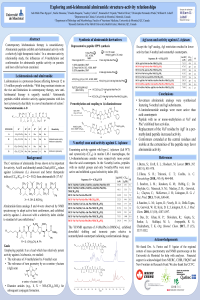
Leishmaniasis is a protozoan disease, which occurs in 12 to 15 million people worldwide and infects greater than 1 million new cases annually.1 The limitations in availability of effective drugs and the rise of drug resistant strains has created an urgent need for new anti-leishmanial therapy.2 In the light of the limitations of contemporary leishmaniasis therapy, the N-methylated almiramide lipo-peptides represent promising leads due to relatively high anti-leishmanial activity and low host toxicity due to theirs likely mechanism of action involving disruption of the vital energy machinery proteins of the glycosome.3,4 With a focus on the influences of N-methylation and conformation on the antiprotozoan activity, our presentation provides a structure-activity relationship study of the almiramide peptides employing resistant parasite strains and murine macrophages.
References
- Burza, S.; Croft, S. L.; Boelaert, M., Leishmaniasis. The Lancet 2019, 392 (10151), 951-970.
- Uliana, S. R.; Trinconi, C. T.; Coelho, A. C., Chemotherapy of leishmaniasis: present challenges. Parasitology 2018, 145 (4), 464-480.
- Sanchez, L. M.; Lopez, D.; Vesely, B. A.; Della Togna, G.; Gerwick, W. H.; Kyle, D. E.; Linington, R. G., Almiramides A− C: discovery and development of a new class of leishmaniasis lead compounds. J. Med. Chem. 2010, 53 (10), 4187-4197.
- Sanchez, L. M.; Knudsen, G. M.; Helbig, C.; De Muylder, G.; Mascuch, S. M.; Mackey, Z. B.; Gerwick, L.; Clayton, C.; McKerrow, J. H.; Linington, R. G. Examination of the mode of action of the almiramide family of natural products against the kinetoplastid parasite Trypanosoma brucei. J. Nat. Prod. 2013, 76 (4), 630-641.
Keywords
M-methylated peptide
almiramide
leishmania
Manuscript
sciforum-045353.pdf
Poster
sciforum_045533_manuscript_AnhMinhThao_poster.pdf
Cocoa as a Source of Bioactive Proteins and Peptides: an In Silico Approach
In Silico Identification of Bioactive Proteins and Peptides in Insects for Human Consumption